
How Much Do Solar Panels Cost for a 3-Bed House in Ireland? (2026 Prices)
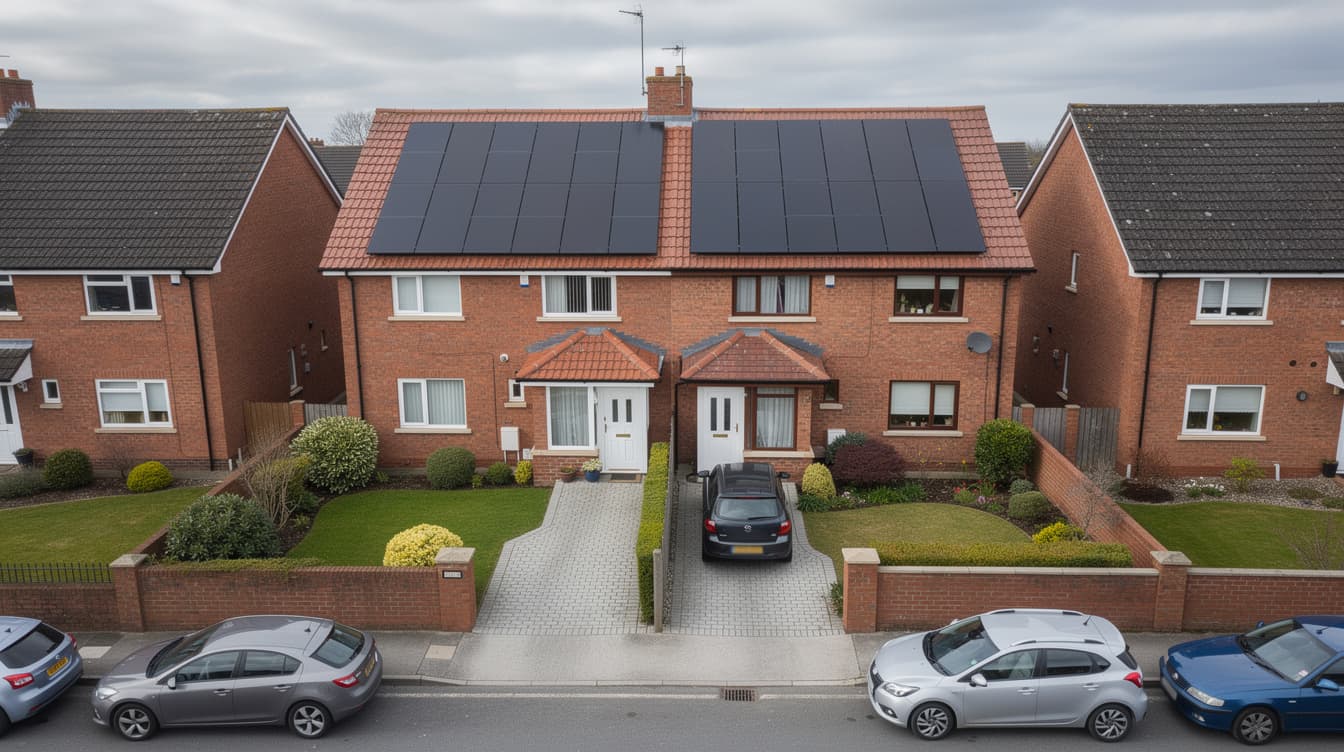
Ireland’s 3-bed semi-detached house is the backbone of Irish housing — there are over 500,000 of them across the country. If you live in one, you are probably paying €1,500–€2,000 a year in electricity. Solar panels can cut that by 40–70%. But how much does a system actually cost for your specific house type? This guide gives you the exact numbers: system size, installed cost, grant, monthly savings, and payback period — all based on real 2026 Irish data.
Get a Quote for Your 3-Bed Home
Free personalised quotes from SEAI-registered installers in your area.
The Quick Answer
If you just want the numbers and do not need the explanation:
| Detail | Typical 3-Bed Semi |
|---|---|
| Recommended system size | 3.5–4.4 kWp (8–10 panels) |
| Installed cost (before grant) | €6,500–€8,500 |
| SEAI grant | €1,800 |
| Your cost after grant | €4,700–€6,700 |
| Annual electricity savings | €800–€1,200 |
| Annual export income | €100–€250 |
| Total annual benefit | €900–€1,450 |
| Payback period | 4–6 years |
| 25-year savings | €20,000–€30,000+ |
Now let’s break down how we get to these numbers.
Why a 3-Bed Semi Is the Solar Sweet Spot
The typical Irish 3-bed semi-detached house is actually ideal for solar panels. Here is why:
- Roof size: A standard 3-bed semi has roughly 30–40 m² of usable roof on the south or south-east/south-west side — enough for 8–12 panels comfortably
- Energy usage: The average 3-bed home uses 3,800–4,500 kWh per year, which a 4 kWp system can largely offset
- Roof pitch: Most Irish semis have a 30–40 degree pitch, which is close to the optimal angle for solar generation in Ireland (35 degrees)
- Simple roof geometry: Semi-detached roofs tend to be straightforward — no valleys, dormers, or complicated shapes that add installation cost
The only common issue is orientation. If your front door faces east or west, your main roof slope will be north-south — one side good, one side not ideal. If your front door faces north or south, you may have east-west facing roof slopes, which still work but generate about 15–20% less than south-facing. Your installer will assess this during the site survey.
What Size System Does a 3-Bed House Need?
System size depends on your electricity usage, not just your house size. Here is a guide based on real Irish consumption patterns:
| Household Type | Annual Usage | Recommended System | Number of Panels |
|---|---|---|---|
| Couple, gas heating | 3,000–3,500 kWh | 3.0–3.5 kWp | 7–8 |
| Family of 3–4, gas heating | 3,800–4,500 kWh | 3.5–4.4 kWp | 8–10 |
| Family of 4–5, electric shower | 4,500–5,500 kWh | 4.4–5.3 kWp | 10–12 |
| Family with heat pump or EV | 5,500–8,000 kWh | 5.3–6.6 kWp | 12–15 |
The most popular choice: A 4.4 kWp system with 10 panels. This is the sweet spot because it maximises the SEAI grant (the grant structure gives you the best value up to 4 kWp), matches the usage of a typical 3–4 person household, and fits comfortably on one side of a standard semi-detached roof.
Full Cost Breakdown: What You Actually Pay
Let us walk through every cost line item. No surprises, no hidden extras.
Scenario: 10-panel system (4.4 kWp) on a 3-bed semi
| Cost Item | Typical Cost | Notes |
|---|---|---|
| Solar panels (10 × 440W) | €2,800–€3,500 | Tier 1 brands: Jinko, Trina, LONGi, Canadian Solar |
| Inverter | €1,200–€1,800 | SolarEdge, Huawei, or Fronius |
| Mounting system & hardware | €400–€600 | Roof hooks, rails, clamps, cabling |
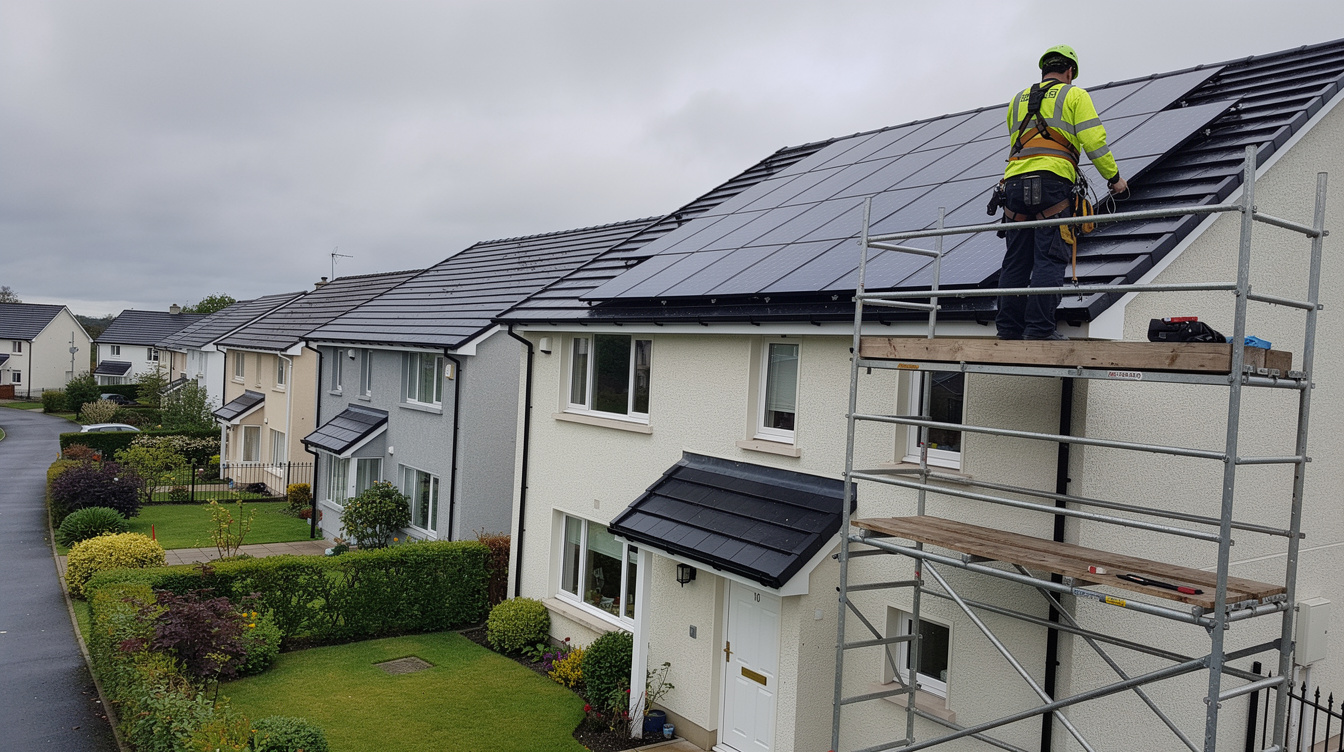
| Installation labour | €1,200–€2,000 | Typically a 1-day job for a 2–3 person crew |
| Scaffolding | €300–€500 | Required for most 2-storey semis |
| BER assessment | €150–€200 | SEAI requires updated BER after installation |
| Bird proofing | €200–€350 | Highly recommended — prevents nesting under panels |
| Immersion diverter (optional) | €350–€500 | Heats water with surplus solar electricity |
| Total before grant | €6,600–€9,450 | 0% VAT included (until Dec 2026) |
| SEAI grant | −€1,800 | Paid after installation — you pay full cost upfront |
| Your net cost | €4,800–€7,650 | Most 3-bed semis land around €5,500–€6,500 |
The wide range reflects differences in installer pricing, equipment quality, and whether you add extras like a diverter or bird proofing. When comparing quotes, always check what is included — a €6,500 quote with everything is better value than a €5,800 quote that excludes scaffolding and BER.
Should You Add a Battery?
A battery stores surplus solar electricity for use in the evening. For a 3-bed semi, the question is whether the extra cost pays off:
| Option | Extra Cost | Extra Annual Savings | Battery Payback |
|---|---|---|---|
| No battery (PV only) | €0 | Baseline | N/A |
| 5 kWh battery (e.g. Huawei LUNA) | €3,000–€4,000 | €300–€500 | 7–10 years |
| 10 kWh battery (e.g. GivEnergy All-in-One) | €4,500–€6,000 | €500–€800 | 7–9 years |
With dynamic tariffs launching in June 2026, a battery becomes significantly more valuable. You can charge at €0.02–€0.05/kWh overnight and avoid peak rates of €0.35–€0.50/kWh in the evening. This alone can add €200–€400 to the battery’s annual value, bringing payback closer to 5–7 years.
Our advice: if you can afford it, add a battery now. It costs €500–€1,000 less to install alongside PV than to retrofit later. If budget is tight, start with PV only and add a battery in 2–3 years when prices drop further.
Get a Quote With or Without Battery
Our installers can quote for PV only, PV + battery, or PV + battery + EV charger.
What Will You Save Each Month?
Let us work through a realistic example for a family of four in a 3-bed semi with a 4.4 kWp system, using April 2026 electricity rates:
| Month | Solar Generation | Self-Consumed | Exported | Monthly Saving |
|---|---|---|---|---|
| Jan | 120 kWh | 100 kWh | 20 kWh | €38 |
| Feb | 180 kWh | 140 kWh | 40 kWh | €54 |
| Mar | 320 kWh | 200 kWh | 120 kWh | €82 |
| Apr | 400 kWh | 220 kWh | 180 kWh | €96 |
| May | 480 kWh | 240 kWh | 240 kWh | €110 |
| Jun | 500 kWh | 250 kWh | 250 kWh | €115 |
| Jul | 470 kWh | 240 kWh | 230 kWh | €108 |
| Aug | 400 kWh | 220 kWh | 180 kWh | €96 |
| Sep | 300 kWh | 200 kWh | 100 kWh | €78 |
| Oct | 200 kWh | 160 kWh | 40 kWh | €60 |
| Nov | 130 kWh | 110 kWh | 20 kWh | €41 |
| Dec | 100 kWh | 85 kWh | 15 kWh | €32 |
| Annual Total | 3,600 kWh | 2,165 kWh | 1,435 kWh | €910 |
Assumptions: Electricity import rate of €0.35/kWh, export rate of €0.18/kWh, south-facing roof, 60% self-consumption ratio (without battery). With a battery, self-consumption rises to 75–85%, pushing annual savings to €1,100–€1,400.
For a deeper monthly savings analysis, see our dedicated guide.
How the SEAI Grant Works
The SEAI solar PV grant reduces your upfront cost significantly. Here is how it scales:
| System Size | Grant Calculation | Grant Amount |
|---|---|---|
| 2 kWp | 2 × €900 | €1,800 |
| 3 kWp | (2 × €900) + (1 × €300) | €2,100 |
| 4 kWp+ | (2 × €900) + (2 × €300) | €2,400 |
Wait — you might have seen €1,800 mentioned elsewhere. That is because the most common system size (4.4 kWp) gets €1,800 under the 2026 rates, and this is what most people actually receive. The maximum of €2,400 applies to larger systems of 4 kWp or above.
Important: You pay the full installed cost upfront and receive the grant from SEAI afterwards (typically 4–6 weeks after installation). Your installer handles the application. The house must be built before 2021 and the installer must be SEAI-registered.
What Makes Prices Go Up or Down?
Two 3-bed semis side by side can have quotes that differ by €2,000+. Here is what drives price variation:
Things that increase cost:
- Premium panel brands (SunPower, Maxeon): add €500–€1,000 for marginal efficiency gains
- Micro-inverters instead of a string inverter: add €500–€800, but better for partially shaded roofs
- Fuse board upgrade: €400–€800 if your board is pre-2000 and does not meet current regulations
- Complex roof: Dormers, valleys, skylights, or split-level roofs add labour and materials
- Longer cable runs: If your fuse board is far from the roof, extra cabling adds €100–€300
- 3-storey houses: Higher scaffolding costs and more labour time
Things that reduce cost:
- Choosing mid-range panels (Jinko, Trina, LONGi): excellent quality at lower cost than premium brands
- Simple south-facing roof: Fastest installation, lowest labour cost
- Multiple quotes: Competition drives prices down. Always get at least 3 quotes.
- Off-peak installation: Some installers offer small discounts for autumn/winter installation when demand is lower
Three Payback Scenarios
Your payback depends heavily on how much solar electricity you use yourself vs export:
| Scenario | Self-Consumption | Annual Saving | Payback (on €5,800 net) |
|---|---|---|---|
| Working from home (high daytime use) | 70% | €1,100–€1,300 | 4–5 years |
| Mixed (some daytime use) | 50% | €850–€1,000 | 5–7 years |
| Out all day (low daytime use) | 35% | €650–€800 | 7–9 years |
Even the worst-case scenario pays back within 9 years on a system that lasts 25–30 years. And these numbers do not account for electricity price increases — if rates rise even 5% per year (they have been rising faster), payback accelerates.
If you are out all day, the single best investment alongside solar is a battery or an immersion diverter. Both shift your surplus to times when you actually use electricity, dramatically increasing your self-consumption.
What Real 3-Bed Semi Quotes Look Like
Here is an example of how three real quotes might compare for a 3-bed semi in South Dublin (April 2026). Names changed, numbers realistic:
| Installer A | Installer B | Installer C | |
|---|---|---|---|
| System size | 4.4 kWp (10 panels) | 4.4 kWp (10 panels) | 4.8 kWp (12 panels) |
| Panels | Jinko Tiger Neo 440W | Trina Vertex S+ 440W | LONGi Hi-MO 7 400W |
| Inverter | SolarEdge SE5K | Huawei SUN2000 | Fronius Primo |
| Scaffolding | Included | €450 extra | Included |
| BER | Included | Included | €180 extra |
| Bird proofing | Included | Not offered | €280 extra |
| Immersion diverter | €400 extra | Not offered | Included |
| Quoted price | €7,800 | €6,900 | €8,400 |
| True all-in cost | €8,200 | €7,350+ | €8,860 |
| After €1,800 grant | €6,400 | €5,550+ | €7,060 |
Installer A is the best overall value: everything included, strong equipment, and a competitive all-in price. Installer B looks cheapest but is missing scaffolding, bird proofing, and a diverter — adding those closes the gap. Installer C offers more panels and a diverter but at a premium. For more on choosing between installers, see our dedicated guide.
How to Pay: Financing Options
Not everyone has €5,000–€7,000 in savings. Here are the main financing options for Irish homeowners in 2026:
- Green personal loan: AIB, Bank of Ireland, and EBS offer green loans at 4.5–6.5% APR for energy upgrades. Monthly repayments on €6,000 over 5 years: roughly €112/month.
- Credit union loan: Many credit unions offer competitive rates for solar installations, sometimes as low as 4%.
- SEAI Better Energy Home grant: Can be combined with the solar PV grant if you are doing other energy upgrades (insulation, heat pump) at the same time.
- Installer payment plans: Some larger installers offer 0% finance over 12–24 months, though availability varies.
When you factor in monthly savings of €75–€120, a green loan can be cash-flow positive from month one — your savings exceed your repayments.
Your Next Steps
- Check your electricity bill for your annual kWh usage and MPRN number
- Look at your roof — which direction does it face? Is there shading from trees or neighbouring buildings?
- Get 3 quotes from SEAI-registered installers
- Compare quotes on an all-in basis (use our installer comparison checklist)
- Pick your installer and pay the deposit to secure your installation slot
The entire process from first quote to panels generating takes 3–6 months in April 2026. Start now and you could have solar panels on your roof by autumn.
Ready to Go Solar?
Get your free personalised quote from SEAI-registered installers.
Frequently Asked Questions
How many solar panels can fit on a 3-bed semi?
A standard 3-bed semi-detached house can typically fit 8–14 panels on the main south-facing roof slope (depending on roof size and any obstructions like skylights or chimneys). Most homeowners install 10 panels (4.4 kWp), which balances cost, grant optimisation, and electricity generation.
Do I need planning permission for solar panels on a 3-bed semi?
No. Residential solar panels in Ireland are exempt from planning permission provided: the panels do not project more than 15 cm above the roof surface, no panel extends above the ridge line, the total area does not exceed 12 m² (or 50 m² for houses not in a conservation area), and the house is not a protected structure.
Will solar panels affect my house insurance?
Most Irish insurers cover professionally installed solar panels under standard home insurance at no extra premium. You should notify your insurer after installation to ensure coverage is confirmed.
How long do solar panels last?
Modern solar panels are warranted for 25–30 years and typically last 30–40 years. After 25 years, they still produce 80–87% of their original output. The inverter may need replacing once (after 10–15 years, €800–€1,200).
Is a south-facing roof essential?
South-facing is optimal, but east/west facing roofs still work well, generating 80–85% of what a south-facing roof produces. Some installers recommend splitting panels across east and west slopes to spread generation over a longer day, which actually improves self-consumption.
What happens during a power cut?
Standard solar PV systems shut down during power cuts for safety reasons (to protect ESB workers on the lines). If you want power during outages, you need a battery with backup capability — models like the Tesla Powerwall and GivEnergy All-in-One offer this feature.
Related Articles
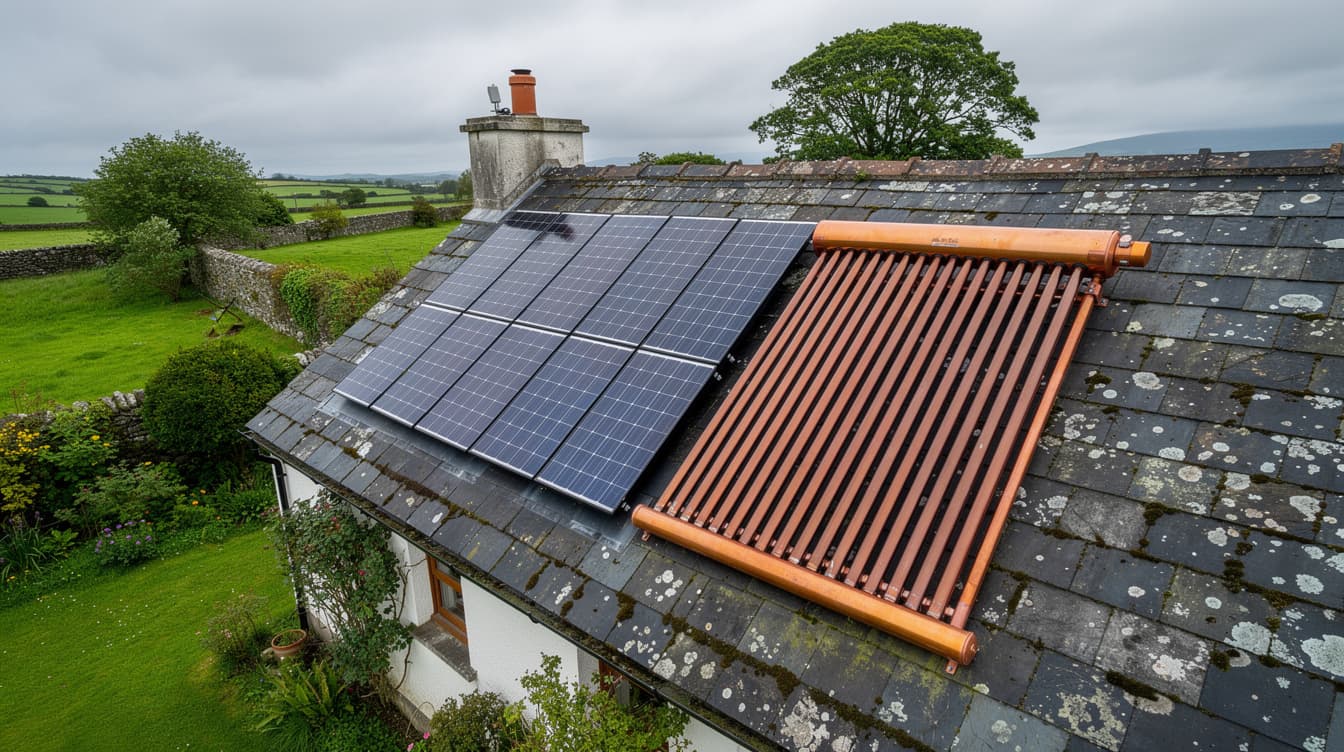
Solar PV vs Solar Thermal Panels Ireland 2026: Costs, Grants & Which Is Better for Your Home
Solar PV vs solar thermal in Ireland compared: costs, SEAI grants, savings, maintenance and which technology is best for Irish homes in 2026.
Solar Panel Waiting Times Ireland 2026: How Long From Quote to Installation (And How to Beat the Queue)
Solar installer wait times have doubled in Ireland. Here are the current timelines for every step from quote to installation, and 7 ways to speed things up.
How to Choose a Solar Panel Installer in Ireland 2026: 10 Questions, 7 Red Flags & What Good Looks Like
10 questions to ask every solar installer, 7 red flags to avoid, and how to compare quotes. A practical guide for Irish homeowners in 2026.