
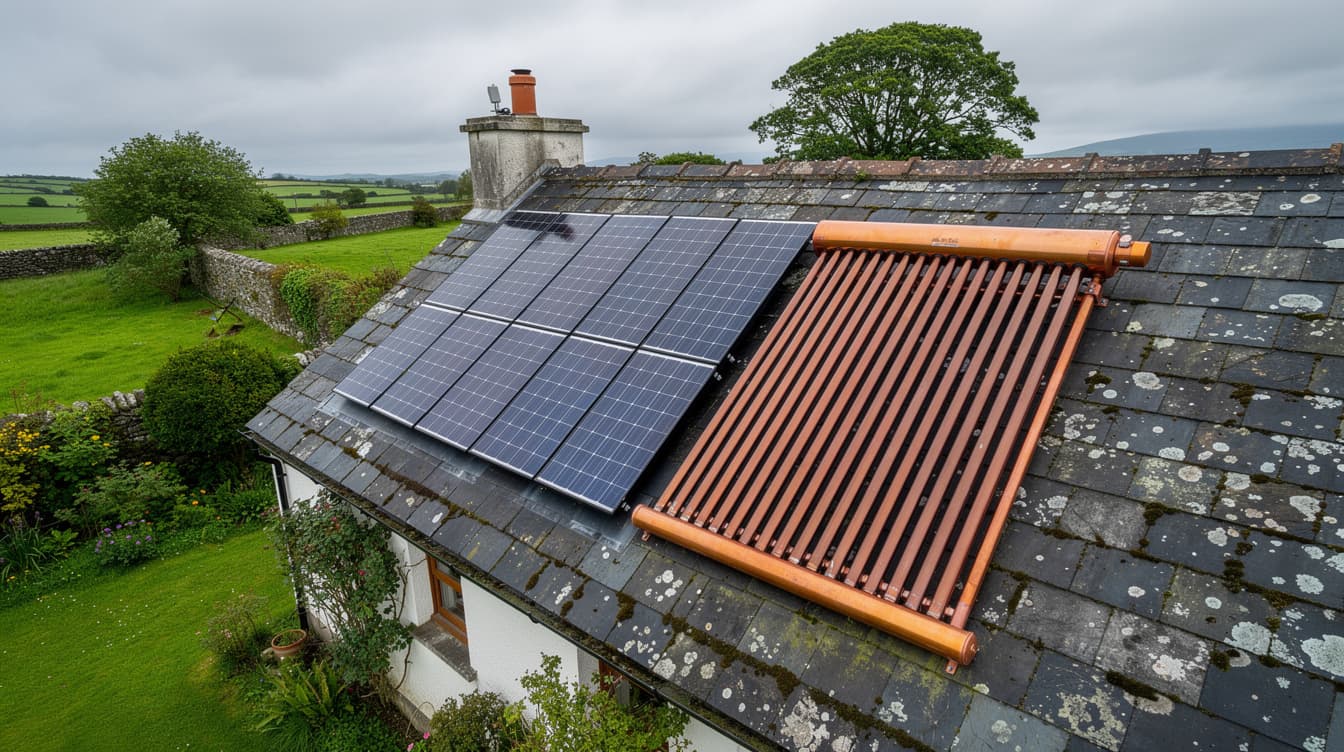
Solar PV vs Solar Thermal Panels Ireland 2026: Costs, Grants & Which Is Better for Your Home
If you are researching solar energy for your Irish home, you have probably come across two very different technologies: solar PV (photovoltaic) panels that generate electricity, and solar thermal panels that heat water. They look similar on a roof but do completely different jobs. In 2026, most Irish homeowners are choosing PV — but that does not mean thermal is dead. This guide breaks down the real costs, savings, grants, and use cases so you can decide which one (or both) makes sense for your home.
Ready to Go Solar?
Get your free personalised quote from SEAI-registered installers.
Solar PV vs Solar Thermal: What Is the Difference?
The names sound interchangeable, but these are fundamentally different technologies:
- Solar PV panels convert sunlight into electricity using silicon cells. That electricity powers everything in your home — lights, appliances, heat pump, EV charger. Surplus gets exported to the grid for payment.
- Solar thermal panels (also called solar collectors) use sunlight to heat a fluid (usually glycol) that circulates through your hot water cylinder. They only heat water — nothing else.
Think of it this way: PV is a mini power station. Thermal is a water heater. One is versatile, the other is specialised.
Head-to-Head Comparison: The Numbers That Matter
| Factor | Solar PV | Solar Thermal |
|---|---|---|
| What it does | Generates electricity | Heats hot water only |
| Typical system cost (installed) | €7,000–€10,000 (4–5 kWp) | €3,000–€5,500 (2–3 panels) |
| SEAI grant | €1,800 (up to 4 kWp) | €1,200 (fixed) |
| Net cost after grant | €5,200–€8,200 | €1,800–€4,300 |
| Annual savings | €800–€1,400 | €200–€400 |
| Payback period | 4–6 years | 5–10 years |
| Export income | Yes — Clean Export Guarantee | No |
| Works with battery | Yes | No |
| Works with EV charger | Yes | No |
| Works with heat pump | Yes | No (compatible but not synergistic) |
| Can heat water | Yes — with immersion diverter (€350–€500) | Yes — that is its only job |
| Roof space needed | 15–25 m² (typical 10 panels) | 3–6 m² (2–3 panels) |
| Lifespan | 25–30 years | 20–25 years |
| Maintenance | Almost none | Glycol fluid replacement every 5–7 years (€150–€250) |
| BER rating improvement | Moderate | Good (direct hot water contribution) |
The table tells a clear story: solar PV costs more upfront but does far more, earns more, and pays back faster. Solar thermal is cheaper but limited to hot water only.
How Each Technology Performs in Irish Weather
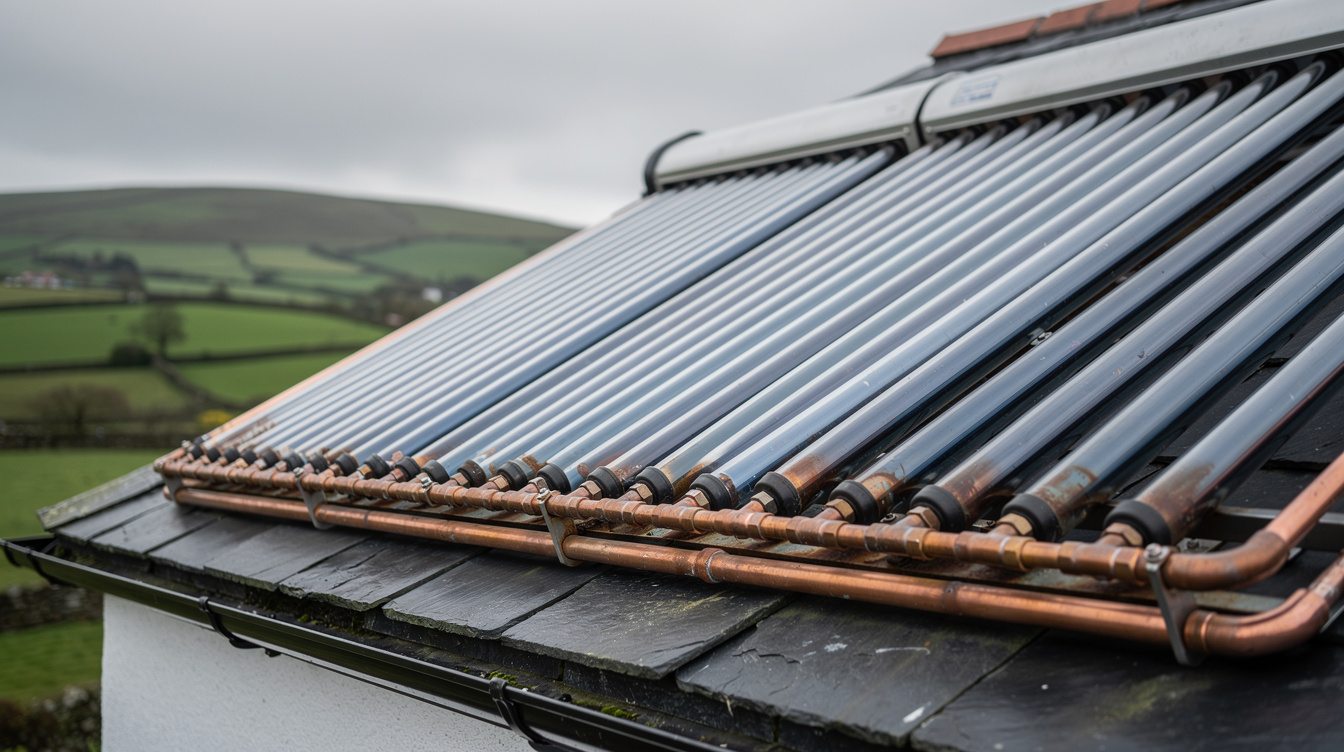
Ireland is not Arizona. We get roughly 1,000–1,200 hours of sunshine per year, compared to 2,500+ in southern Spain. Both technologies work in Irish conditions, but they handle our overcast skies differently:
Solar PV in Irish Weather
PV panels generate electricity from daylight, not direct sunshine. Even on a grey day in December, a 4.4 kWp system produces some electricity. Annual output in Ireland averages 900–1,100 kWh per installed kWp. Modern panels with half-cut cell technology have improved low-light performance significantly — output in overcast conditions is up roughly 15% compared to panels from five years ago.
Solar Thermal in Irish Weather
Thermal collectors are more sensitive to direct sunlight intensity. Flat plate collectors struggle on cloudy days, while evacuated tube collectors perform better in diffuse light (making them the preferred choice in Ireland). A well-sized solar thermal system covers 50–60% of a household’s hot water needs annually — close to 100% in summer but only 10–20% in winter.
The seasonal mismatch is thermal’s biggest weakness in Ireland: it produces most hot water in summer when you need it least, and very little in winter when you need it most. PV has the same summer peak, but surplus electricity can be exported for income or stored in a battery — surplus hot water just sits in your cylinder.
The Game-Changer: PV with an Immersion Diverter
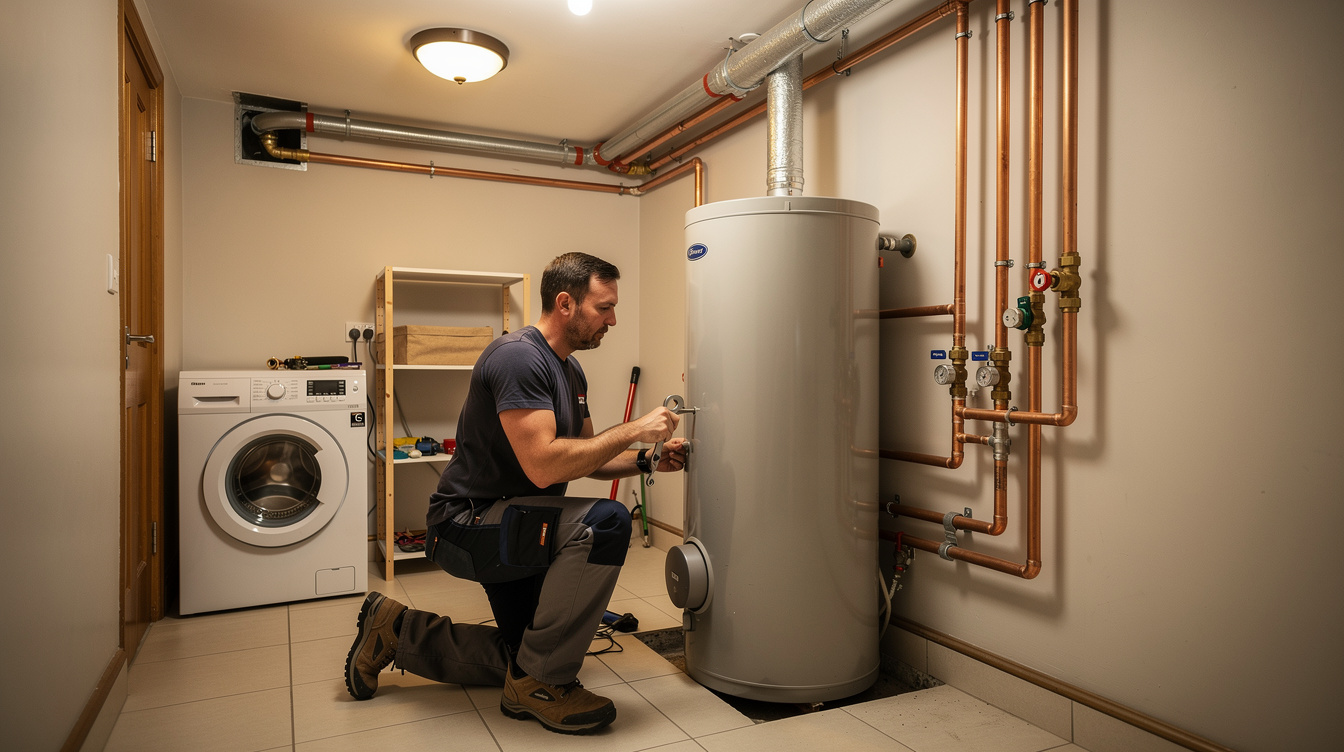
This is the reason solar thermal installations have fallen sharply in Ireland since 2020. A solar PV system with an immersion diverter (like the Myenergi Eddi or SolarEdge smart energy manager) does what thermal does — and more:
- Your PV panels generate electricity all day
- Your home uses what it needs for appliances, lights, heat pump, etc.
- The diverter sends any surplus electricity to your immersion heater instead of exporting it
- Your hot water heats up for free, using your own solar power
- If there is still surplus after the tank is hot, it gets exported to the grid for payment
The diverter costs €350–€500 fitted. When you add that to a PV system, you get electricity generation, hot water heating, export income, battery compatibility, and EV charging capability — all from one installation. A standalone thermal system gives you hot water only.
The Installer Perspective
Most SEAI-registered installers in Ireland now recommend PV over thermal for new installations. The typical advice from installers we work with: “If you are starting from scratch, go PV with a diverter. If you already have thermal panels that are working well, keep them and add PV panels alongside.”
When Solar Thermal Still Makes Sense in 2026
Despite PV’s dominance, there are genuine scenarios where solar thermal is the better choice:
1. Very Limited Roof Space
If your roof can fit 2–3 panels but not 10, thermal gives you more hot water benefit per square metre than PV. A single 2 m² evacuated tube collector can cover 50% of a couple’s hot water needs. Two PV panels in the same space would generate maybe 300–400 kWh of electricity — enough to run a fridge, not to meaningfully heat water.
2. High Hot Water Demand
Homes with high hot water consumption — large families (5+ people), B&Bs, guest houses, or homes with oil-fired boilers — benefit more from thermal. If you are spending €600–€1,000 a year just on heating water, a thermal system that cuts that by 50–60% has a strong payback.
3. You Already Have a Thermal System
If your solar thermal panels are still working (they last 20–25 years), there is no reason to rip them out. Add PV panels alongside them and get the best of both worlds. Your thermal handles hot water, PV handles everything else.
4. Budget Constraints
A solar thermal system costs €1,800–€4,300 after the SEAI grant. If you cannot stretch to €5,200+ for PV, thermal is still a worthwhile investment that will save €200–€400 per year on water heating.
5. BER Rating Priority
Solar thermal contributes strongly to BER rating improvements because the DEAP methodology gives direct credit for renewable hot water. If your primary goal is boosting your BER for a property sale, thermal can be efficient for the cost.
Full Cost Breakdown: Ireland 2026
| Cost Element | Solar PV (4.4 kWp) | Solar Thermal (evacuated tube) |
|---|---|---|
| Panels/collectors | €3,500–€4,500 | €1,500–€2,500 |
| Inverter | €1,200–€1,800 | N/A |
| Hot water cylinder (if needed) | N/A (uses existing immersion) | €500–€1,000 (twin-coil upgrade) |
| Immersion diverter (optional) | €350–€500 | N/A |
| Installation labour | €1,500–€2,500 | €800–€1,500 |
| Scaffolding | €300–€600 | €200–€400 |
| BER assessment | €150–€200 | €150–€200 |
| Total before grant | €7,000–€10,100 | €3,150–€5,600 |
| SEAI grant | −€1,800 | −€1,200 |
| Total after grant | €5,200–€8,300 | €1,950–€4,400 |
Zero VAT applies to both technologies in Ireland until at least December 2026, keeping installed costs lower than they would otherwise be.
Get a Quote for PV, Thermal, or Both
Our SEAI-registered installers can advise which technology suits your home.
SEAI Grants: PV vs Thermal
The SEAI grant structure is different for each technology:
Solar PV Grant (2026)
- €900 per kWp for the first 2 kWp
- €300 per kWp for the next 2 kWp
- Maximum €2,400 for ≥4 kWp system
- Most common grant: €1,800 (for a 4 kWp system)
- House must be built before 2021
- Installer must be SEAI-registered
Solar Thermal Grant (2026)
- Fixed grant of €1,200 regardless of system size
- House must be built before 2021
- Installer must be SEAI-registered
- Your existing hot water system must be assessed
Can you claim both? Yes. If you install PV and thermal on the same property, you can claim both the €1,800 PV grant and the €1,200 thermal grant — a total of €3,000 in grants. However, for most homes it makes more financial sense to put all your roof space toward PV and add a diverter for hot water.
Two Types of Solar Thermal: Flat Plate vs Evacuated Tube
If you do go thermal, you will choose between two collector types:
| Feature | Flat Plate | Evacuated Tube |
|---|---|---|
| How it looks | Flat dark panel (like PV) | Rows of glass tubes |
| Performance in overcast conditions | Moderate | Better — vacuum insulation reduces heat loss |
| Cost | €2,500–€3,500 installed | €3,500–€5,500 installed |
| Best for Ireland? | Adequate for south-facing roofs | Preferred — better in Irish climate |
| Durability | Very robust, fewer parts | Individual tubes can crack (replaceable) |
| Weight | Heavier | Lighter |
Most Irish installers recommend evacuated tubes because they extract more heat from our diffuse, cloudy light. Flat plate is a solid budget choice if your roof faces south and gets good direct sunlight.
Can You Install Both PV and Thermal Together?
Yes, and some homes do. A combined system works like this:
- Solar thermal panels (2–3 m²) handle hot water directly
- Solar PV panels (remaining roof space) handle electricity, exports, EV charging, and heat pump
- You claim both SEAI grants (€3,000 total)
However, most installers now advise against this for new installations. The reasoning is simple: using all your roof space for PV and adding a €350–€500 diverter gives you everything the dual system does, with less complexity, lower maintenance, and a single technology to manage. The only scenario where dual makes sense is if you have extensive roof space and very high hot water demand.
Maintenance: Another PV Advantage
This is often overlooked in the buying decision, but it matters over a 20–25 year lifespan:
| Maintenance Task | Solar PV | Solar Thermal |
|---|---|---|
| Panel cleaning | Rain does most of it. Optional annual clean. | Same |
| Fluid replacement | None — no fluid in system | Glycol needs replacing every 5–7 years (€150–€250) |
| Pump replacement | N/A | Circulation pump may need replacing after 10–15 years (€200–€400) |
| Inverter replacement | Once after 10–15 years (€800–€1,200) | N/A |
| Total 25-year maintenance cost | €800–€1,200 | €700–€1,400 |
Maintenance costs are broadly similar over the full lifespan. The difference is that PV maintenance is one big event (inverter swap) while thermal is ongoing smaller costs. Many homeowners forget about glycol replacement, and degraded glycol reduces thermal efficiency by 20–30%.
The Verdict: Which Should You Choose in 2026?
For most Irish homeowners in 2026, solar PV is the clear winner. It generates electricity for everything in your home, earns export income, pairs with batteries and EV chargers, and handles hot water through a simple diverter. The technology has matured, costs have dropped, and the ecosystem around PV (smart tariffs, batteries, EV charging) makes it far more valuable than it was even three years ago.
Choose solar PV if:
- You want to reduce your overall electricity bill, not just hot water costs
- You want to earn income from exporting surplus electricity
- You have or plan to get a battery, heat pump, or EV
- You have 15+ m² of south or south-east/south-west facing roof space
- You want minimal ongoing maintenance
Choose solar thermal if:
- You have very limited roof space (under 6 m²)
- Your primary goal is reducing hot water costs specifically
- You have high hot water demand (5+ person household, B&B)
- You have a tight budget and cannot afford PV
- You want to maximise your BER rating improvement at lowest cost
Consider both if:
- You have extensive roof space (30+ m²) and very high hot water demand
- You want to claim both SEAI grants (€3,000 total)
- You already have one technology and want to add the other
Ready to Go Solar?
Get your free personalised quote from SEAI-registered installers.
Frequently Asked Questions
Can solar PV panels heat water?
Yes. With an immersion diverter (like the Myenergi Eddi, €350–€500 installed), surplus PV electricity automatically heats your hot water cylinder. Most new PV installations in Ireland include a diverter as standard or as an add-on.
Is solar thermal cheaper than PV?
Yes, to install. A thermal system costs €1,950–€4,400 after the SEAI grant, vs €5,200–€8,300 for PV. But PV saves €800–€1,400 per year compared to €200–€400 for thermal, so PV pays back faster despite the higher upfront cost.
Can I add PV panels later if I start with thermal?
Absolutely. Many Irish homes installed solar thermal in the 2010s and are now adding PV alongside. Both technologies can share the same roof, and you can claim the PV grant even if you previously claimed the thermal grant.
Do I need a new hot water cylinder for solar thermal?
Usually, yes. Solar thermal needs a twin-coil cylinder — one coil for the boiler and one for the solar collectors. If your current cylinder is single-coil, upgrading costs €500–€1,000 and should be included in your installer’s quote. PV with a diverter works with any existing immersion heater.
Which technology is better for the environment?
Both reduce carbon emissions. PV typically displaces more CO2 because it replaces grid electricity (which still includes fossil fuel generation in Ireland), while thermal only replaces the fuel used to heat water. A 4.4 kWp PV system prevents roughly 1.5–2 tonnes of CO2 per year. A solar thermal system prevents roughly 0.4–0.6 tonnes per year.
What about solar thermal for underfloor heating?
Solar thermal can supplement underfloor heating, but the seasonal mismatch is severe: underfloor heating runs hardest in winter when solar thermal output is lowest. A heat pump powered by PV is a far more effective combination for space heating in Ireland.
Related Articles
How Much Do Solar Panels Cost for a 3-Bed House in Ireland? (2026 Prices)
A 4.4 kWp solar system on a 3-bed semi costs €4,700–€6,700 after SEAI grant and saves €900–€1,450/year. Full 2026 cost breakdown with monthly savings.
Solar Panel Waiting Times Ireland 2026: How Long From Quote to Installation (And How to Beat the Queue)
Solar installer wait times have doubled in Ireland. Here are the current timelines for every step from quote to installation, and 7 ways to speed things up.
How to Choose a Solar Panel Installer in Ireland 2026: 10 Questions, 7 Red Flags & What Good Looks Like
10 questions to ask every solar installer, 7 red flags to avoid, and how to compare quotes. A practical guide for Irish homeowners in 2026.