
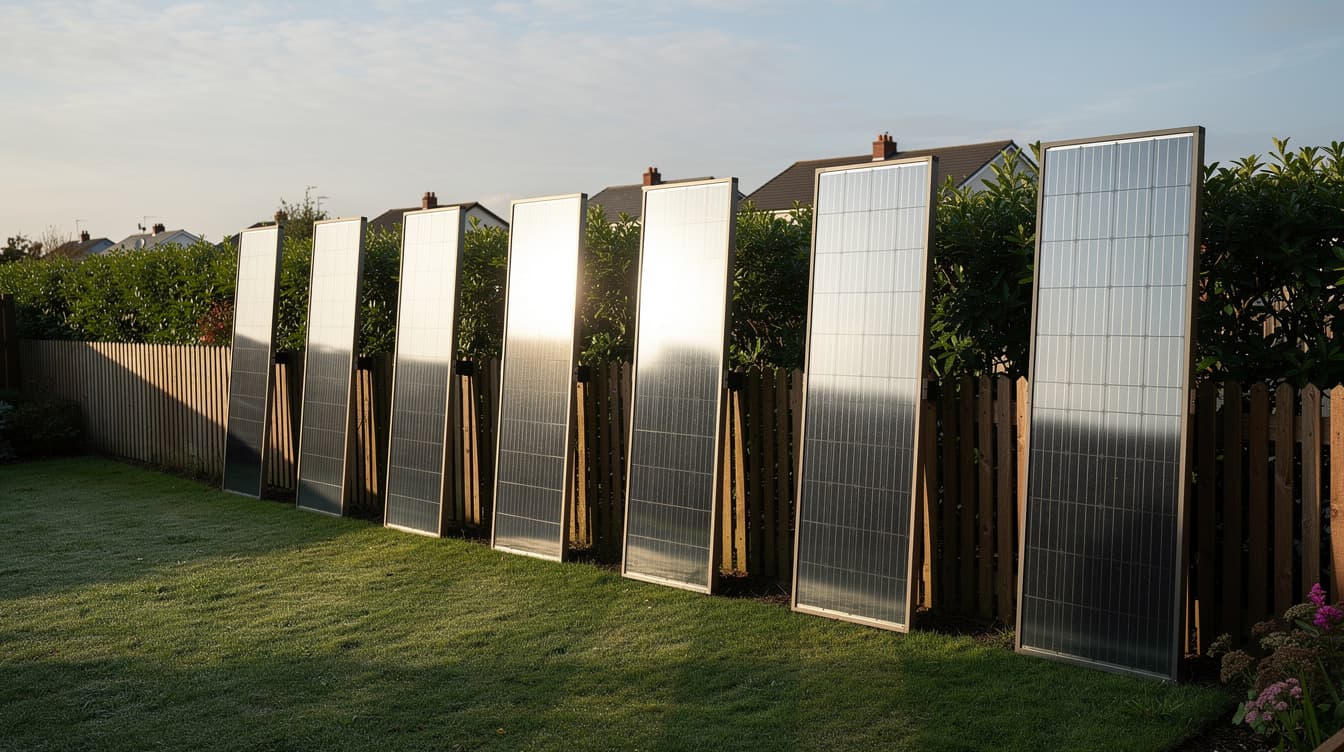
Vertical Solar Panels & Solar Fences Ireland 2026: When Bifacial on a Fence Beats a Rooftop Array
Not every Irish home has a south-facing roof. Some don't have a suitable roof at all — too shaded, too small, listed building, planning-restricted, or the wrong pitch. For years these homes had one answer: no solar. In 2026, a second answer is quietly gaining traction: vertical bifacial solar. Panels mounted on a garden fence, a gable wall, or a purpose-built stand, generating power from both faces and shrugging off the low winter sun angle better than a flat rooftop array. This guide covers what vertical and fence-mounted solar actually is, how it performs in Irish light, what it costs to fit, and when it's the right call over waiting for a roof retrofit.
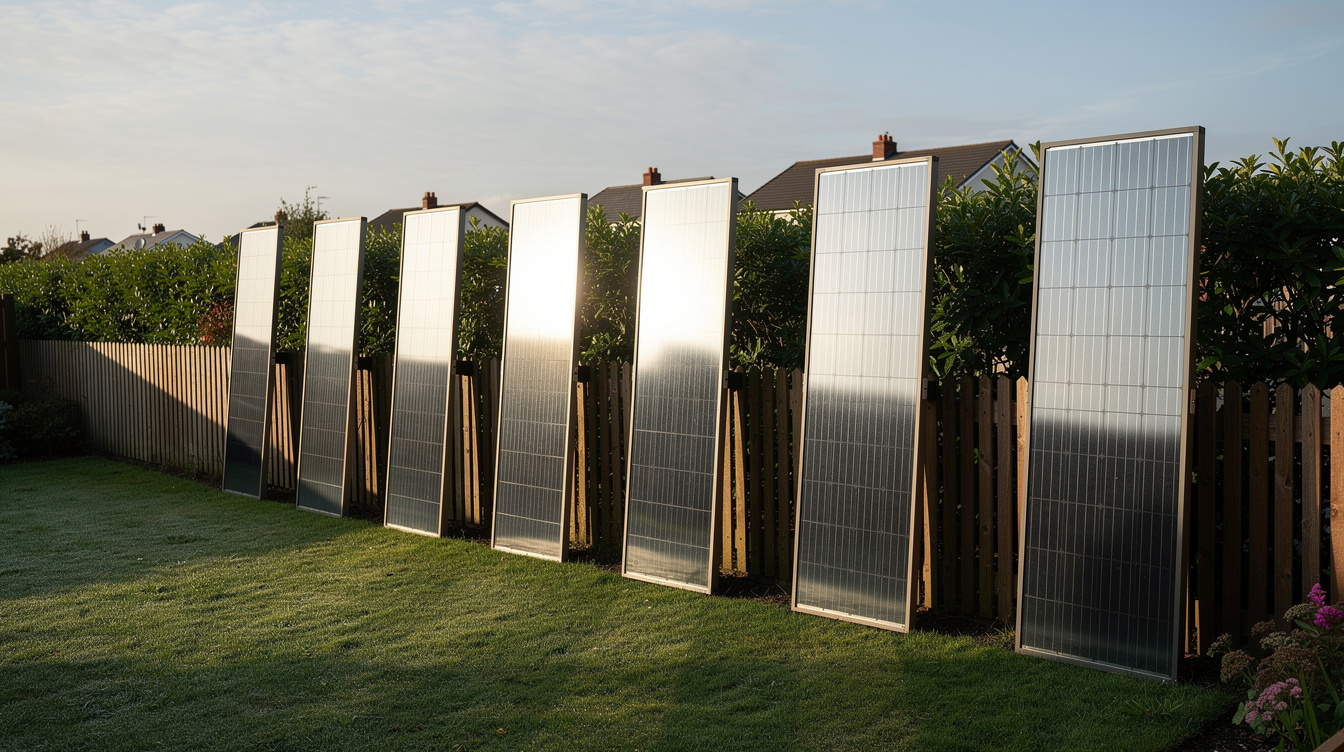
What is a vertical solar fence?
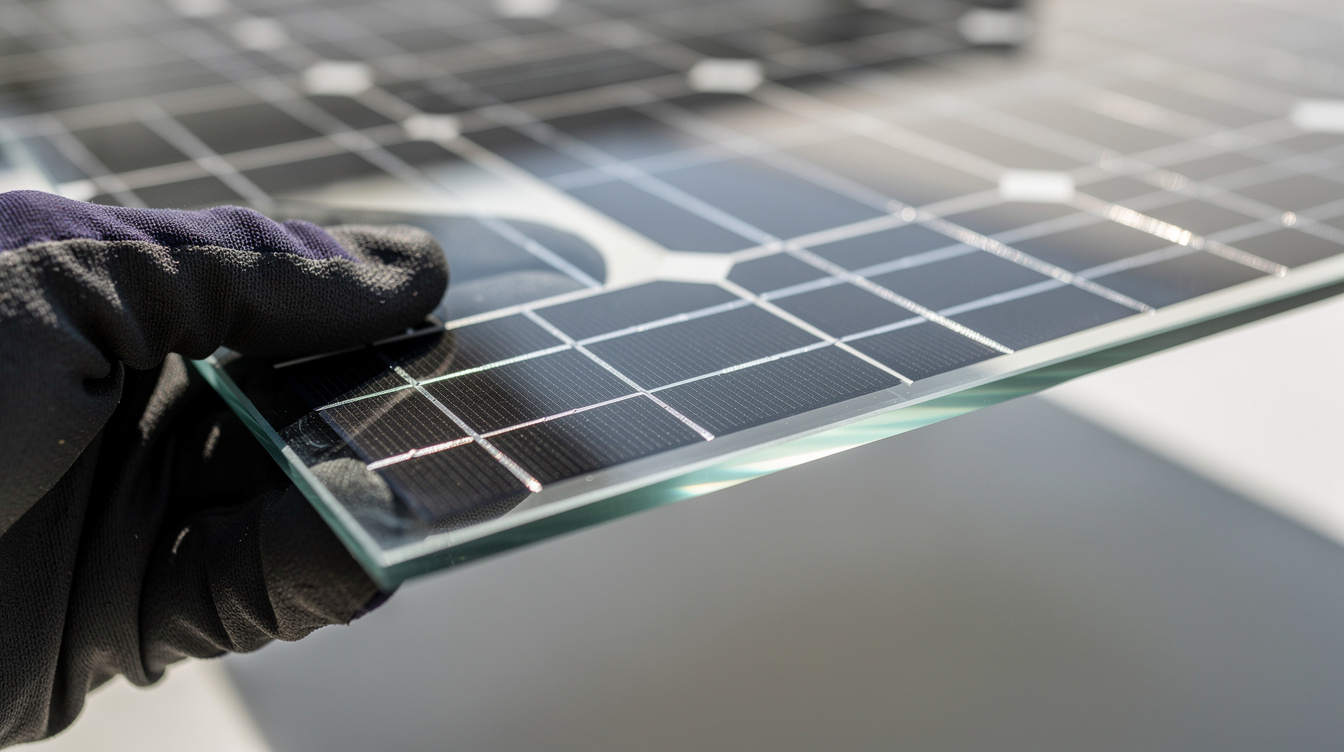
A vertical solar fence is a run of bifacial glass-glass PV panels mounted upright — either as replacement fence panels or on a dedicated ground frame — instead of laid at a shallow roof angle. The word "bifacial" matters. These panels generate power from both the front and rear surfaces, so a vertical east-west run captures the morning sun on one face and the evening sun on the other. In practice, that produces a generation profile that is flatter through the day than a south-facing rooftop array, with two solid peaks (roughly 09:00 and 17:00) instead of one midday spike.
Two Fraunhofer studies from Germany (2023–2025) and the University of Reading's PV group have now validated in northern-European light what the Chinese manufacturers claimed: a vertical east-west bifacial run at latitude 53° produces roughly 85–95% of the annual kWh of the same panels laid at 35° south, but with 30–40% of the generation shifted into the morning and evening peak hours. For Irish homes on Time-of-Use tariffs, that peak-shift is worth real money.
Why vertical works surprisingly well in Ireland
Ireland's solar profile is unusually forgiving of non-optimal panel orientation. Three physical facts drive this:
- Low sun angle. Even at midsummer, the sun peaks at only 60° above the horizon in Dublin. In winter it's under 15°. Vertical panels see sunlight closer to perpendicular in winter than roof panels do, so their winter yield is disproportionately good.
- Diffuse light dominates. Roughly 55–65% of Irish annual solar energy arrives as diffuse (cloudy-sky) light, not direct beam. Diffuse light hits vertical bifacial panels almost as well as tilted ones because both faces contribute.
- Cool operating temperature. Panels lose about 0.35% output per °C above 25°C. Irish air rarely pushes cell temperatures past 35°C, and vertical panels stay cooler still because both faces radiate freely. Roof panels bake against a hot slate or membrane.
Realistic 2026 output figures
What can you actually generate? Below are field-measured annual yields for typical Irish setups, based on 2025–2026 installer data and PVGIS 5.3 modelling for Dublin:
| Configuration | Panels | kWp | Annual kWh (Dublin) | Peak-hour share |
|---|---|---|---|---|
| Roof, 35° south | 10 mono (450W) | 4.5 | 4,050 | 18% |
| Fence, vertical E-W bifacial | 10 bifacial (440W) | 4.4 | 3,680 | 38% |
| Roof, 15° east-facing | 10 mono (450W) | 4.5 | 3,240 | 22% |
| Gable wall, vertical south bifacial | 8 bifacial (440W) | 3.5 | 3,150 | 25% |
Notice the fence array produces 91% of the roof array's total kWh but shifts more than double the share into peak hours. That's worth roughly €170–€250 more per year in self-consumption savings on a standard Irish Time-of-Use tariff.
Curious if vertical solar suits your garden?
Get a free quote from an SEAI-registered installer familiar with fence and wall-mounted bifacial systems.
What it costs to fit in Ireland (2026)
Vertical fence installations cost more per kWp than a comparable roof install. There are two reasons: bifacial glass-glass panels themselves are 25–40% more expensive than monofacial equivalents, and the ground-mounting frame is more work than roof rails. Typical fitted 2026 prices:
| Setup | Size | Installed cost (inc. inverter, VAT) | SEAI grant | Net cost |
|---|---|---|---|---|
| Fence run (bifacial) | 4.4 kWp | €11,800–€13,200 | €1,800 | €10,000–€11,400 |
| Gable-wall mounted | 3.5 kWp | €9,400–€10,600 | €1,800 | €7,600–€8,800 |
| Freestanding ground frame | 4.4 kWp | €10,900–€12,400 | €1,800 | €9,100–€10,600 |
| Comparison: 4.4 kWp roof | 4.4 kWp | €9,050 net (median Aug 2026) | included | €9,050 |
Yes, vertical is a €1,000–€2,000 premium on a comparable roof install. But if you don't have a roof option, "expensive" and "impossible" are very different numbers.
Which brands make bifacial panels worth buying in 2026
Bifacial has gone mainstream. Every Tier 1 manufacturer now ships a glass-glass bifacial line at close to monofacial pricing. In Ireland in 2026, the following are widely stocked by SEAI-registered installers:
- Jinko Tiger Neo N-type Bifacial (440–465W) — the volume default; 30-year linear power warranty, 25-year product warranty.
- Longi Hi-MO 6 Bifacial (450–475W) — premium efficiency (22.8%); more common on premium residential jobs.
- JA Solar DeepBlue 4.0 Bifacial (430–455W) — strong low-light performance; often specified for west-of-Ireland installs.
- AIKO Neostar 2P (445–470W) — back-contact bifacial; the highest bifacial gain (up to 30% rear yield) but priciest.
- Trina Vertex S+ Bifacial (435–460W) — good value; often specified for larger installs.
Planning permission for vertical solar in Ireland
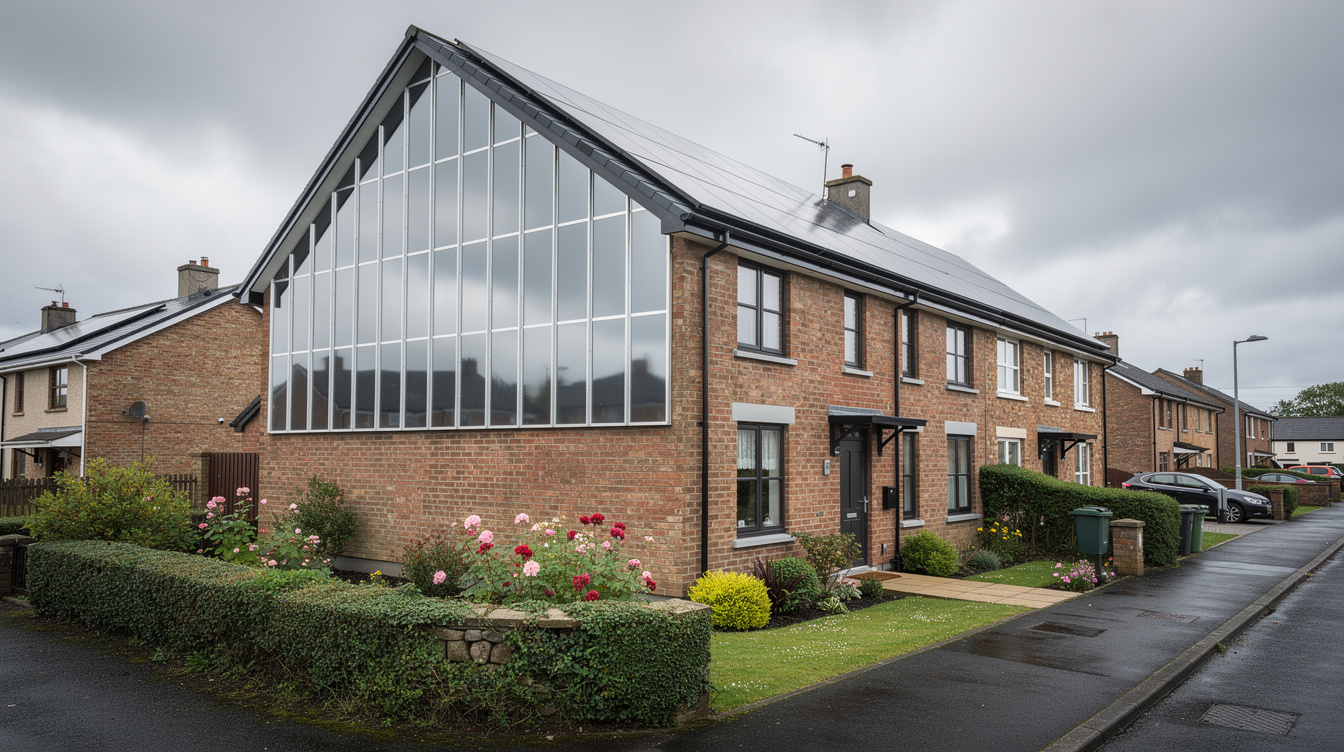
The good news: Ireland's 2022 planning exemption for solar PV was updated in 2023 to explicitly include ground-mounted and wall-mounted arrays on domestic property, up to 25 m² and within a rear or side garden. That covers essentially every domestic fence-solar install a homeowner would consider.
Two edge cases still need attention:
- Front garden or road-facing: not covered by the 2023 amendment. Requires planning permission.
- Protected structure or ACA (Architectural Conservation Area): always requires planning — the exemption doesn't apply. Common in Dublin 2, Georgian Limerick, Kilkenny centre, and similar.
The panels themselves need the standard NC6 notification to ESB Networks. Same 6 kW inverter export cap as any residential PV system.
Where fence solar goes wrong
Three failure modes come up in the installer post-mortems I've read:
- Underestimating shading. A 6-foot fence line running along a hedge, garage wall, or neighbour's shed can lose 40–60% of expected yield to shading that wouldn't have hit a rooftop array. Do a shade survey with the Solmetric SunEye or the equivalent tool before you commit.
- Structural attachment. A fence run of 10 bifacial panels weighs roughly 220 kg and behaves like a sail in Atlantic wind. Domestic fence posts are not rated for that load. Vertical installs need concrete pad footings or steel ground screws, not the timber post you already have. Cheap installers who screw panels to an existing fence produce disasters that fall over in the first Storm Éowyn-scale event.
- Wiring path. A garden fence is typically 15–25 metres from the consumer unit. That's a long DC cable run and adds inverter placement complexity. Budget for the extra copper.
When vertical is the right choice
Vertical solar wins in four situations:
- Your roof physically cannot take PV (listed, wrong pitch, structural, planning).
- Your roof is south-facing but heavily shaded — and you have a clear east-west fence line.
- You use significant electricity in morning and evening peak hours — and your supplier's ToU rates make peak-shifted generation more valuable than midday.
- You want to add generation without touching the roof at all — useful when a re-roof is 3–5 years away.
For everyone else with a sound south-facing pitched roof, a conventional rooftop install remains the better default. Use our solar panel calculator to model both cases side-by-side before you commit to either.
Frequently asked questions
Do vertical panels self-clean in Irish rain? Yes — more so than roof panels, actually. Vertical glass sheds water and dust faster, and pollen build-up is minimal. Most installers recommend one wash per year (roof panels typically need two).
Can I put solar on the fence between my garden and my neighbour's? Legally you can if the fence sits on your side of the boundary and the array doesn't overhang. In practice: talk to your neighbour first, especially about wind noise from the mounting frame in gale conditions.
Are bifacial panels covered by the SEAI grant? Yes. As long as the panels and the installer are on the SEAI-registered list, bifacial and vertical installations qualify for the full €1,800 domestic solar PV grant on the same terms as a rooftop system.
What about frost and snow? Vertical panels shed snow within hours of accumulation (roof panels sometimes stay covered for days). No frost-related output loss.
Ready to Explore Vertical Solar?
Ask an SEAI-registered installer to model both roof and fence options for your home.
Bottom line
Vertical bifacial solar — on a fence, gable wall, or freestanding frame — is a real, planning-exempt, SEAI-grant-eligible option in Ireland in 2026 for homes without a good roof. Expect 85–95% of the annual kWh of a south-facing roof array at a €1,000–€2,000 premium, with substantially more of that generation landing in the valuable morning/evening peak hours. If your roof is fine, go conventional. If it isn't, don't wait — the maths now works.
Related Articles
Solar Battery Brands Ireland 2026: Tesla Powerwall 3 vs BYD vs Pylontech vs Sigenergy vs Sunsynk Compared
Compare Tesla Powerwall 3, BYD, Pylontech Force H2, Sigenergy and Sunsynk for Irish homes in 2026: installed prices, warranties, cycle counts, backup and V2G.
PV Solar Diverter Ireland 2026: Eddi vs iBoost vs PowerDiverter Compared
Compare Eddi, Solar iBoost+ and PowerDiverter for Irish solar homes in 2026: real prices, install costs, VAT savings, and honest payback vs the CEG.
2kW Solar System Ireland 2026: Cost, Suitability & Payback for Small Homes
2 kWp solar in Ireland 2026: costs €3,500 net after €700 SEAI grant, generates 1,850 kWh/yr south-facing, pays back in 5.4 years. When it fits vs going to 4.4 kWp.