
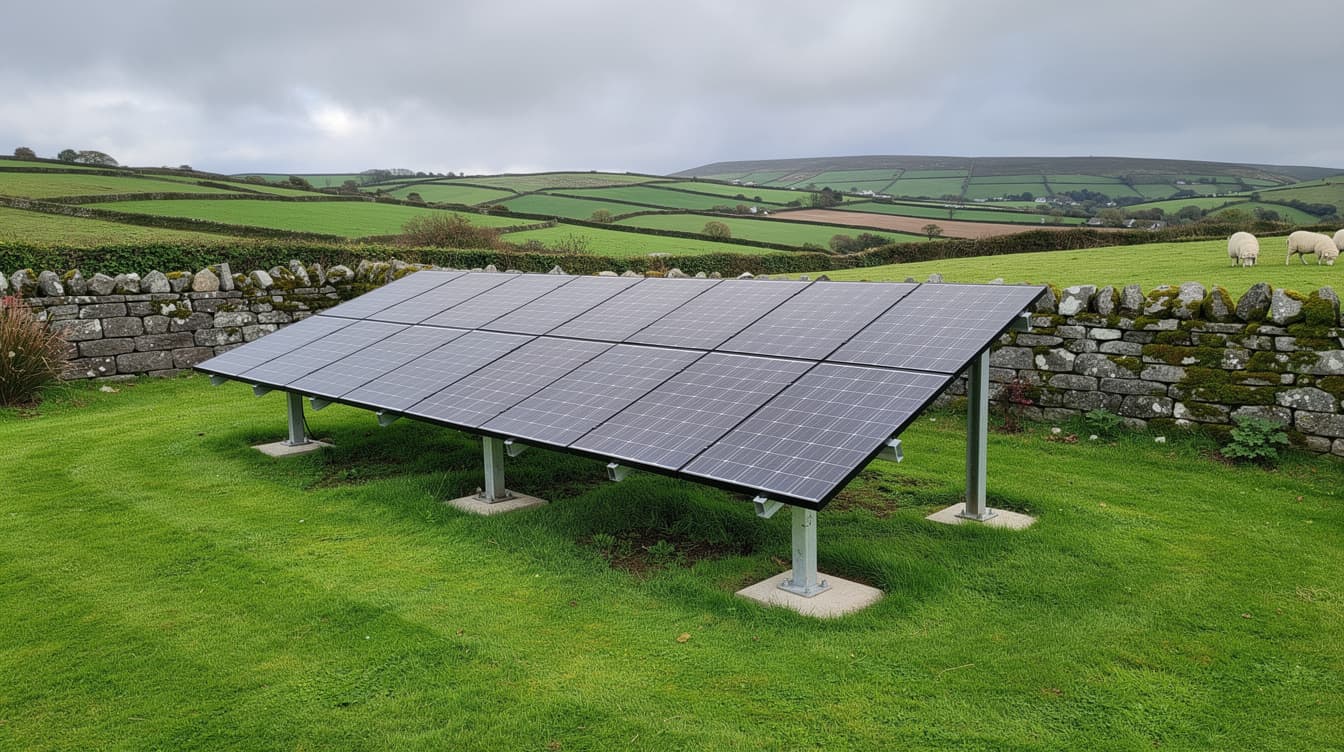
Ground-Mounted Solar Panels Ireland 2026: Costs, Planning Rules, Pros & Cons vs Rooftop
Not every Irish home has the right roof for solar. Maybe yours faces north. Maybe it's thatched, has dormer windows, or is a protected structure where rooftop panels need planning permission you'd rather avoid. Or maybe you're a farmer with half an acre of rough ground that's doing nothing productive. In all these cases, ground-mounted solar panels are the answer — and in 2026, they qualify for the same SEAI grants, the same 0% VAT, and the same export payments as rooftop systems.
This guide covers everything: how much ground-mounted systems cost in Ireland, the planning permission rules (they're more generous than you'd think), how they compare to rooftop on performance and payback, the foundation options, and who should — and shouldn't — consider going ground-level.
Get Ground-Mount Solar Quotes
Compare prices from SEAI-registered installers who do ground-mounted systems — free, no obligation.
Who Should Consider Ground-Mounted Solar?
Ground-mounted panels aren't for everyone. They cost more than rooftop and need space. But they're the better choice if any of these apply:
- Your roof is unsuitable: North-facing, thatched, too steep, too shallow, heavily shaded by trees, or structurally weak.
- You live in a protected structure or architectural conservation area where rooftop panels need planning permission.
- You're a farmer: You have land, you have high daytime electricity use (milking parlours, grain drying, cold storage), and you may qualify for TAMS III grants on top of SEAI.
- You want maximum output: Ground arrays can be angled perfectly south at the optimal 30–35° tilt, and they run 2–3% more efficiently than rooftop panels thanks to better airflow and cooling.
- You plan to expand later: Adding more panels to a ground array is far simpler than retrofitting extra roof rails.
How Much Do Ground-Mounted Solar Panels Cost in Ireland?
Ground-mounted systems cost 15–30% more than equivalent rooftop installations. The extra cost comes from the racking frame, concrete foundations, and additional cabling from the array to your meter board. Here's what to expect in May 2026:
| System Size | Number of Panels | Ground-Mount Cost | After €1,800 SEAI Grant | Equivalent Rooftop Cost |
|---|---|---|---|---|
| 3 kWp | 7–8 | €6,500–€8,000 | €4,700–€6,200 | €5,000–€6,200 |
| 4 kWp | 10 | €8,000–€10,500 | €6,200–€8,700 | €6,200–€7,800 |
| 6 kWp | 14–15 | €11,500–€14,500 | €9,700–€12,700 | €8,500–€11,000 |
| 10 kWp | 24–25 | €16,000–€21,000 | €14,200–€19,200 | €12,000–€16,000 |
What drives the price difference?
- Racking and frame: €1,200–€3,000 depending on system size and whether you choose galvanised steel or aluminium.
- Foundations: Concrete pad foundations add €800–€1,500. Ground screws (faster, less disruptive) cost €600–€1,200.
- Trenching and cabling: Running armoured cable from the array to your house adds €500–€2,000+, depending on distance. Every 10 metres of trench adds roughly €150–€250.
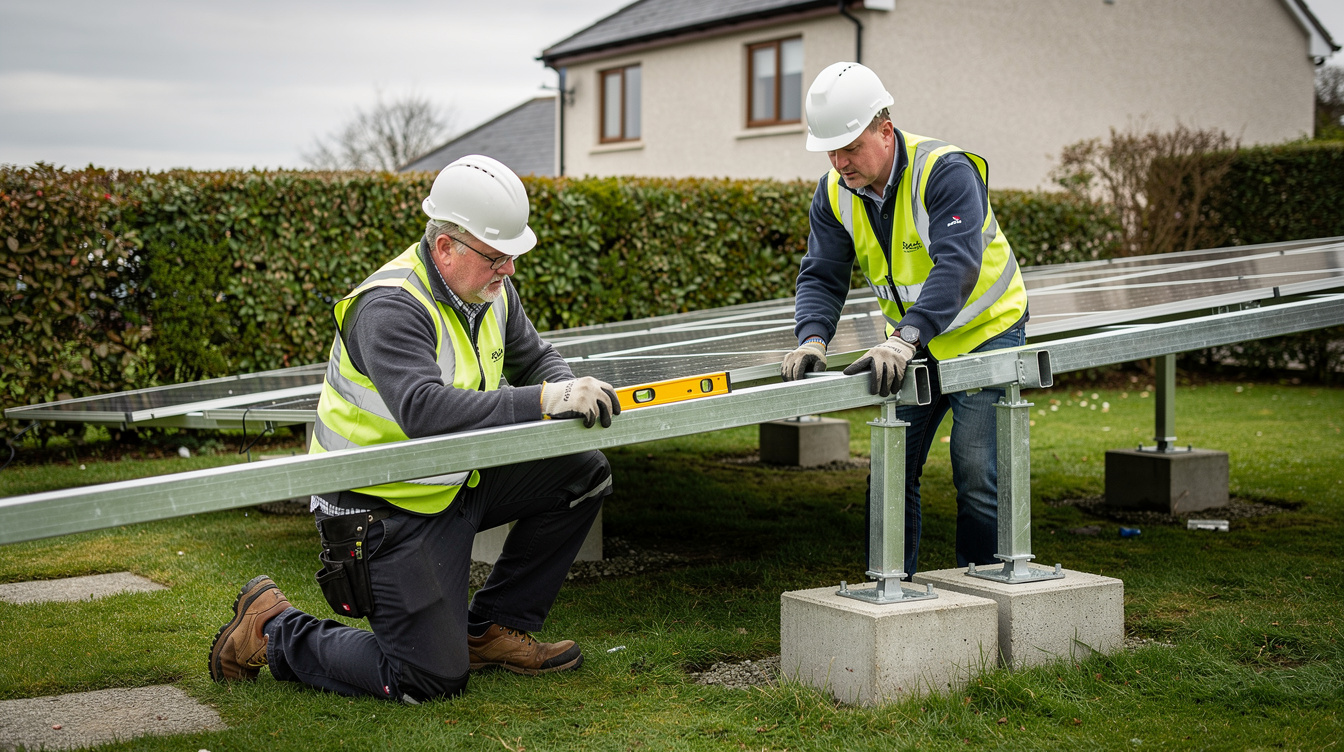
Planning Permission: The 25 m² Rule
Ground-mounted solar panels in Ireland are exempt development (no planning permission needed) as long as all three conditions are met:
- The total panel area does not exceed 25 m² (roughly 12–14 standard panels, or about 5–6 kWp).
- The panels are no more than 2 metres above ground level.
- The remaining private open space to the rear or side of the house is at least 25 m² after the array is installed.
What if you need a bigger system? If your array exceeds 25 m², you'll need planning permission from your local authority. This costs €34 for a residential application and typically takes 8–12 weeks. In practice, permission is almost always granted for residential ground-mount arrays — there are few objection grounds for panels in a back garden.
Farmers: Agricultural buildings and land have different planning exemptions. Solar panels mounted on or near farm buildings may qualify under separate agricultural exemptions. Check with your county council or see our solar panels for farms guide.
Ground-Mounted vs Rooftop: Head-to-Head Comparison
| Factor | Ground-Mounted | Rooftop |
|---|---|---|
| Cost (4 kWp) | €8,000–€10,500 | €6,200–€7,800 |
| Annual output (4 kWp) | 3,600–4,200 kWh | 3,400–3,900 kWh |
| Performance edge | 2–3% higher (better cooling + optimal angle) | Baseline |
| SEAI grant eligible? | Yes (€1,800) | Yes (€1,800) |
| Planning permission | Exempt under 25 m² | Exempt under 25 m² (50% of roof) |
| Installation time | 2–3 days | 1–2 days |
| Maintenance access | Easy (ground level) | Needs ladders/scaffolding |
| Scalability | Easy to add more panels | Limited by roof area |
| Space required | ~25 m² per kWp (with spacing) | ~6 m² per kWp |
| Shading risk | Higher (trees, hedges, walls) | Lower (above obstacles) |
| Roof impact | None | Roof penetrations required |
Bottom line: If you have suitable roof space, rooftop is almost always cheaper and more space-efficient. Ground-mounted wins when your roof is unsuitable, you want maximum performance, or you have land to spare.
Foundation Types for Irish Ground
Irish ground conditions matter. Here's what your installer will recommend based on your site:
Concrete pad foundations
The most common option for residential ground-mount systems. Pre-cast concrete blocks or poured pads are placed at each support point. They work on virtually any soil type, including the heavy clay common across Munster and Leinster. Cost: €800–€1,500 for a typical 4 kWp array.
Ground screws (helical piles)
Metal screws are driven into the ground using a hydraulic driver — no concrete, no excavation, minimal ground disturbance. Ideal for gardens where you want to preserve the lawn. They're faster to install (usually done in a few hours) and fully reversible. Cost: €600–€1,200 for a 4 kWp array.
Not suitable for: Very rocky ground (common in Connemara, Burren, parts of Donegal) or very soft boggy ground.
Ballast-weighted systems
For situations where you can't penetrate the ground (concrete yards, gravelled areas), heavy concrete ballast blocks hold the frame in place. Common on farms. No ground penetration means no planning complications and easy removal later.
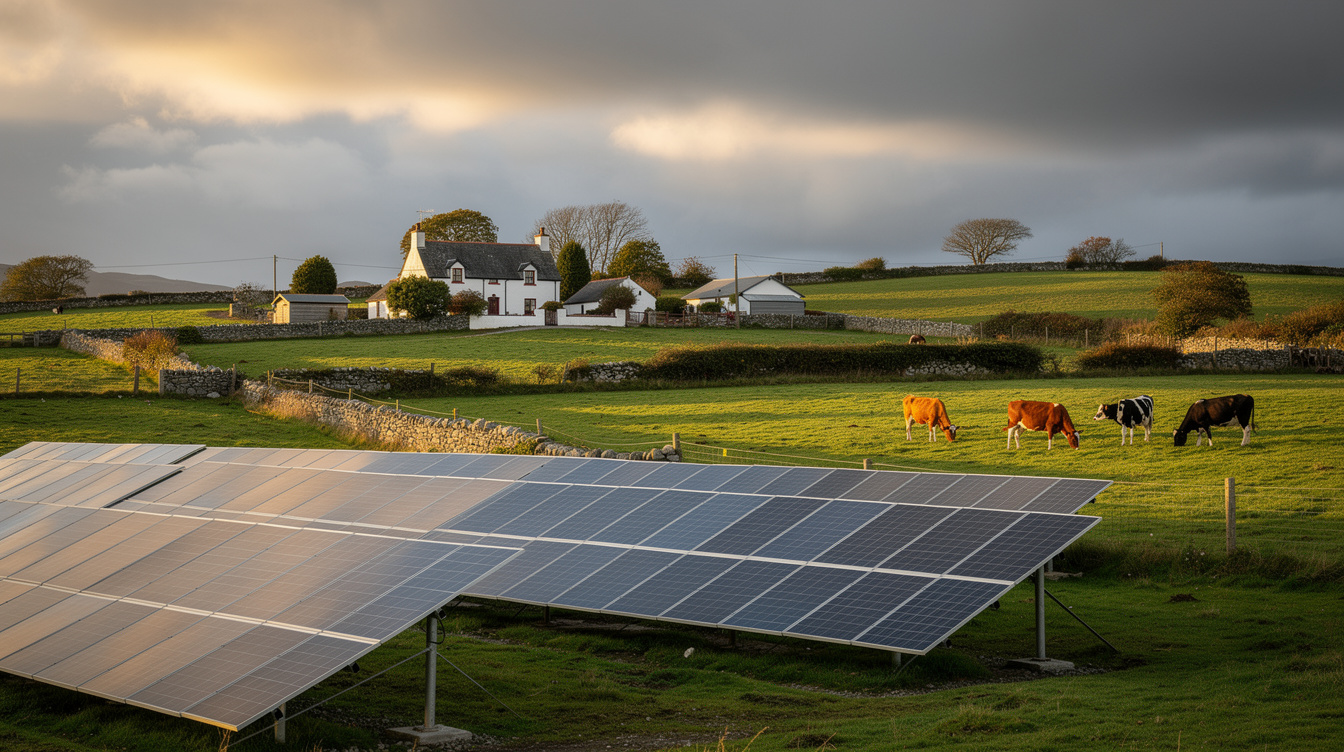
Installation Process: What to Expect
A ground-mounted install takes longer than rooftop — typically 2–3 days of on-site work plus a day for trenching. Here's the typical timeline:
- Site survey (Day 0): Your installer visits, checks ground conditions, shading analysis, measures the distance to your meter board, and designs the array layout.
- Foundation work (Day 1): Concrete pads are poured or ground screws are installed. For concrete, you'll need 3–5 days of curing time before the frame goes up.
- Trenching (Day 1–2): A trench is dug from the array location to your house for the DC/AC cable. Minimum depth is 600 mm. If crossing a driveway or patio, ducting is installed.
- Frame and panel mounting (Day 2–3): The aluminium or steel racking frame is bolted to the foundations, panels are mounted, and wiring is connected.
- Electrical connection (Day 3): The inverter is installed (usually inside your house, near the meter board), panels are connected, and the system is tested.
- DNO notification: Your installer notifies ESB Networks. This can take 2–6 weeks for confirmation, but your system can usually start generating immediately.
SEAI Grants and TAMS III for Ground-Mounted Systems
Ground-mounted panels qualify for the same grants as rooftop:
| Grant | Amount | Who Qualifies |
|---|---|---|
| SEAI Solar PV Grant | Up to €1,800 | Homeowners (house built before 2021) |
| TAMS III Solar PV | 40–60% of eligible costs | Registered farmers (systems up to 162 kWp) |
| SEAI Non-Domestic Grant | Up to €162,600 | Businesses, farms, community organisations |
| 0% VAT | Saves 13.5% (€800–€2,500) | All residential solar installations |
Farmers take note: TAMS III can stack with the SEAI grant in some cases, bringing your effective cost down by 50–70%. A 10 kWp ground-mounted system costing €18,000 could net out at €5,400–€9,000 after both grants. Talk to your farm advisor — the application process for TAMS III is separate from SEAI and requires a farm plan.
Need Ground-Mount Advice?
Tell us about your site and we'll connect you with installers experienced in ground-mounted systems.
Common Mistakes to Avoid
1. Underestimating shading
Ground-mounted panels sit lower than rooftop ones, so hedges, walls, sheds, and trees cast longer shadows. Your installer should do a shading analysis at the site survey. A 2-metre hedge 5 metres south of your array can reduce output by 15–20% in winter months.
2. Skimping on cabling distance
Every extra metre of cable between the array and your inverter causes voltage drop. For runs over 30 metres, you may need thicker cable (6 mm² instead of 4 mm²) to maintain efficiency. Get this costed in the original quote — it's expensive to upgrade later.
3. Forgetting about mowing access
If your array sits in a grassy area, you'll need to mow around and under it. Make sure the frame height allows a mower to pass underneath (minimum 50–60 cm clearance at the lowest point). Some homeowners lay weed membrane under the array to avoid this entirely.
4. Not future-proofing for batteries
If you think you might add a battery later, tell your installer now. The inverter choice matters — a hybrid inverter (like Huawei SUN2000 or GivEnergy) can accept a battery later without rewiring, saving €500–€1,000 on a future upgrade.
Is a Ground-Mounted System Worth It?
Let's run the numbers for a typical scenario: a 4 kWp ground-mounted system on a rural property in the Midlands.
| Item | Value |
|---|---|
| System cost (installed) | €9,200 |
| SEAI grant | –€1,800 |
| Net cost | €7,400 |
| Annual output | 3,800 kWh |
| Self-consumption (50%) | 1,900 kWh × 24c = €456 |
| Export income (50%) | 1,900 kWh × 21c = €399 |
| Total annual benefit | €855 |
| Payback period | 8.7 years |
| 25-year lifetime value | €21,375 |
The payback is longer than rooftop (typically 5–7 years) because of the higher installation cost. But the lifetime value is still excellent — €21,000+ in savings and income from a €7,400 net investment. And for homeowners whose roof simply can't take panels, the comparison isn't ground-mount vs rooftop — it's ground-mount vs no solar at all.
Use our solar panel calculator to model your specific scenario.
Ready to Go Solar?
Get your free personalised quote from SEAI-registered installers experienced with ground-mounted systems.
Frequently Asked Questions
Do ground-mounted panels need planning permission in Ireland?
No, as long as the total panel area is under 25 m², the height is under 2 metres, and you retain at least 25 m² of open space. For larger systems, a planning application (€34 fee) is required but rarely refused.
Can I get the SEAI grant for ground-mounted solar?
Yes. The SEAI solar PV grant of up to €1,800 applies to ground-mounted systems, provided you use an SEAI-registered installer and your home was built before 2021.
How much space do I need for a ground-mounted system?
As a rule of thumb, allow roughly 25 m² per kWp when you include inter-row spacing to prevent self-shading. A 4 kWp system needs about 100 m² of unshaded ground (roughly 10m × 10m).
Are ground-mounted panels more efficient than rooftop?
Slightly — about 2–3% more efficient on average. Better air circulation keeps them cooler (panels lose efficiency as they heat up), and they can be positioned at the exact optimal angle and direction. This advantage is partially offset by the higher installation cost.
Can I install ground-mounted panels myself?
Technically you can assemble the frame and panels, but electrical connection must be done by a qualified electrician. More importantly, DIY installations don't qualify for the SEAI grant, and self-installed systems may void your home insurance. For most people, professional installation is the sensible choice.
What about security and theft?
Ground-level panels are more accessible than rooftop ones, so security can be a concern in rural areas. Options include security fencing, CCTV, motion-sensor lighting, and tamper-resistant bolts on the panel clamps. Most installers can advise on suitable measures for your location.
Related Articles
Solar Panels Cork 2026: Costs, Installers, Output & Why Cork Is Ireland's Solar Sweet Spot
Solar panels in Cork 2026: real costs from €3,000 after grant, 1,417 sunshine hours, 300+ installers compared. Cork-specific output, planning and savings data.
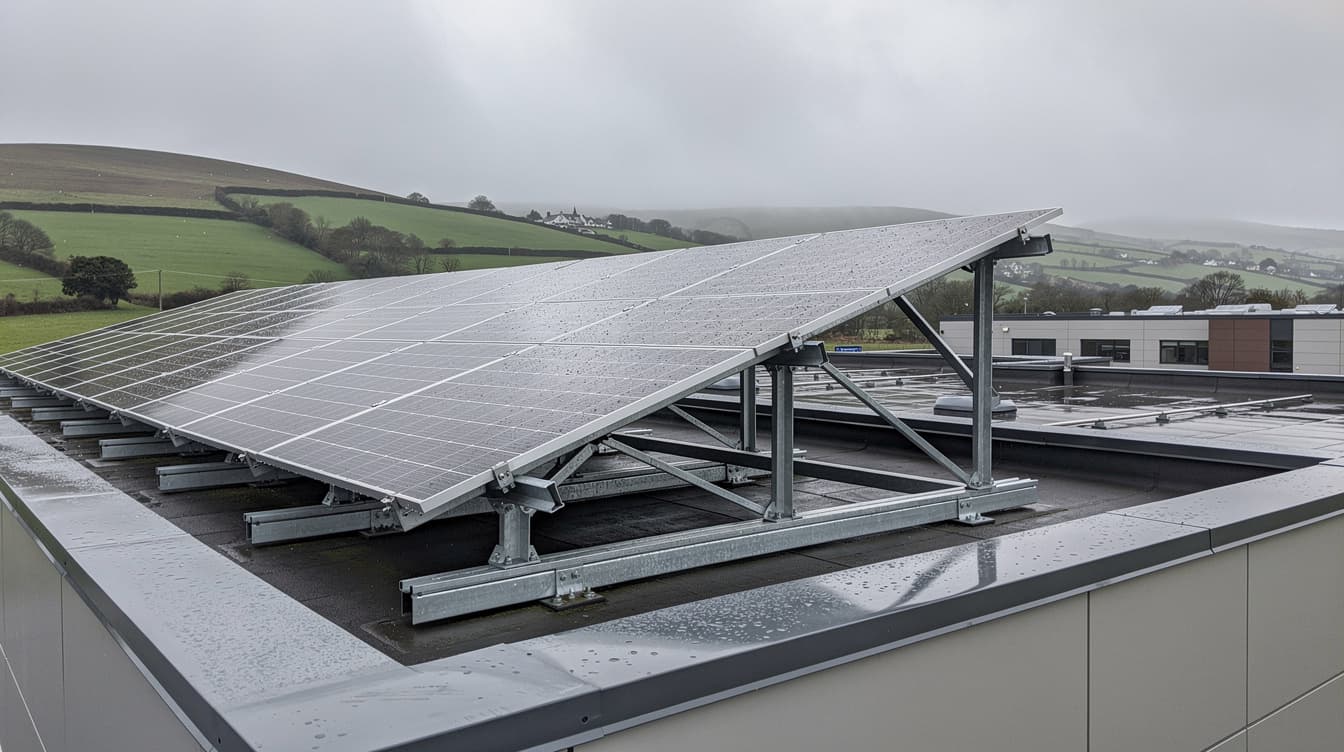
Solar Panels on a Flat Roof in Ireland 2026: Mounting, Costs & Planning Rules
Flat roof solar costs €500-€1,000 extra for tilt frames. Ballasted systems need no drilling. Full guide to mounting, planning permission and structural checks.
Solar Panels for a 2-Bed House in Ireland 2026: Costs, System Sizes & Why Small Homes Are Ideal
How much do solar panels cost for a 2-bed house in Ireland? From €2,400 after SEAI grant. System sizes, real savings, and why smaller homes get faster payback.