
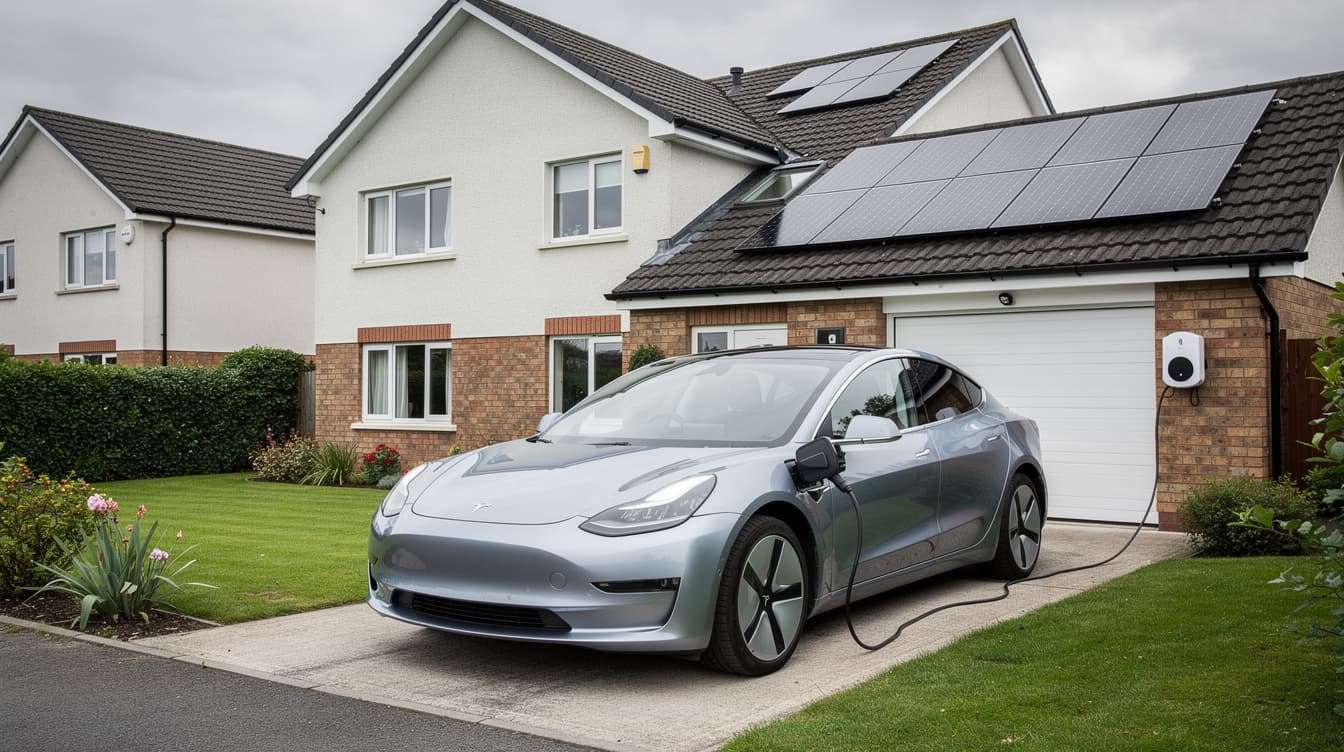
Solar Panels and Electric Cars in Ireland: How to Charge Your EV with Free Sunshine (2026)
EV sales in Ireland surged 110% in April 2026. Solar panel installations are up 65%. Here is how to combine them for the biggest savings.
Two of the fastest-growing purchases Irish homeowners are making right now — solar panels and electric cars — happen to be a perfect match. Your solar panels generate free electricity during the day. Your EV sits in the driveway waiting to soak it up. The result: you are driving on sunshine instead of paying 35c/kWh to the grid or €1.80/litre at the pump.
But making this work well requires some planning. How many panels do you actually need? What kind of charger should you buy? Can you charge during the day if you are at work? And what is the real-world payback when you combine both investments?
This guide answers all of it with Irish-specific data, 2026 pricing, and practical advice you can act on today.
The Numbers: What EV Charging Actually Costs in Ireland
Before we talk about solar, you need to understand what you are currently spending — or will spend — on EV charging. Here is a breakdown of the three main charging scenarios in 2026:
| Charging Method | Cost per kWh | Annual Cost (15,000 km) | Equivalent Petrol Cost |
|---|---|---|---|
| Home charging (day rate) | ~35c/kWh | €1,050–€1,300 | €2,200–€2,700 |
| Home charging (night rate) | ~16c/kWh | €480–€600 | |
| Public fast charger | 45–65c/kWh | €1,350–€1,950 | |
| Solar (free generation) | €0 | €0 |
The average Irish driver covers about 15,000 km per year. A typical EV uses 15–20 kWh per 100 km, meaning you need roughly 2,250–3,000 kWh per year just for the car. That is a significant electricity bill — unless your roof is generating it for free.
Get a Solar + EV Charging Quote
Find out what size solar system you need to charge your EV for free.
How Many Solar Panels Do You Need to Charge an EV?

This depends on how far you drive. Here is a practical guide based on typical Irish driving patterns and solar output of approximately 900 kWh per kWp per year:
| Driving Profile | Annual km | kWh Needed | Extra Solar Capacity | Extra Panels |
|---|---|---|---|---|
| Light (commuter, WFH hybrid) | 8,000 km | ~1,400 kWh | 1.5–2 kWp | 3–5 |
| Average (typical Irish driver) | 15,000 km | ~2,700 kWh | 3–3.5 kWp | 7–8 |
| Heavy (sales rep, long commute) | 25,000 km | ~4,500 kWh | 5–6 kWp | 12–14 |
Important caveat: These numbers assume you can actually use all the solar energy for charging. In reality, you will only capture 30–50% of your solar generation for the EV (the rest powers your home or gets exported). So for a typical driver, a 6–7 kWp system (14–16 panels) is the sweet spot that covers both home electricity and most of your EV charging.
If you already have solar panels and are adding an EV, check your current export data. If you are exporting significant energy to the grid, you have headroom to absorb EV charging without adding more panels.
Three Ways to Charge Your EV with Solar
Not everyone is home during the day when the sun is shining. Here are the three main strategies, ranked from best to most practical:
Strategy 1: Direct Solar Charging (Best Savings, Requires Daytime Availability)
If you work from home, are retired, or have flexible hours, this is the gold standard. You plug in your EV during the day and let your solar panels charge it directly.
A smart charger with solar divert mode (like the myenergi Zappi) is essential here. It monitors your solar generation in real time and adjusts the charging rate to match whatever surplus energy your panels are producing. When a cloud passes over and generation drops, the charger slows down or pauses. When the sun returns, it ramps back up.
Realistic savings: On a good summer day in Ireland, a 6 kWp system can add 20–30 kWh to your EV — enough for 100–170 km of driving. In winter, expect 5–10 kWh on a clear day. Over the year, direct solar charging can cover 40–60% of an average driver’s needs.
Strategy 2: Battery Buffer (Best for Commuters)
If you drive to work during the day, your solar panels are generating while your car is not at home. The solution: a home battery that stores solar energy during the day, then charges your EV when you plug in after work.
A 5–10 kWh battery like the Tesla Powerwall or Huawei LUNA 2000 can store enough solar energy during the day to add 25–55 km of range to your EV each evening. It is not free — the battery adds €3,500–€8,000 to your system cost — but it dramatically increases your solar self-consumption.
Strategy 3: Export and Buy Back (Simplest, Lowest Savings)
The no-hardware approach: export your solar energy to the grid during the day via the Clean Export Guarantee, then charge your EV at the cheapest night rate.
The maths: you currently receive 18–24c/kWh for exported solar (depending on supplier). Night-rate electricity costs ~16c/kWh. So you are essentially converting daytime solar into night-time EV charging at a small profit. Not as good as free direct charging, but it works for everyone regardless of schedule.
The Smart Charger: Your Most Important Purchase
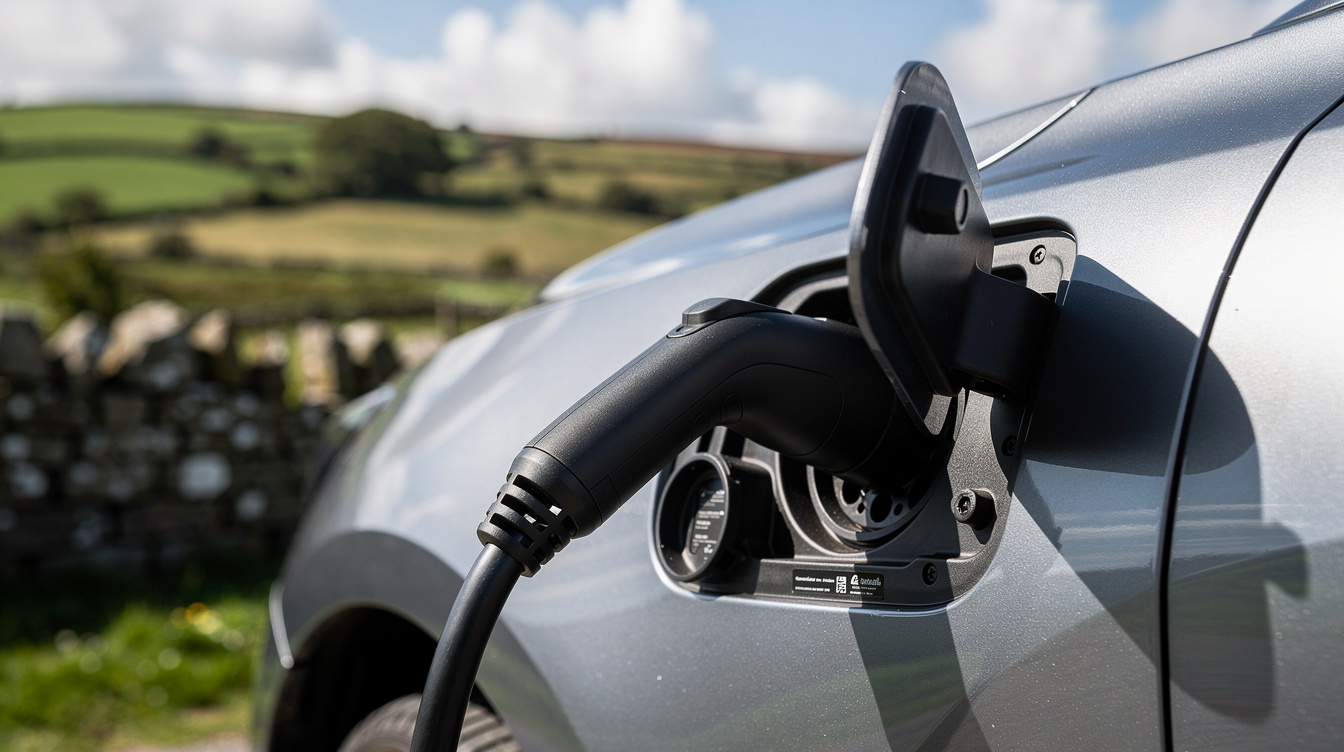
If you have solar panels (or plan to get them), do not just buy the cheapest EV charger. You need a solar-compatible smart charger that can dynamically match charging to your solar output.
| Charger | Solar Divert | Power | Price (installed) | SEAI Grant |
|---|---|---|---|---|
| myenergi Zappi | Yes (built-in) | 7.4 kW | €1,100–€1,400 | €300 |
| SolarEdge EV Charger | Yes (with SolarEdge inverter) | 7.4 kW | €1,200–€1,500 | €300 |
| Ohme Home Pro | Yes (via app) | 7.4 kW | €900–€1,200 | €300 |
| Easee Charge | Via integration | 7.4 kW | €950–€1,300 | €300 |
The myenergi Zappi is the most popular choice for solar EV charging in Ireland because its solar divert mode works out of the box with any inverter brand — no compatibility concerns. It uses a CT clamp on your meter tail to monitor surplus energy in real time.
SEAI EV charger grant: The SEAI offers a €300 grant towards the purchase and installation of a home EV charger. Your home must have been built and occupied before 2011, and the charger must be installed by a Safe Electric registered contractor.
The Full Cost: Solar + EV Charger Combined
Here is what the total investment looks like when you combine solar panels with an EV charger in 2026:
| Component | Cost | Grant | Net Cost |
|---|---|---|---|
| 6 kWp solar system (14 panels) | €8,500–€10,000 | €1,800 | €6,700–€8,200 |
| Smart EV charger (Zappi or similar) | €1,100–€1,400 | €300 | €800–€1,100 |
| Total | €9,600–€11,400 | €2,100 | €7,500–€9,300 |
Optional: add a 5 kWh battery (€3,500–€5,000) to maximise self-consumption if you charge mostly in the evenings.
Real-World Payback: Solar + EV vs. Grid + Petrol
Let us compare the total annual running costs for a household driving 15,000 km with and without solar:
| Scenario | Annual Fuel/Electricity | Annual Home Electricity | Total Annual Energy |
|---|---|---|---|
| Petrol car + grid electricity | €2,400 | €2,100 | €4,500 |
| EV + grid charging | €600 | €2,100 | €2,700 |
| EV + solar + smart charger | €250 | €1,200 | €1,450 |
Annual saving with solar + EV vs. petrol + grid: €3,050.
At a net investment of €7,500–€9,300, the combined solar + EV charger system pays for itself in 2.5–3 years when compared to a petrol car on grid electricity. Even compared to an EV charging from the grid, the solar system pays back in 5–7 years.
Calculate Your Solar + EV Savings
Use our free calculator to see how much you could save with solar panels.
Already Have Solar? How to Add EV Charging
If you already have solar panels and are buying (or have bought) an EV, here is your upgrade path:
- Check your current export levels. Log into your inverter monitoring app (SolarEdge, Enphase, Fronius, etc.) and look at how much energy you are exporting to the grid. If you are exporting 1,500+ kWh per year, you have plenty of spare solar for EV charging.
- Install a smart charger with solar divert. The Zappi is the most popular retrofit option because it works with any inverter. Budget €800–€1,100 after the SEAI grant.
- Consider adding more panels. If your roof has space and your export is low, adding 4–6 extra panels (1.5–2.5 kWp) costs €1,500–€3,000 and gives you dedicated EV charging capacity. Note: the SEAI grant only applies once per property, so this extension would not qualify for an additional grant.
Planning to Buy Both? Install Solar First
If you are considering both solar panels and an EV, install the solar first. Here is why:
- Solar savings start immediately — your panels reduce your electricity bill from day one, whether you have an EV or not
- SEAI solar grant processing takes 4–8 weeks — start this process early
- You can size the solar system for your future EV — tell your installer you are planning to add an EV so they can design a larger system
- EV charger installation is much faster — typically 2–3 hours, can be done at any time
- Your installer may offer a package deal — many Irish solar companies now install EV chargers too, and bundling can save €200–€400
What About Vehicle-to-Home (V2H)?
Vehicle-to-home technology lets your EV battery power your house — essentially turning your car into a massive home battery. Some 2026 EVs support this:
- Hyundai Ioniq 5 and Ioniq 6 — V2L (vehicle-to-load) as standard
- Kia EV6 and EV9 — V2L as standard
- BYD Atto 3 and Seal — V2L supported
- Ford F-150 Lightning — full V2H with Ford Charge Station Pro
V2L (vehicle-to-load) lets you plug appliances directly into the car via a standard socket. V2H (vehicle-to-home) is more advanced — it feeds power back through your home wiring. V2H requires a compatible bidirectional charger and is still relatively new in Ireland, but it is coming. When it matures, an EV with a 60 kWh battery could store enough solar energy to power your entire house for 2–3 days.
Frequently Asked Questions
Can I charge my EV from solar panels on a cloudy day?
Yes, but more slowly. On a typical overcast Irish day, a 6 kWp system still generates 5–15 kWh. A smart charger like the Zappi will adjust the charging rate to match whatever solar is available — even if it is only trickle-charging at 1.4 kW. Over 6–8 hours, even cloudy conditions can add 30–50 km of range.
Do I need a three-phase electricity supply?
No. Most Irish homes have single-phase, and a 7.4 kW charger works perfectly on single-phase. Three-phase is only needed for 22 kW chargers, which are typically for commercial settings and unnecessary for home solar charging.
Can I use a standard 3-pin plug to charge my EV from solar?
Technically yes — most EVs come with a granny charger that plugs into a standard socket. But a standard plug charges at only 2.3 kW, which is too slow to efficiently use solar surplus. A dedicated 7.4 kW smart charger is strongly recommended for solar integration.
What if I have solar panels but no off-street parking?
Without a driveway or garage, home EV charging is difficult regardless of solar. Your best option is Strategy 3 (export solar, buy back at night rates via public charging or workplace charging). Some apartment complexes and housing estates are now installing shared solar canopy chargers — worth checking with your management company.
How much does a home EV charger add to my electricity bill?
Without solar, an EV adds roughly €500–€1,300 per year to your bill depending on tariff and driving distance. With solar panels and a smart charger, this can drop to €100–€400 per year — you are only paying for the charging that happens outside of solar hours.
Ready to Drive on Sunshine?
Get a free quote for solar panels sized for your home and EV.
Related Articles
EV Charger + Solar Panels Ireland 2026: Combined Install Costs & Free Charging
Real 2026 Ireland costs for combined solar + EV charger install. €2,100 grant stack, best solar-diverting chargers, and how many free EV km you actually get.
Solar Carports Ireland 2026: Costs, Planning & When They Beat a Roof Install
What a solar carport really costs in Ireland in 2026, whether the SEAI grant applies, planning rules, EV charger pairing and payback maths.

Time-of-Use Tariffs & Solar Panels Ireland 2026: Smart Plans, Dynamic Rates & Battery Arbitrage
Ireland's new dynamic tariffs launched June 2026. Which smart plan matches your solar+battery setup, real savings by household, EV nightsaver tricks & mistakes to avoid.