
Solar Panels & Power Cuts in Ireland 2026: Will Yours Work During a Blackout?
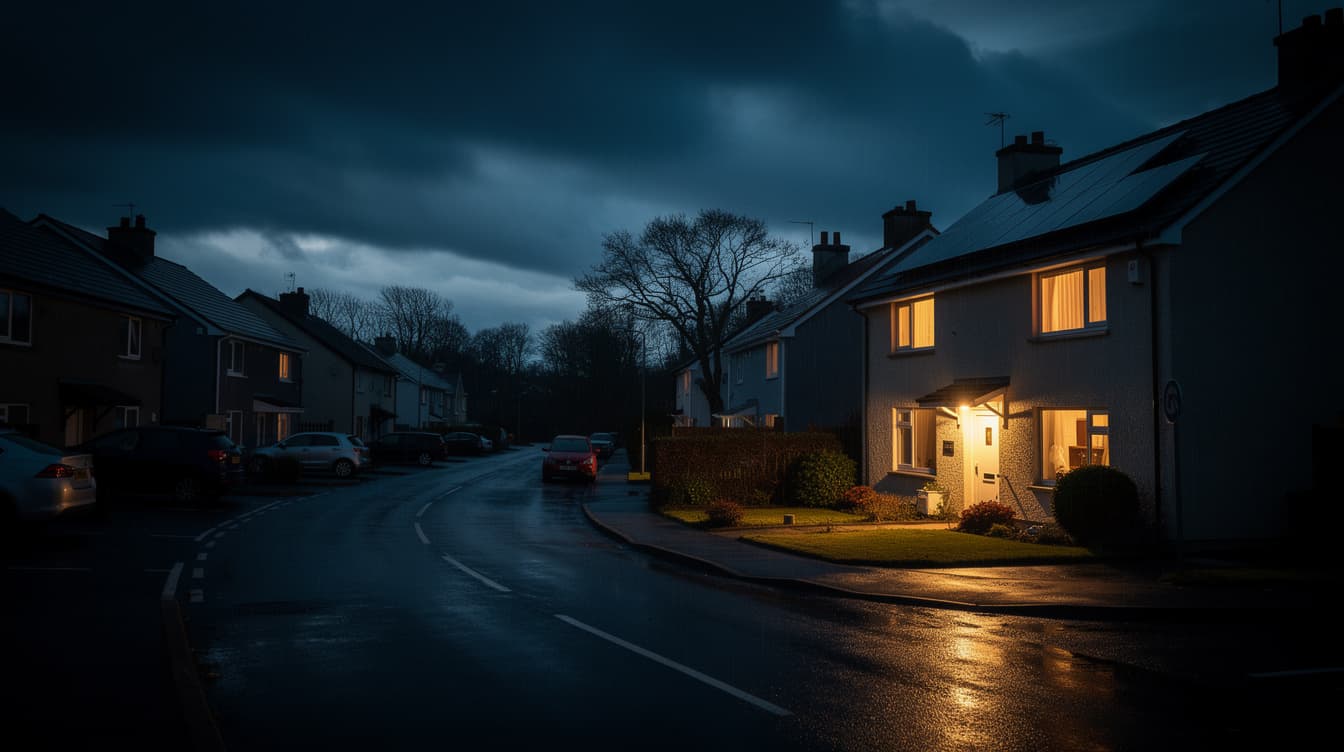
Storm Éowyn, January 2025. More than 700,000 Irish homes lost power. Rural households in Mayo, Sligo and Galway waited up to eight days for reconnection. Homeowners with solar panels on the roof watched them do absolutely nothing.
If you already have solar or you’re about to install, this is the question most Irish homeowners get wrong: will my panels power the house when the grid goes down?
The short answer for a standard grid-tied install is no. When ESB Networks loses power, your inverter shuts off within milliseconds – even if the sun is shining. That’s not a bug; it’s a legally required safety feature under the ESB Networks G99 grid code. But there’s a specific hardware choice that turns solar into real blackout protection, and it’s the fastest-growing add-on in the Irish battery market in 2026.
This guide explains exactly why grid-tied solar dies during an outage, the two backup options that actually work, real 2026 costs, and which battery brands sold in Ireland now include a proper Emergency Power Supply (EPS) or whole-home backup gateway.
Why a Standard Grid-Tied Solar System Shuts Off During a Blackout
Every solar inverter installed in Ireland must comply with the ESB Networks Distribution Code and, for residential systems above 6 kVA and all new installs since 2021, the G99 protection standard. Both mandate anti-islanding: if the grid voltage or frequency disappears, the inverter must disconnect within 200 milliseconds and stay off until the grid is stable again.
Why? Because a solar inverter pushing power into a “dead” grid could electrocute the ESB Networks engineer who’s just climbed the pole at the top of your road to fix a downed line. This isn’t optional or configurable – it’s baked into every certified inverter sold in Ireland.
Consequences of anti-islanding for you as a homeowner during a power cut:
- Panels are still generating (invisibly) but the inverter refuses to deliver anything to the house.
- No electricity to the sockets, the boiler pump, the fridge or the broadband router.
- No charging of your solar battery from the panels (in most standard installs).
- System won’t restart until ESB Networks restores the supply and holds it stable for the inverter’s reconnection timer (typically 60–300 seconds).

The Two Ways Solar Actually Works During a Blackout
To keep any part of your house running from your panels during a grid outage, you need hardware that can safely form its own mini-grid. Two setups do this – and only two:
Option 1: Battery + Hybrid Inverter with EPS (Emergency Power Supply)
The most common setup in Ireland in 2026. A hybrid inverter (which combines the solar inverter and battery charger in one unit) has a dedicated EPS output socket – usually a single 13A socket on the wall next to the inverter, or a small dedicated circuit wired to a few essential outlets. When the grid drops, the inverter isolates itself from the grid, then powers only that EPS circuit from the battery. The panels continue to charge the battery during daylight.
What it powers: Whatever you plug into that EPS socket – typically a fridge, a router, a phone charger, LED lights via extension lead. Not the whole house.
What it costs to add: If you’re specifying a battery from scratch and choose a hybrid inverter with EPS built in, the cost premium over a non-EPS version is roughly €0 to €300. It’s essentially a spec choice at install time.
Option 2: Battery + Whole-Home Backup Gateway
A backup gateway (Tesla’s name for it; GivEnergy calls it a “whole-home backup box”) is a bigger, smarter transfer switch installed at the mains consumer unit. When the grid drops, it disconnects your entire property from ESB Networks in milliseconds and hands the load over to the battery, powering some or all of your normal house circuits.
What it powers: Selected circuits (typically lighting, fridge/freezer, sockets, boiler pump) or the whole house depending on how it’s wired. High-current loads like electric showers, hobs and EV chargers usually get isolated on backup mode to protect the battery.
What it costs to add: Roughly €1,500–€3,000 on top of the battery cost, including gateway hardware and additional consumer-unit work. Most installers in Ireland now quote this as an optional line item.
Want Solar That Keeps the Lights On?
Get a free quote from SEAI-registered installers who can spec a hybrid inverter with EPS or a whole-home backup gateway.
Which Battery Systems Sold in Ireland Actually Support Backup?
Here’s the honest state of the Irish 2026 battery market. Not every battery sold as “backup capable” delivers the same experience – there are meaningful differences in switchover time, load capacity, and whether the panels keep charging while off-grid.
| Battery System | Backup Type | Continuous Output | Switchover Time |
|---|---|---|---|
| Tesla Powerwall 3 | Whole-home via built-in gateway | 11.5 kW | < 40 ms |
| GivEnergy AIO 13.5 + Backup Box | Whole-home or partial with backup box | 6.0 kW | < 20 ms |
| Huawei LUNA S1 + Backup Box B0 | Whole-home (partial recommended) | 5.0–10.0 kW (inverter dependent) | < 20 ms |
| SolaX Triple Power / X3-Hybrid | EPS socket (partial) | 3.0–6.0 kW | < 100 ms |
| Sunsynk Ecco / 5 kW Hybrid | EPS socket (partial) | 5.0 kW | < 50 ms |
| GoodWe ET / EM series | EPS socket (partial) | 3.0–5.0 kW | < 50 ms |
| Sigenergy SigenStor | Whole-home or EPS | 6.0–12.0 kW (module scaled) | < 20 ms |
The critical spec most homeowners miss when quoting is continuous output. A 5 kW EPS output copes with a fridge (150 W), lights (200 W), a router (10 W), a kettle (2,200 W) and a laptop (60 W) – a total of ~2.6 kW, well within limits. But an electric shower (8,500 W) or an induction hob at full tilt (7,000+ W) will trip the EPS instantly. Ask your installer to list the loads you can and can’t run on backup.
How Long Can Solar + Battery Actually Keep My House Running?
Runtime depends on three variables: battery kWh, the loads you leave switched on, and how much solar top-up you get during daylight while off-grid.
Here’s a realistic worked example for a typical January outage in Ireland – the worst-case month for solar generation:
| Setup | Essentials Load (per day) | Solar Top-Up (Jan avg) | Runtime on Battery |
|---|---|---|---|
| 5 kWh battery + 4 kWp panels | 4 kWh (fridge, lights, router, kettle x2) | ~2 kWh | Indefinite in daylight; battery depletes on cloudy days after ~30 hours |
| 10 kWh battery + 5 kWp panels | 6 kWh (add TV, oven cycle) | ~3 kWh | Indefinite in daylight; 3–4 days rolling on mixed weather |
| 13.5 kWh battery + 6 kWp panels | 10 kWh (whole home except shower/hob) | ~3.5 kWh | Indefinite in daylight; ~2 days rolling on cloudy weather |
The critical realisation from these numbers: even a modest battery lets a home ride through a multi-day outage in daylight hours, because the panels top up the battery each day. Where it gets tight is a run of very dark December/January days – the exact conditions that also cause storm outages. Sizing the battery for 1.5–2 days of essential-only loads gives you a comfortable margin.
Ireland’s 2025–2026 Storm Outage Reality
Ireland’s grid is more exposed to storm damage than many EU countries: 22% of the ESB Networks distribution network is overhead line, mostly in rural areas. Since 2020 that has translated into a run of multi-day outages that homeowners now factor into their solar decision.
- Storm Éowyn (January 2025): Peak of 725,000 customers without power. Some rural Mayo, Sligo, Galway and Donegal households were 8+ days without reconnection.
- Storm Bert (November 2024): Peak of 158,000 without power; 4–5 day outages in parts of the West.
- Storm Debi (November 2023): 234,000 customers off; some rural outages ran 3–4 days.
ESB Networks’ own strategic plan for 2026–2030 forecasts continued increases in high-impact storm events driven by warmer North Atlantic sea temperatures. In other words: this isn’t a one-off. Rural households in particular have shifted from “backup is nice-to-have” to “backup is standard spec” on new solar quotes.
Retrofit: Can I Add Backup to Existing Solar Panels?
Yes, but it’s more expensive and more disruptive than specifying it up-front. Two paths:
- Replace your existing string inverter with a hybrid inverter + battery. This is the cleanest solution technically. Your existing panels re-wire onto the new hybrid, and you add a battery with EPS or backup gateway. Typical total cost: €5,500–€9,500 depending on battery size. The old inverter can often be sold second-hand to recover ~€300–€500.
- Add an AC-coupled battery with its own inverter and backup gateway. Simpler retrofit – keeps your existing solar inverter and bolts on a separate battery/inverter with backup. Slightly less efficient (a few % round-trip loss) but cheaper labour. Typical cost: €5,000–€8,500.
Either way, an ESB Networks NC6 notification refresh is required if your total inverter output changes. Your installer handles the form. See our NC6 guide for the process.
What About a Generator Instead?
A common alternative in rural Ireland: a small petrol or diesel generator for storm outages. Here’s how it stacks up against a solar-plus-battery backup:
| Factor | Generator (5 kW petrol) | Solar + Battery + Backup |
|---|---|---|
| Upfront cost | €700–€2,500 | €5,000–€9,500 |
| Fuel dependency | Yes – needs petrol/diesel stockpile | No – refuels itself from panels |
| Everyday value | Zero – sits idle 99% of the time | Saves €900–€1,300/year on bills |
| Noise / emissions | Very loud, exhaust fumes | Silent, zero emissions |
| Grant available | No | €1,800 SEAI Solar PV grant |
| Reliability after 5 years | Often unreliable if not serviced | Battery under warranty 10 years |
The tidy answer: if you already want solar for the bill savings, adding backup capability is an incremental €500–€3,000 depending on setup, and it dwarfs a standalone generator in everyday value. If you don’t want solar at all and just need occasional backup, a generator is cheaper – but the last five winters have shown how frustrating a fuel-dependent solution becomes during real multi-day rural outages.
What About Simply Charging an EV to Run the House?
A few homeowners ask about V2H (vehicle-to-home) – using their EV battery as house backup. As of mid-2026 only a handful of EVs sold in Ireland support bidirectional charging with V2H hardware (Nissan Leaf/Ariya, Kia EV6 GT-Line, VW ID.4 with the latest 3P firmware, MG4 XPower on certain configs). ESB Networks has approved trials but no full retail V2H rollout yet. Realistic homeowner path in 2026 is still a dedicated home battery.
Frequently Asked Questions
Do my panels charge the battery during a power cut?
Yes, on any properly specified hybrid inverter or backup gateway system – the inverter forms its own local grid so the panels continue producing and topping up the battery. On some older AC-coupled setups without a compatible backup box, panels stop producing when the grid goes down. Confirm this with your installer explicitly.
How fast does backup kick in when the grid drops?
Modern Irish-market batteries switch over between 20 ms and 100 ms – fast enough that computers keep running, TVs stay on, and boiler timers don’t reset. A generator, by contrast, takes 5–20 seconds to auto-start (if it’s wired for auto-start) or several minutes to start manually.
Will my broadband work during a power cut?
Your router yes, on backup – but the local fibre or cable exchange also needs power. Eir, Vodafone and Virgin Media exchanges typically have 6–24 hours of battery backup, then depend on ESB restoring supply. In a multi-day outage broadband usually drops after ~1 day even with your house running.
Can I use my solar in an outage without a battery?
Almost never, in a residential Irish install. Only very rare “secure power supply” inverters (SMA Sunny Boy models were the classic example) can output limited power directly from panels during a grid outage – and even then only when the sun is fully out, output is capped at ~2 kW, and it’s not suitable for continuous use. Vanishingly few Irish installers stock these now.
Does the SEAI grant cover backup capability?
The SEAI Solar PV grant (up to €1,800) applies to the solar system itself. It does not separately fund the battery, the backup gateway, or an EPS-capable inverter – but the underlying system it supports still qualifies as long as it meets SEAI’s standard eligibility. See our grant eligibility checker to confirm.
Do I need planning permission for a home battery?
No. Home batteries installed indoors (typically utility rooms, garages, or under-stairs cupboards) don’t require planning. Outdoor batteries fall under the same solar-adjacent exemptions as inverters. Confirm with your installer that the location complies with manufacturer install guidance for ventilation and clearances.
Can I add backup to a leased or PPA solar system?
Only with the panel-owner’s consent, since it modifies the inverter setup. In practice most PPA operators either refuse or charge substantial fees. If you’re still under a PPA, this is a strong argument for buying out the contract before adding backup.
Ready to Keep the Lights on Through the Next Storm?
Get a free quote from SEAI-registered installers for solar + battery + backup, sized to your household loads.
Last updated: July 2026. Storm outage figures reflect ESB Networks published reports. Battery specifications reflect Irish retail data sheets as of Q2 2026.
Related Articles
Solar Battery Brands Ireland 2026: Tesla Powerwall 3 vs BYD vs Pylontech vs Sigenergy vs Sunsynk Compared
Compare Tesla Powerwall 3, BYD, Pylontech Force H2, Sigenergy and Sunsynk for Irish homes in 2026: installed prices, warranties, cycle counts, backup and V2G.
Solar Battery Sizing Ireland 2026: 5kWh vs 10kWh vs 15kWh Framework
How to size a home solar battery in Ireland 2026. Real payback maths for 5, 10, 15 kWh options, the evening-kWh rule, and the mistakes that cost you thousands.
Best Solar Setup Ireland 2026: Complete System Design Guide
The best solar setup for Ireland 2026 — panels, inverter, battery, diverter and installer — with 4 real-world configurations, prices and paybacks.