
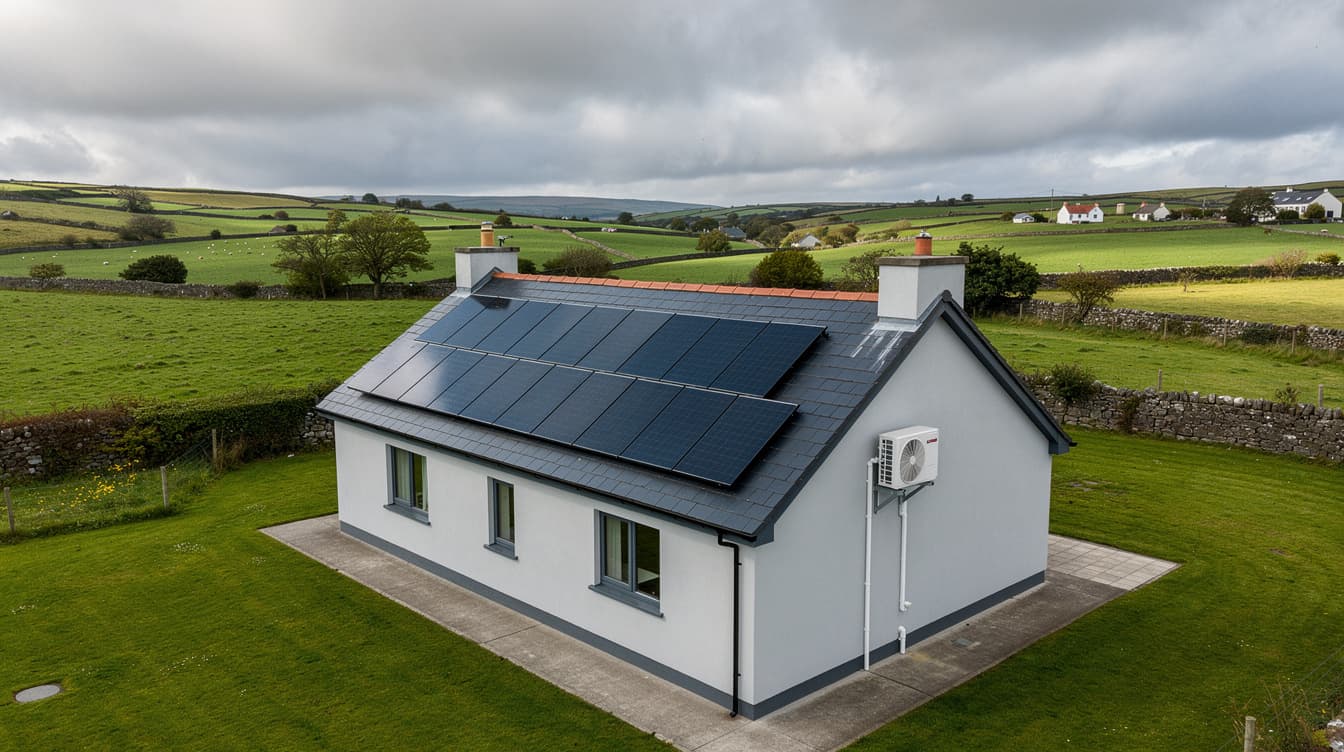
Best Heating System to Pair With Solar Panels Ireland 2026: Heat Pump vs Gas vs Oil vs Infrared
Your solar panels make electricity. Your heating system spends it – or spends gas, or spends oil, or spends kerosene. The single biggest decision that determines how much of your solar production you actually use (rather than exporting to the grid at 20–24c/kWh) is which heating system sits underneath the panels.
This guide ranks every heating system available in Ireland in 2026 by how well it pairs with a home solar array. Real running costs, real payback figures, real SEAI grant stacks – and the specific pairings that make sense for different Irish house types.
The 30-second answer
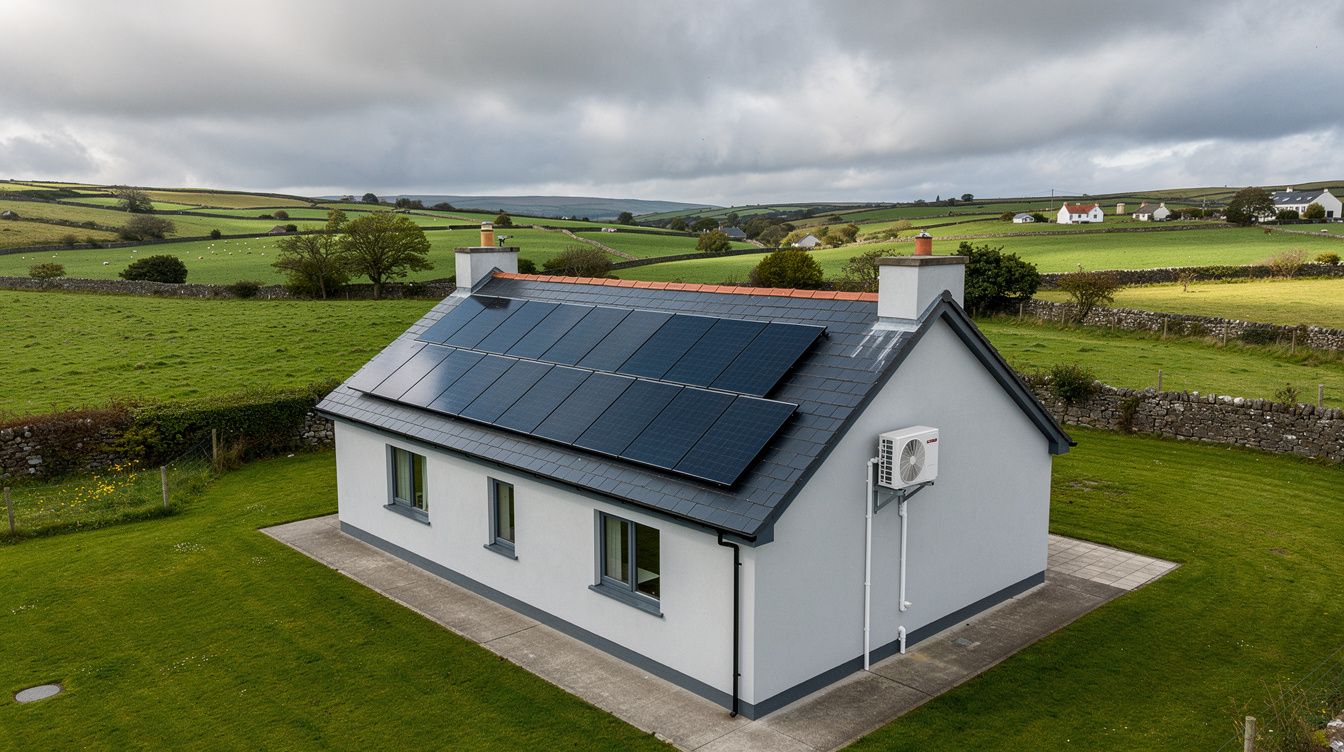
For most Irish homes going solar in 2026, an air-to-water heat pump is the best-matched heating system – it turns 1 kWh of your solar electricity into roughly 3–4 kWh of heat, cuts total household energy bills by 60–80%, and stacks a €6,500–€7,500 heat pump grant on top of your €1,800 solar grant.
But heat pumps aren't right for every house. Here's how the alternatives compare when solar is already on the roof:
| Heating system + 4 kWp solar | Annual heating cost (typical 3-bed) | Solar “fit” | SEAI grants available |
|---|---|---|---|
| Air-to-water heat pump | €600–€1,100 | Excellent | €1,800 PV + €6,500–€7,500 HP |
| Air-to-air heat pump | €450–€900 | Excellent (but no hot water) | €1,800 PV only |
| Gas boiler + solar diverter | €1,200–€1,900 | Good (hot water only) | €1,800 PV only |
| Oil boiler + solar diverter | €1,700–€2,600 | Weak (hot water only) | €1,800 PV only |
| Infrared heating panels | €1,400–€2,400 | Fair (mostly winter, mostly night) | €1,800 PV only |
| Storage heaters (NightSaver) | €1,100–€2,000 | Poor (charges 2–8am) | €1,800 PV only |
| Direct electric only | €2,200–€3,800 | Poor (heating needed when sun isn’t out) | €1,800 PV only |
Numbers assume a 130 m² 3-bed semi with B3 BER, standard 24-hour tariff plus solar self-consumption where relevant. Sources: SEAI heat pump grant scheme (updated Feb 2026), Bord Gáis / Electric Ireland residential tariffs (July 2026), CSO household energy data.
Why the “heating pairing” question matters more than the panels
A 4 kWp solar system in Ireland generates about 3,600–4,000 kWh/year. Roughly 30–45% of that lands on your appliances directly (a “self-consumption” figure); the rest exports to the grid for 20–24c/kWh under the Clean Export Guarantee.
Your heating system decides that self-consumption rate. Consider two identical 4 kWp installs:
- House A – gas boiler, solar diverter for hot water. Self-consumption ~35%. Direct solar value: €350/yr. Export: €450/yr. Total solar benefit: €800/yr.
- House B – air-to-water heat pump on a smart tariff. Self-consumption ~55%. Direct solar value: €750/yr (heat pump consumes 4,000–6,000 kWh electricity/yr for heating). Export: €250/yr. Total solar benefit: €1,000/yr – plus the heat pump itself replaces a €1,800–€2,500 oil bill with €600–€1,100 in electricity.
Same panels, same roof, same weather. But House B saves roughly €2,000/year more on total energy bills because the heating system was chosen to consume solar – not fight it.
Ready to Go Solar?
Get your free personalised quote from SEAI-registered installers.
1. Air-to-water heat pump + solar – the gold standard
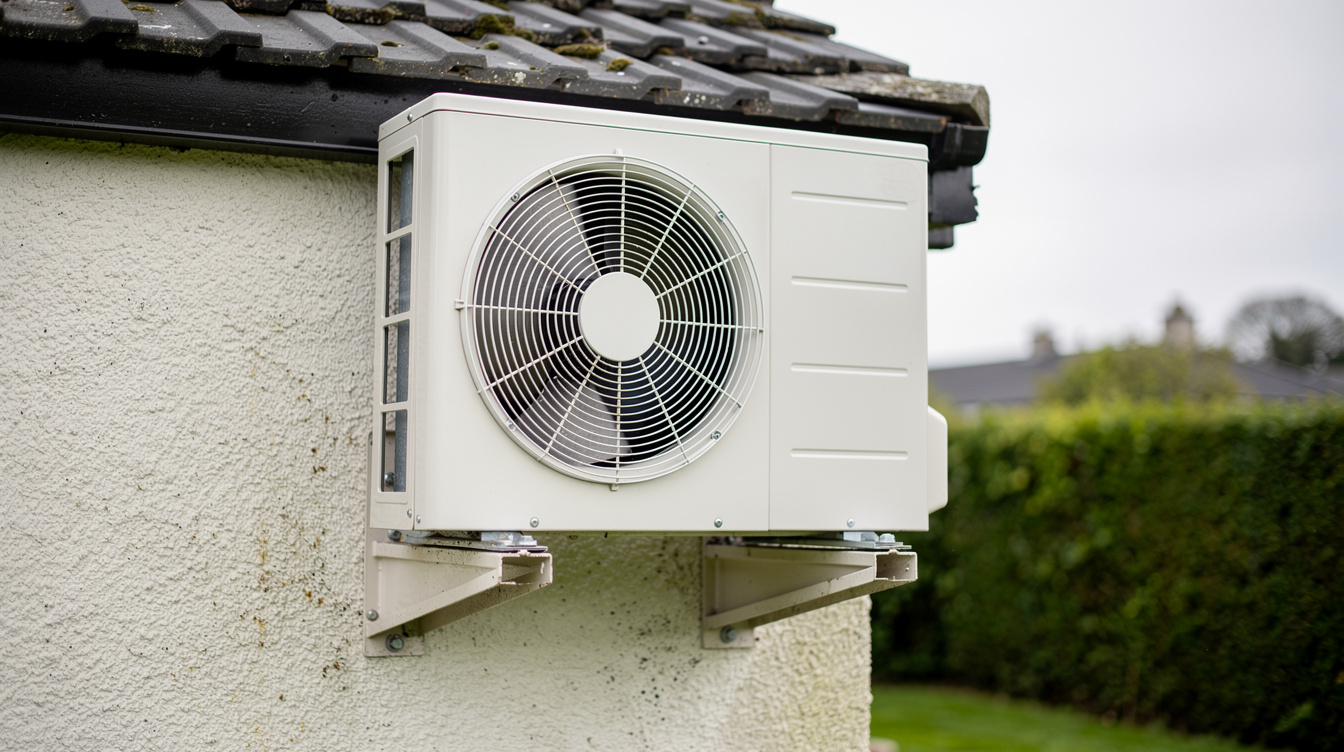
An air-to-water (A2W) heat pump takes ambient outdoor heat and delivers it through your existing radiators or underfloor heating. It also produces domestic hot water. In Ireland’s mild-winter climate a well-installed A2W unit hits a seasonal Coefficient of Performance (SCOP) between 3.0 and 4.2 – every 1 kWh of electricity becomes 3–4 kWh of heat.
Why it pairs perfectly with solar
- Heat pumps run all day (unlike gas boilers that fire in short bursts), so they can “soak up” midday solar generation.
- Hot water tank charging can be scheduled for peak solar hours (11am–3pm) using the heat pump’s built-in timer.
- Total annual electricity use jumps from ~4,000 kWh to 8,000–12,000 kWh, meaning a 4–6 kWp array almost never overproduces.
Real 2026 running costs
A 130 m² B3 semi in Ireland uses about 12,000 kWh/yr of heating and hot water energy. Split by source:
- Oil (900L @ €1.15/L): ~€1,900/yr in oil
- Gas (12,000 kWh @ 9.5c/kWh): ~€1,300/yr in gas (plus €250 standing charge)
- Heat pump (4,000 kWh electric @ 32c/kWh standard): ~€1,280/yr
- Heat pump + 4 kWp solar + smart tariff: ~€600–€900/yr
Total install cost (2026, Ireland)
- A2W heat pump 8–12 kW: €15,000–€22,000 before grant
- SEAI Heat Pump Grant (technical assessment first): €6,500–€7,500
- Net cost of heat pump: €8,000–€14,500
- Add 4 kWp solar + battery: €8,500–€11,000 net after €1,800 PV grant
Combined out-of-pocket investment: €16,500–€25,500. Combined annual saving over oil + no-PV baseline: €2,000–€3,500. Payback: 7–12 years.
Where it doesn’t work
Heat pumps need a “heat-pump-ready” house: BER of at least B3 (ideally B2 or A), oversized rads or underfloor, a decent buffer/water tank, and enough electrical headroom (usually fine on single-phase 63A, but check). A poorly insulated Victorian terrace with cast-iron rads is not a heat pump job – look at gas or oil + hot water diverter instead.
2. Air-to-air heat pump + solar – the flat-and-apartment special
Air-to-air (A2A) units are the “split” systems you see on Mediterranean holidays: wall-mounted indoor cassette + outdoor condenser. In heating mode a modern A2A unit hits an SCOP of 3.5–4.5 – higher than A2W because there’s no water loop to lose heat in.
Best fit for
- Apartments and duplexes where plumbing a wet system is impractical
- 2-bed bungalows and dormers where one or two indoor units cover the whole floor plan
- Extensions, converted garages, home offices as a top-up to gas central heating
Solar pairing notes
A2A units draw 500W–2,000W each when running – a near-perfect match for a mid-size solar array’s midday output. But A2A doesn’t produce hot water, so you still need an immersion (add a solar diverter) or a gas combi boiler alongside.
Install cost: €2,500–€5,000 for a single-zone install, €6,000–€10,000 for a whole-house multi-split. No SEAI grant for A2A (only A2W qualifies), but the low upfront cost means payback of 6–10 years even without support.
3. Gas boiler + solar diverter – the pragmatic upgrade
If you’re on the gas network and your boiler has 5+ good years left in it, don’t rip it out. Add solar + a €300–€500 solar diverter (Eddi, iBoost, or Solic 200) that dumps excess solar production into your hot water immersion instead of exporting to the grid.
What you save
- Diverter offsets 60–80% of your gas hot water demand from March–October
- Typical Irish home uses ~2,500 kWh/yr of gas for hot water = ~€240/yr
- Diverter recovers €150–€200/yr in avoided gas – plus the same energy that would’ve exported at 20c/kWh
- Total diverter payback: 2–3 years
Should you swap the gas boiler for a heat pump?
Only if: (a) it’s 15+ years old and near end of life, (b) you’re doing a deep retrofit anyway, or (c) gas prices spike hard (2022-style). At current gas rates and current heat pump install costs, a 5-year-old A-rated combi boiler + solar + diverter is often the better financial choice.
Where gas + solar wins outright
City-centre terraces and Victorian semis where the retrofit gap to a heat pump is €20k+ (external wall insulation, new emitters, hot water cylinder). Solar + diverter cuts the household energy bill by 25–35% for €9,000 all-in, without touching the boiler.
4. Oil boiler + solar – the “how do I get off oil” problem
Roughly 600,000 Irish homes still burn kerosene. In 2026, a full 900-litre tank fill is €1,000–€1,150 and most rural 3-beds burn 900–1,400 litres a year. Oil is the most expensive heating fuel per kWh in Ireland after direct electric.
The honest recommendation
If you have oil now and are going solar, plan the exit. A solar diverter on the oil boiler’s hot water immersion saves €200–€300/yr – useful, not transformative. The real move is:
- Install solar this year (grants, quick payback, no disruption)
- Use year 1 to insulate: attic, cavity, EWI if solid wall. Get to B3 BER or better.
- Once B3+, apply for the SEAI heat pump grant (technical assessment required)
- Swap the oil boiler for an A2W heat pump – solar array is already there to feed it
Total programme: €25,000–€40,000 out of pocket, €15,000–€20,000 in stacked SEAI grants (solar + heat pump + insulation), €2,000–€3,000 annual saving vs oil-only baseline. Payback 10–15 years, but the house is transformed and adds 2–3 BER grades (roughly €25k–€40k of resale value).
5. Infrared heating panels + solar – the marketed “perfect match” (that mostly isn’t)
Infrared panel salespeople love to say “pair them with solar for free heat!”. The maths doesn’t back it up in Ireland.
Infrared panels convert 1 kWh of electricity into 1 kWh of heat – there’s no COP multiplier. When it’s coldest (December, January, 8am and 6pm), your panels are producing 200–600W total, which won’t even run one 800W infrared panel. So the electricity for heating is coming from the grid at 30–40c/kWh, not from your roof.
Where infrared + solar can make sense
- Shoulder-season top-up: heating a home office in April/September when the array is producing 2–3 kW and you don’t want to fire the boiler
- Zoned rooms in a large house where central heating is overkill for one occupant
- Well-insulated new-builds where the total heating demand is tiny (under 30 kWh/m²/yr)
Anywhere else, treat infrared panels as supplementary, not primary heat.
6. Storage heaters (NightSaver) + solar – timing mismatch
Storage heaters charge on the Electric Ireland NightSaver rate between 2am and 8am (or ESB Networks equivalent windows). Solar produces zero in that window. So there’s no direct pairing benefit – your solar generation and your storage heaters never meet.
If you already have storage heaters:
- Keep them for space heating on the night rate (currently ~14c/kWh vs 32c day rate)
- Use solar to run everything else during the day (appliances, hot water via diverter, EV)
- Plan to migrate to a heat pump within 5–7 years if the fabric supports it
7. Direct electric (panel heaters, oil-filled rads) + solar – the last resort
The worst pairing on paper: heating demand highest when solar output lowest. In practice, direct electric heating is only worth it if:
- You’re in a very small dwelling (studio, mobile home, granny flat)
- Your grid tariff is the cheapest available and you have battery storage to arbitrage day/night rates
- You’re heating an outbuilding that’s only used intermittently
Everyone else: upgrade to a heat pump or, at minimum, a modern A-rated gas combi with a solar diverter.
The SEAI grant stack – how much can you actually claim in 2026?
| Measure | 2026 SEAI grant | Combined with solar? |
|---|---|---|
| Solar PV (up to 4 kWp) | €1,800 | — |
| Air-to-water heat pump | €6,500–€7,500 | Yes (via One Stop Shop or Individual Measure) |
| Heat pump technical assessment | €200 | Yes |
| Attic insulation | €1,300–€1,700 | Yes |
| Cavity wall insulation | €800–€1,700 | Yes |
| Full deep retrofit (One Stop Shop) | Up to €28,750 (avg €18k–€25k) | Yes (solar included in package) |
A homeowner going solar + heat pump + attic + cavity through the One Stop Shop route in 2026 typically claims €12,000–€18,000 in combined SEAI supports, on total works of €35,000–€50,000.
Which pairing is best for your house?
The 1970s–80s 3-bed semi (most common Irish home)
Best pairing: Solar + gas boiler + solar diverter today, plan heat pump swap in 3–7 years after insulation upgrades. Immediate spend: €9,000–€11,000. Annual saving: €900–€1,400.
The 1990s–2000s A/B-rated detached
Best pairing: Solar + air-to-water heat pump straight away. Immediate spend: €18,000–€26,000 net of grants. Annual saving: €2,000–€3,500.
The new-build A2/A1 estate house
Best pairing: Almost certainly already has an A2W heat pump. Add 4–6 kWp solar + 5–10 kWh battery for €8,500–€12,000. Annual saving: €1,200–€1,800.
The rural bungalow on oil
Best pairing: Solar + diverter now (€9,000), insulate over 12–18 months, then heat pump. Total programme €30,000–€40,000 out of pocket. Cuts total energy bill from €3,500/yr to €800–€1,200/yr.
The city terrace / Victorian semi
Best pairing: Solar + gas + diverter, skip the heat pump unless deep retrofit is on the table. The fabric doesn’t support a heat pump economically without major external wall insulation.
The apartment or duplex
Best pairing: Solar (if roof rights allow) + air-to-air heat pump for space heating + immersion + solar diverter for hot water. Total spend: €12,000–€18,000.
Not sure which pairing suits your home?
SEAI-registered installers will assess your house and price both solar + heat pump options.
Tariff strategy – the missing ingredient
Your heating system pairing is only half the equation. Which electricity tariff you’re on decides the rest.
Standard 24-hour tariff
Simplest. Works fine with solar + heat pump if the heat pump is set to run heavily 10am–4pm.
NightSaver (day/night)
Good for storage heaters and immersion tanks charging on night rate. Solar pairing weaker – you’re losing the daytime price advantage.
Smart / time-of-use tariffs (Electric Ireland Home Electric+, Bord Gáis Clean Energy, Energia Smart Data, SSE Airtricity Smart)
Best fit for solar + heat pump homes in 2026. Cheap 2–5am window for battery/EV charging, expensive 5–7pm peak (avoid heavy loads), and reasonable daytime rate that the solar array offsets. Typical setup:
- Heat pump programmed to charge hot water 11am–3pm (solar peak)
- Battery charges from grid 2–5am at ~14c/kWh
- Battery discharges 5–7pm at ~45c/kWh peak-rate avoidance
- EV charges from surplus solar first, grid overnight second
See our full time-of-use tariffs guide for the current 2026 smart plans compared.
Frequently asked questions
Is a heat pump worth it if I’m getting solar panels?
Yes – more so than without solar. A heat pump doubles or triples the amount of solar production you use directly (self-consumption), and solar cuts the heat pump’s only running cost (electricity) by 30–50%. Together they’re the biggest single household energy upgrade available in Ireland in 2026.
Can I get the SEAI heat pump grant and the solar PV grant on the same house?
Yes. They’re separate schemes with separate applications. Both can be claimed within the same 12-month period. Many installers now offer “bundle” quotes covering both.
Do I need a bigger solar array if I’m adding a heat pump?
Not necessarily, but bigger helps. A pre-heat-pump home usually maxes out at 4 kWp; add a heat pump and 6 kWp becomes the sweet spot. The extra 2 kWp costs about €2,000 net and adds ~1,800 kWh/yr of generation – roughly enough to cover the heat pump’s summer electricity demand entirely.
Will a heat pump work in Ireland’s climate?
Yes. Modern A2W heat pumps hold performance down to −7°C (Ireland’s coldest week is typically −2°C to −5°C). Over 100,000 Irish homes now have heat pumps installed, most in new-builds under Part L building regulations.
Is a solar diverter worth it if I’m getting a heat pump?
No. Air-to-water heat pumps handle hot water via their own hot water cylinder, and you schedule that cylinder to charge during solar peak. A separate immersion diverter is redundant on a heat pump home.
What if I have gas but plan to switch to a heat pump in 5 years?
Install solar now – grants and payback don’t improve by waiting. Add a €300 solar diverter to the existing gas hot water cylinder for the interim years. When the heat pump goes in, the diverter can be repurposed for EV charging or removed.
What about hydrogen boilers?
Ireland has no timeline for hydrogen in the domestic gas network before 2035, and cost per kWh is projected to be 2–3× current natural gas. Ignore it for household planning today.
Do I need three-phase power for a heat pump?
Usually no. Domestic A2W heat pumps up to 12 kW run on single-phase 63A supplies. Very large units (16 kW+) may need three-phase; check with your installer and see our three-phase solar guide if your house already has three-phase.
The bottom line
If you’re quoting for solar in 2026 and you’re on gas, install solar with a diverter and keep the boiler until it dies naturally. If you’re on oil, install solar this year and plan the heat pump within 24 months. If you’re in a new B-or-better home, install solar and heat pump together as one project. If you’re in a Victorian terrace or older solid-wall home, solar + gas + diverter is genuinely the right long-term answer.
The single biggest mistake in 2026 is picking heating and solar as separate decisions. They’re one system – and the pairing you choose will determine 60–80% of your household energy bills for the next 20 years.
Get quotes for solar + heat pump together
Our SEAI-registered network prices both together, so you see the real combined payback – not two separate quotes that don’t add up.
Related Articles
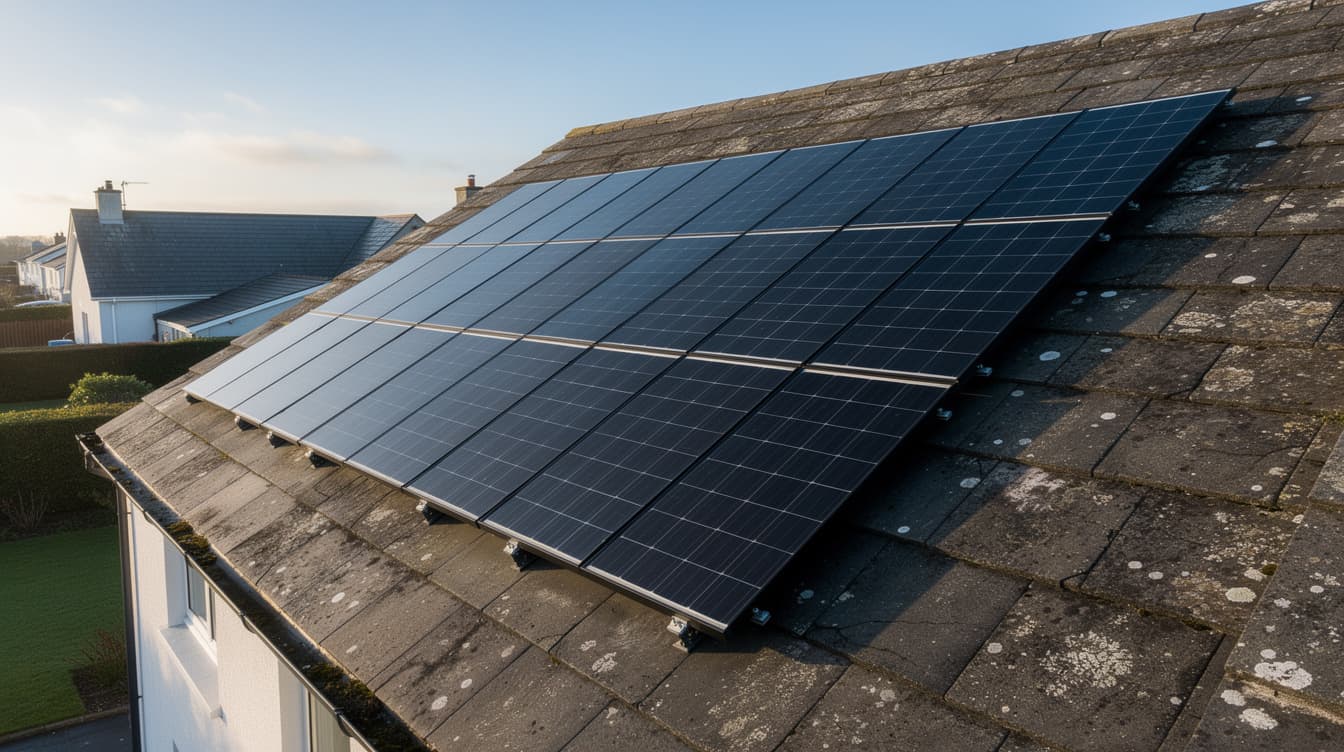
How Many Solar Panels Do You Need Ireland 2026: Panel Count vs kW Explained
How many solar panels for a 4kW, 5kW, 6kW or 10kW Irish home in 2026: panel-count tables, real prices per tier, roof area, NC6 limits and battery sizing.
Best Solar Setup Ireland 2026: Complete System Design Guide
The best solar setup for Ireland 2026 — panels, inverter, battery, diverter and installer — with 4 real-world configurations, prices and paybacks.
20 Solar Panels Ireland 2026: Cost, Output, Battery & Payback
What 20 solar panels cost in Ireland 2026 (€12.7-18.6k net after grant), 7,600-8,100 kWh output, roof space, battery choice and payback vs 10 or 14 panels.