
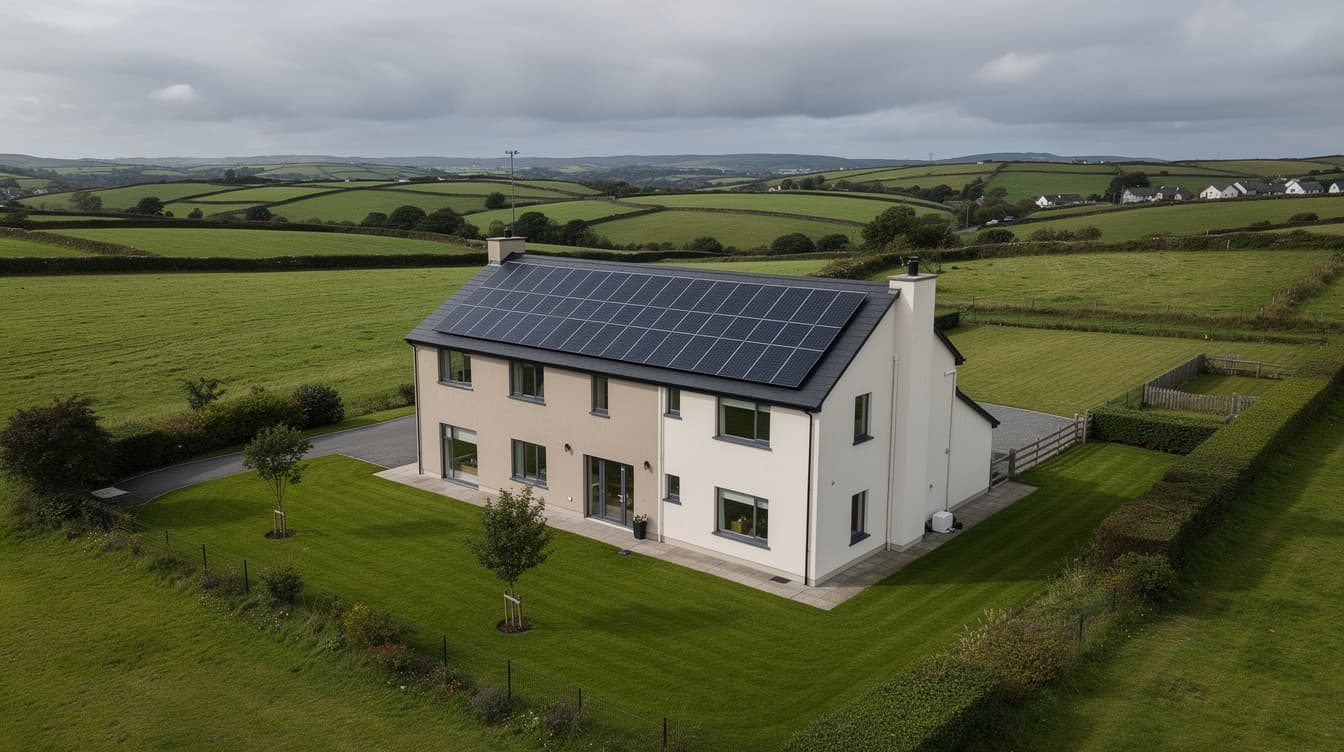
20 Solar Panels Ireland 2026: Cost, Output, Battery & Payback
Twenty panels is the upper end of a “normal” Irish home install — the point where you leave the SEAI grant behind, cross the informal 6 kWp threshold that anchors most of our 12- and 14-panel guides, and start needing a bit more thought around inverter sizing, ESB paperwork and export planning. But for 4 + bed detached homes, homes with a heat pump, or households running two EVs, it’s often exactly the right count — and it’s the quickest way to future‑proof a roof if you know you’re moving toward all‑electric.
This 2026 guide covers what 20 solar panels actually cost in Ireland (August 2026 pricing), realistic month‑by‑month output for the 8.8 kWp array size, whether it’s worth going bigger than 14 or 16, how the SEAI grant caps interact, and which battery / diverter setups make the extra panels pay back fastest.
What does a 20-panel solar system cost in Ireland in 2026?
Twenty 440 W panels gives you an 8.8 kWp array. That’s well above the 6 kWp SEAI grant cap (which pays a flat €1,800 no matter the size, on any array 2 kWp or larger) and above the 6 kW inverter threshold that keeps you inside ESB Networks’ NC6 notification‑only pathway on single phase. Typical August 2026 all‑in installed pricing, from SEAI‑registered installers:
| Setup | Gross price | After €1,800 SEAI grant |
|---|---|---|
| 20 × 440 W panels + 6 kW hybrid inverter (no battery) | €13,400 – €15,600 | €11,600 – €13,800 |
| 20 panels + 5 kWh LiFePO₄ battery | €15,800 – €17,900 | €14,000 – €16,100 |
| 20 panels + 10 kWh battery (most‑paired option 2026) | €17,900 – €20,400 | €16,100 – €18,600 |
| 20 panels + 10 kWh battery + MyEnergi Eddi diverter | €18,600 – €21,300 | €16,800 – €19,500 |
Two things push the price a notch above the linear scale you might expect coming from a 14‑panel quote:
- You almost always need a 6 kW hybrid inverter (rather than 5 kW), and often two MPPT strings if the 20 panels span two roof pitches. That’s an extra €300–550 on the inverter line.
- Scaffolding and safety costs don’t double when you go from 14 to 20 panels — but they do tick up, especially on two‑pitch installs where the crew needs access to both slopes.
Ready to Go Solar?
Get your free personalised quote from SEAI-registered installers.
How much roof space do 20 solar panels need?
A single 440 W panel in the 2026 residential market is typically around 1.13 m × 1.72 m — roughly 1.95 m² each. Twenty panels therefore need about 39 m² of clear roof area, plus 30–50 cm perimeter clearance for the mounting rails and fire margin.
In practice that shakes out like this on common Irish roof shapes:
- 4‑bed detached, single south-facing pitch (7m × 6m): comfortably fits 20 panels in portrait — usually 5 columns × 4 rows.
- 3‑bed semi‑detached, single pitch (~5m × 5m): tight. Usually caps at 14–16 panels on the main pitch; going to 20 means using the second pitch or a garage roof.
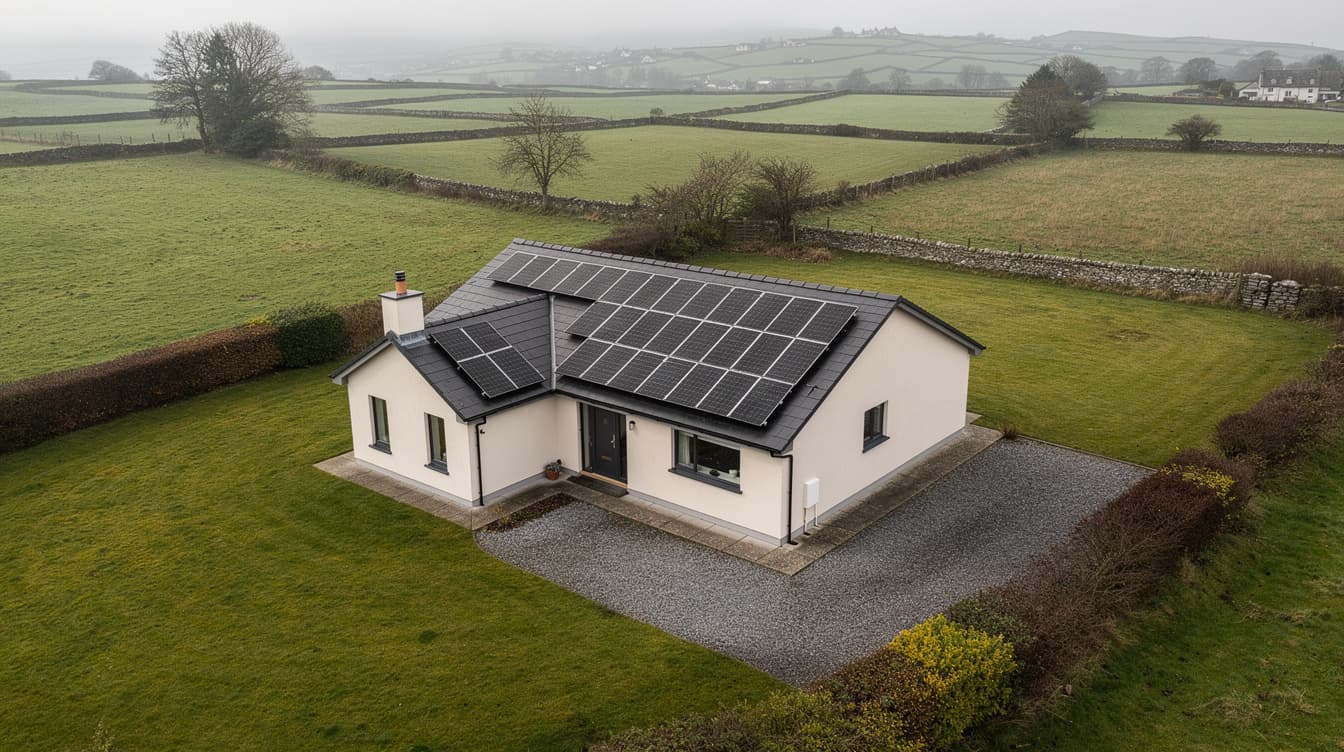
- Bungalow with long shallow roof: ideal — panels can be laid in landscape orientation, 10 columns × 2 rows on one side.
- Terrace / townhouse: rarely fits 20 on the main dwelling. Consider a smaller array or a wraparound install with an adjoining outbuilding.
If you’re unsure, the shortcut is to use satellite imagery: measure the main roof pitch, subtract dormers, chimneys and vent stacks, then check the remaining rectangle can hold a 39 m² clear panel block. If it can’t, you’re into split‑pitch territory and should plan for a dual‑MPPT inverter.
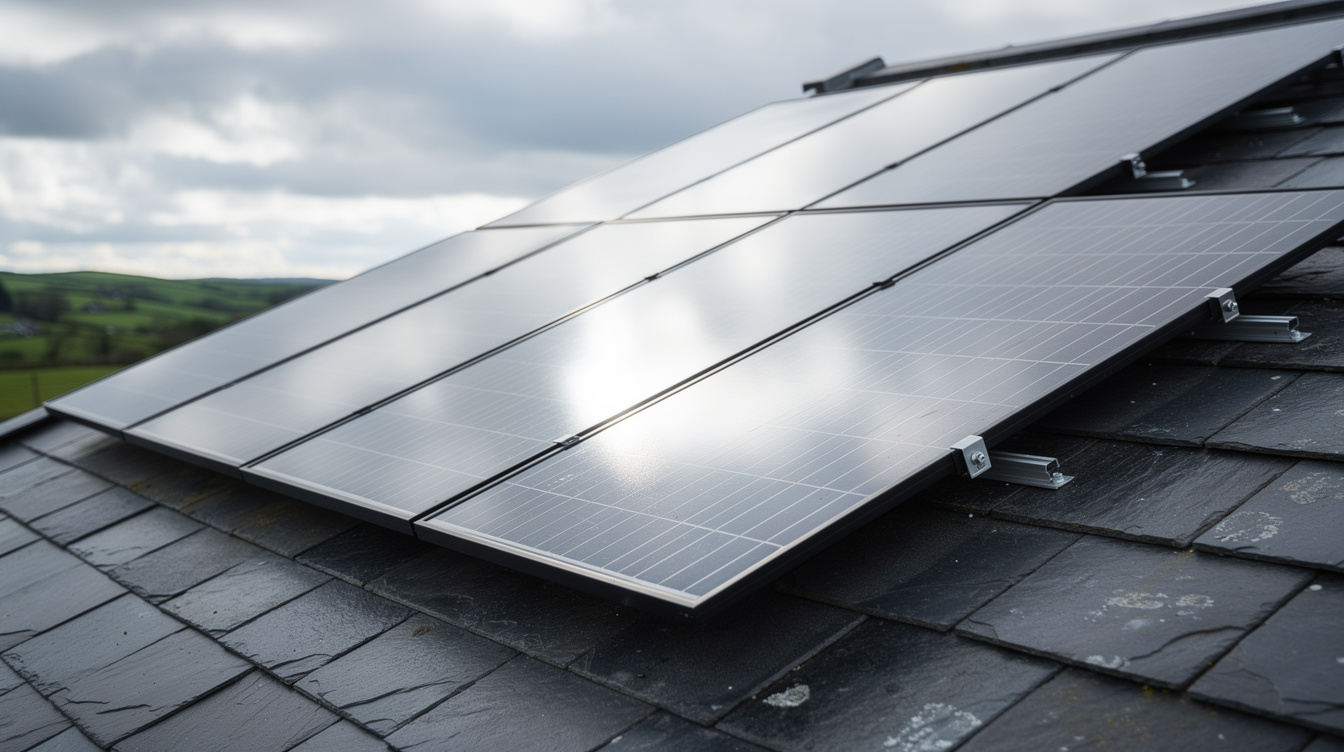
Annual output: what should 20 panels produce in Ireland?
Based on PVGIS‑5 modelling for a south‑facing 8.8 kWp array at 35° tilt in the Irish midlands, expect roughly 7,600–8,100 kWh per year. Cork and Wexford tip above 8,200 kWh; Donegal, west Mayo and inland Ulster typically 7,300–7,600 kWh. Month by month:
| Month | Typical output (kWh) | Share of annual |
|---|---|---|
| January | 210 – 260 | 3% |
| February | 360 – 430 | 5% |
| March | 640 – 720 | 9% |
| April | 890 – 990 | 12% |
| May | 1,050 – 1,150 | 14% |
| June | 1,050 – 1,150 | 14% |
| July | 1,000 – 1,100 | 13% |
| August | 830 – 930 | 11% |
| September | 620 – 700 | 8% |
| October | 400 – 470 | 5% |
| November | 220 – 270 | 3% |
| December | 170 – 210 | 3% |
| Annual total | 7,600 – 8,100 kWh | 100% |
To put those numbers in perspective: May to July delivers roughly 41% of the annual output in just three months. A 20‑panel array in that window is generating 35–38 kWh per average day — more than most Irish households use in 24 hours, even with a heat pump running. That’s why the battery and export strategy matter so much for arrays this size, and why 20 panels doesn’t make sense at all without at least one of them.
Is 20 panels the right size for your home?
Rough rule of thumb: aim to size the array so annual output is 80–110% of annual household electricity usage. Under 80% and you’re leaving grid‑offset value on the table; over 110% and you’re disproportionately selling to the grid at 18–24 c/kWh CEG instead of offsetting a 32–38 c/kWh import unit rate. Twenty panels lands at 7,600–8,100 kWh, which suits:
| Household profile | Typical annual usage | Is 20 panels right? |
|---|---|---|
| 2‑person, no EV, gas heating | 3,000 kWh | Oversized — look at 12 panels |
| 4‑bed family, no EV, gas heating | 4,500 kWh | Oversized — look at 14 panels |
| 4‑bed family + 1 EV, gas heating | 7,000 kWh | Solid fit |
| 4‑bed family + heat pump, no EV | 8,500 kWh | Excellent fit |
| 4‑bed family + heat pump + 1 EV | 11,000 kWh | Undersized — consider 24 panels |
| Rural home + heat pump + 2 EVs | 14,000 kWh | Add 20 more panels or size up to 24–28 |
Note that these are annual averages — the January/February months where a 20‑panel array only delivers 210–430 kWh mean even a well‑sized system still imports meaningfully from the grid in winter. The right number of panels for you is a compromise between summer surplus, winter shortfall, and how much of the summer surplus you actually want to send to the grid.
Do you need a battery with 20 solar panels?
At 8.8 kWp, the answer is almost always yes — not for winter, but because your summer generation profile now looks nothing like your usage profile.
A typical 20‑panel household in June generates around 35 kWh in a single day, most of it between 09:00 and 17:00. Baseload usage in that window is often only 3–5 kWh. Without a battery, roughly 25–28 kWh per summer day gets exported to the grid at the CEG rate. With a 10 kWh battery you shift most of the evening/night load off‑grid too. Rough cash impact at Aug 2026 tariffs (Electric Ireland 34.5 c/kWh peak import, SSE Airtricity 22.7 c/kWh CEG rate):
- No battery: ~35% self-consumption. Grid imports drop by ~2,650 kWh/year, exports ~5,000 kWh/year. Annual bill saving: ~€915 + ~€1,135 CEG credit = ~€2,050/year.
- 5 kWh battery: ~55% self-consumption. Grid imports drop by ~4,200 kWh/year, exports ~3,600 kWh/year. Annual: ~€1,450 + ~€820 = ~€2,270/year.
- 10 kWh battery: ~72% self-consumption. Grid imports drop by ~5,500 kWh/year, exports ~2,300 kWh/year. Annual: ~€1,900 + ~€520 = ~€2,420/year.
- 10 kWh battery + Eddi diverter: ~80% self-consumption. Also displaces ~1,300 kWh of gas/oil hot‑water heating per year. Combined value: ~€2,650/year.
The gap between no battery and 10 kWh is about €370/year in cash terms. Against an extra ~€4,500 for the 10 kWh battery, that’s a 12‑year payback on the battery alone at today’s tariffs — borderline. Where a battery earns its keep at this array size is time‑of‑use tariff arbitrage: charging from a 8–9 c/kWh Night Boost window and discharging into the 45 c/kWh evening peak on top of storing solar. Do the maths on your actual usage curve before committing.
Payback: how quickly does 20 panels pay for itself?
Working from the annual savings above and the typical net installed costs after grant:
| Configuration | Net cost after grant | Annual saving | Simple payback |
|---|---|---|---|
| 20 panels, no battery | €12,700 | €2,050 | 6.2 years |
| 20 panels + 5 kWh battery | €15,050 | €2,270 | 6.6 years |
| 20 panels + 10 kWh battery | €17,350 | €2,420 | 7.2 years |
| 20 panels + 10 kWh + Eddi | €18,150 | €2,650 | 6.8 years |
Over a 25‑year system life (panels typically retain 87–90% of nameplate output after year 25 under 2026‑typical warranties), lifetime cash value ranges from about €44,000 (no battery) to €56,000 (full stack with diverter) — before any electricity price inflation and before the Eddi displaces fossil hot water heating.
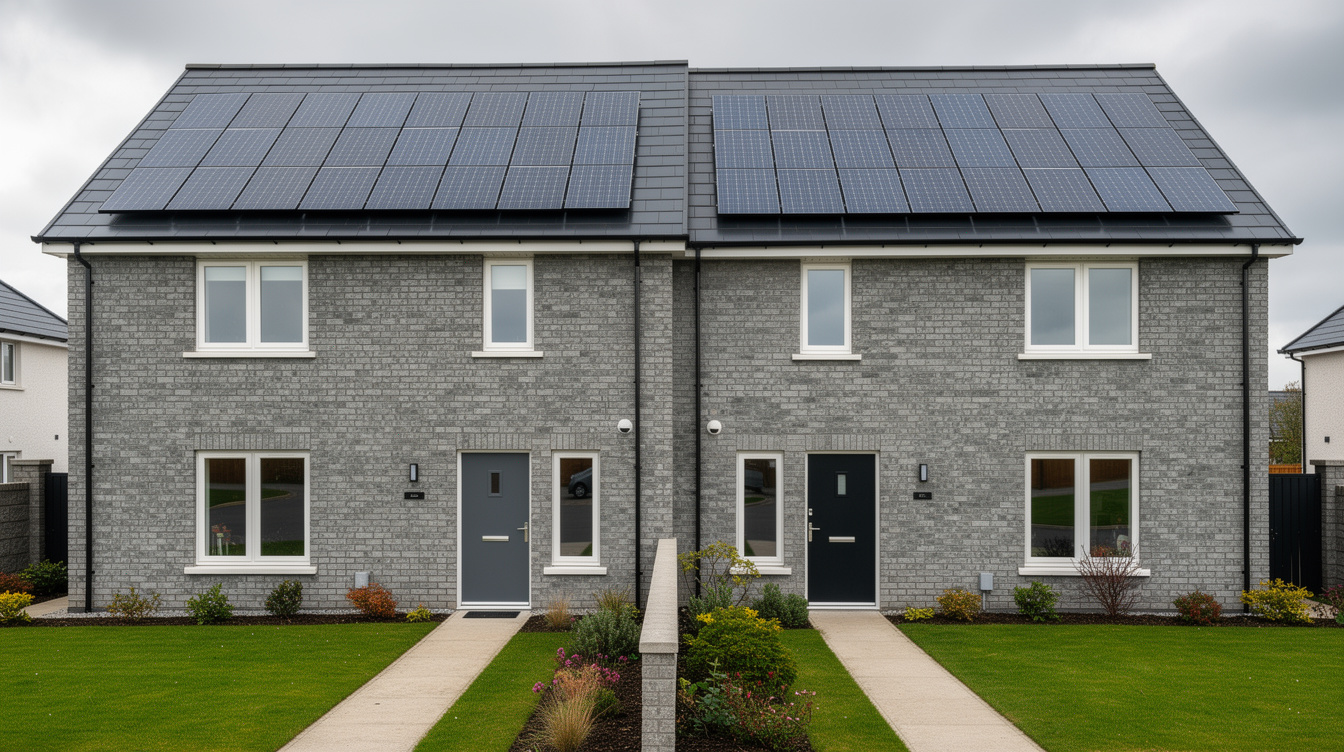
10 vs 14 vs 20 panels — side-by-side
| Metric | 10 panels (4.4 kWp) | 14 panels (6.16 kWp) | 20 panels (8.8 kWp) |
|---|---|---|---|
| Net cost + 5 kWh battery | €10,300 | €12,650 | €15,050 |
| Annual output | 3,800 kWh | 5,300 kWh | 7,850 kWh |
| Roof area needed | ~20 m² | ~28 m² | ~39 m² |
| SEAI grant | €1,800 (full) | €1,800 (full) | €1,800 (full) |
| Payback | 6.7 years | 6.4 years | 6.6 years |
| Best for | Small semi, low usage | Standard 3‑4 bed, gas heating | Heat pump, EV, all-electric |
Payback is remarkably flat across all three sizes — the SEAI grant is the same, and the marginal cost per panel goes down as you scale. What changes materially is how much of your bill you eliminate. For a typical 4‑bed with a heat pump, 10 panels covers ~30% of usage, 14 panels ~50%, and 20 panels ~85%. If you’re moving toward all‑electric or already there, the extra six panels between 14 and 20 are the ones that finally get you off the grid for 8 months of the year.
ESB Networks paperwork: NC6 vs NC7 for 20-panel installs
A 20‑panel array paired with a 6 kW inverter stays inside the NC6 “notification‑only” pathway for single‑phase homes — that’s the standard route your installer files after commissioning, no pre‑approval required. Two things push you into the slower NC7 “pre‑approval” pathway:
- An inverter rated above 6 kW on single‑phase supply (11.05 kW is the ceiling on three‑phase). Some installers try to pair 20 panels with a 7.6 kW inverter to squeeze more clipping‑free summer output — that requires NC7 and 4–10 weeks of ESB waiting.
- Rural feeders where ESB Networks already knows the line is congested (typical in parts of west Clare, north Donegal, west Kerry). Even a 6 kW install can get bumped to NC7 review.
Practical takeaway: stick with a 6 kW hybrid inverter for a 20‑panel install unless you have a specific reason (heavy summer clipping, planned expansion) to go larger — the DC‑to‑AC ratio of 1.47 on an 8.8 kWp array with a 6 kW inverter is well within the 1.2–1.5 range most installers target for Ireland.
Ready to Go Solar?
Get your free personalised quote from SEAI-registered installers.
Best-in-class 20-panel configurations from Irish installers in Aug 2026
Four common ways installers spec a 20‑panel system in 2026, based on recent quotes across SEAI‑registered companies:
- Budget: 20 × Canadian Solar HiKu6 435 W + Sungrow SH6.0RT hybrid + 5 kWh Pylontech Force L1. Typical fitted: €13,900 net. Solid warranty (25y product, 25y linear performance), well‑established brand.
- Mainstream: 20 × Jinko Tiger Neo 470 W N-type + Sungrow SH6.0RT + 9.6 kWh BYD HVS. Typical fitted: €15,800 net. N‑type wafer + LFP battery + better low‑light output.
- Premium: 20 × AIKO Comet 3S 475 W (or LONGi Hi-MO X10 460 W) + SolarEdge SE6K + 10 kWh SolarEdge Home Battery. Typical fitted: €18,400 net. Module-level MPPT, industry‑leading efficiency, longest warranty.
- All-electric ready: 20 × JA DeepBlue 4.0 Pro 445 W + Sunsynk 6 kW hybrid + 10.24 kWh Sunsynk battery + Eddi. Typical fitted: €18,800 net. Purpose‑built for households with heat pump + EV + hot water immersion.
Prices are actual quote midpoints from Aug 2026, VAT‑inclusive (0% VAT on solar in Ireland to Dec 2030) and after the €1,800 SEAI grant. Get quotes from three installers before committing — there’s regularly €2,000–3,000 variance for the same spec.
Common mistakes with 20-panel installs — watch for these
- Undersized inverter: a 5 kW inverter on an 8.8 kWp array clips 8–12% of summer output. Extra €350–450 for a 6 kW hybrid recovers within 4 summers.
- Skipping the post-works BER assessment: A 20‑panel array typically bumps a C1/C2 home to B2 or B1 — worth €7,500–12,500 on resale (Property Price Register data for 2025–2026 shows a 4.1% average premium per BER band improvement in Dublin, 3.2% nationally). Skipping the €185 BER re‑assessment leaves that on the table.
- Not planning MPPT strings: If 20 panels span two roof pitches with different orientations (e.g. south-east + south-west), you need a dual-MPPT inverter. A single-MPPT inverter fed by mixed strings will drag both pitches down to the weaker one’s output.
- Oversized battery too early: 15‑20 kWh batteries rarely earn back their extra cost in a residential setting even with 20 panels. Stay at 5–10 kWh, add a second battery later if usage patterns change (most 2026 hybrid inverters allow it).
- Forgetting the diverter: For homes with an immersion heater, adding a €600–700 MyEnergi Eddi or myenergi Zappi routes surplus solar to hot water first — typically worth €250–330/year on a 20‑panel array, so it pays back in 2.5 years.
Frequently asked questions
Do 20 solar panels need three-phase electricity?
No. A 20‑panel / 8.8 kWp array pairs cleanly with a 6 kW single‑phase hybrid inverter and stays inside ESB Networks’ NC6 pathway. Three‑phase becomes relevant only above 6 kW inverter output. See our 3-phase voltage guide if you’re unsure what supply you have.
Do 20 panels qualify for the full SEAI grant?
Yes. The SEAI Solar PV grant is a flat €1,800 for any residential array 2 kWp or larger (built before Dec 2020 — the pre-2021 build cutoff), with no upper cap. An 8.8 kWp system gets exactly the same €1,800 as a 2 kWp system.
Do I need planning permission for 20 solar panels?
For most Irish homes, no. Under SI 493/2022 residential solar PV became fully planning‑exempt in October 2022 with no upper cap on roof coverage — the previous 12 m² limit was removed. Protected structures, ACAs and listed buildings still need planning. Full detail in our planning permission guide.
Can I expand from 14 to 20 panels later?
Technically yes, but rarely cost‑effective. Adding 6 panels retroactively costs almost as much as installing them from day one because you need a new scaffold, new NC6 re-notification, and often a bigger inverter. If you think you’ll go all‑electric within 5 years, install 20 upfront.
How much roof space do 20 solar panels actually need?
About 39 m² of clear panel area plus 30–50 cm perimeter clearance — roughly 45 m² of usable pitch. On a single south‑facing pitch that’s typically 7 m wide × 6 m long. Split-pitch installs can spread across smaller pitches on either side of a ridge.
Will 20 panels overload my ESB connection?
Not on standard 12 kVA single‑phase supply, which is what almost all Irish detached and semi‑detached homes have. A 6 kW inverter uses at most half your available capacity. See our NC6 guide for how the notification works.
What’s the payback difference between 20 panels with and without a battery?
Roughly identical — the battery adds ~€370/year to savings but costs an extra ~€2,400 for a 5 kWh unit. Payback of the panels alone: 6.2 years. Payback of the panels + battery: 6.6 years. The battery is more about self‑consumption comfort and time‑of‑use tariff arbitrage than raw payback.
Bottom line
Twenty panels is the sweet spot for future‑proofed Irish homes — specifically households with a heat pump, an EV, or a plan to add either within the system’s lifetime. At August 2026 pricing you’re looking at €12,700–18,600 net after grant, 7,600–8,100 kWh/year output, and a 6–7 year payback that’s remarkably close to smaller systems because the SEAI grant is flat and the marginal cost per panel drops with scale.
For everyone else — smaller households, gas‑heated homes, no EV — 14 or 12 panels is usually the smarter buy. Match the system size to where you’ll be in 5 years, not to today’s bill.
Ready to Go Solar?
Get 3 free quotes from SEAI-registered installers for a 20-panel system sized to your home.
Related guides: 14 solar panels Ireland 2026 · 12 solar panels Ireland 2026 · Best solar batteries Ireland 2026 · How to compare solar quotes · ESB Networks NC6 form guide
Related Articles
12 Solar Panels Ireland 2026: Cost, Output, Battery & Payback
What 12 solar panels cost in Ireland 2026 (€9.1-10.8k after grant), annual kWh output, battery sizing, roof space needed and how 12 stacks vs 10 or 14 panels.
14 Solar Panels Ireland 2026: Cost, kWh Output, Battery & Payback
What 14 solar panels cost in Ireland 2026 (€10.4-12.1k after grant), annual kWh output, roof space, battery pairing and how 14 stacks vs 12 or 16 panels.
Best Solar Setup Ireland 2026: Complete System Design Guide
The best solar setup for Ireland 2026 — panels, inverter, battery, diverter and installer — with 4 real-world configurations, prices and paybacks.