
14 Solar Panels Ireland 2026: Cost, kWh Output, Battery & Payback
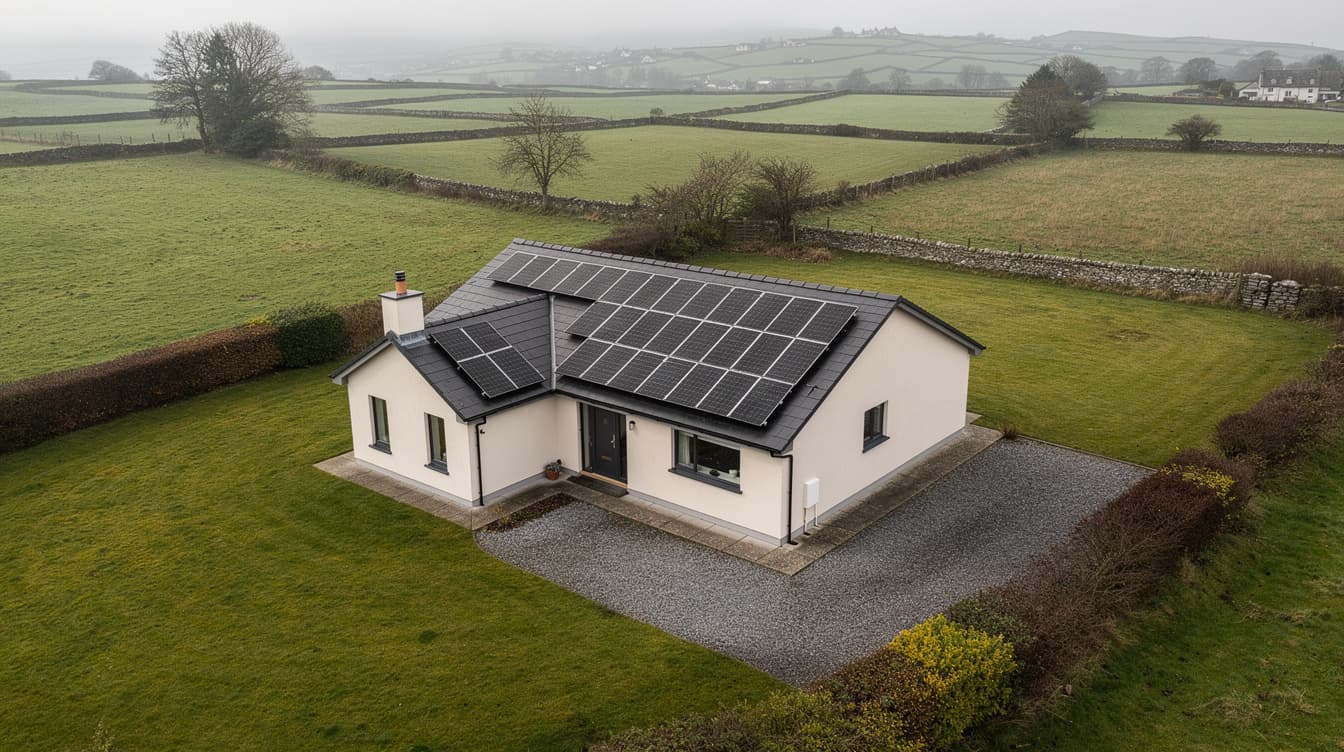
Fourteen panels sits right in the sweet spot for Irish homes in 2026 — big enough to run a 3–4 bed semi with a heat pump or EV charger, small enough to fit on a single well-orientated roof pitch and stay comfortably inside the SEAI grant cap. It’s also one of the most Googled sizings on the island because, at typical 440–450 W panels, 14 modules land bang on the 6 kWp threshold that unlocks the full €1,800 grant and, if you want it, most 5 kWh battery packages.
This guide breaks down what 14 panels actually costs in Ireland today (August 2026), what output to expect month by month, whether it’s the right count for your roof and bills, and how it stacks up against 12- and 16-panel setups.
What does a 14-panel solar system cost in Ireland in 2026?
Typical all-in installed pricing for a 14-panel system with a modern hybrid inverter, on a single-pitch tile or slate roof, from an SEAI-registered installer in August 2026:
| Setup | Gross price | After €1,800 SEAI grant |
|---|---|---|
| 14 × 440 W panels + 5 kW hybrid inverter (no battery) | €9,600 – €11,200 | €7,800 – €9,400 |
| 14 panels + 5 kWh LiFePO₄ battery (most common in 2026) | €12,200 – €13,900 | €10,400 – €12,100 |
| 14 panels + 10 kWh battery + EV-ready charger | €14,600 – €16,800 | €12,800 – €15,000 |
| 14 panels split across 2 roof pitches (extra rails, MC4 runs) | +€400 – €700 | same premium after grant |
Prices have softened another 3–5% since spring 2026 as wholesale panel and inverter kit dropped and the pool of active SEAI-registered installers (1,268 nationally at the start of August) kept quote competition tight. If you’re being quoted meaningfully above €13,900 gross for a 14-panel + 5 kWh package, get two more free comparison quotes before signing.
Ready to Go Solar?
Get your free personalised quote from SEAI-registered installers.
Is 14 panels a 6 kWp system?
Almost exactly. Fourteen 440 W panels comes out at 6.16 kWp; fourteen 450 W panels at 6.30 kWp. Both sit at or just above the SEAI grant’s 6 kWp cap, meaning you get the full €1,800 without leaving unused headroom. It’s the single most common domestic sizing installers quote in 2026 for exactly this reason.
If your quote uses 400 W panels, 14 modules would only be 5.6 kWp — you’d still get the full grant, but you’d be leaving 400 W of grant-eligible capacity on the table. Ask whether the installer can substitute 440 W or 450 W modules for the same price (most can, in August 2026).
Roof space: will 14 panels fit?
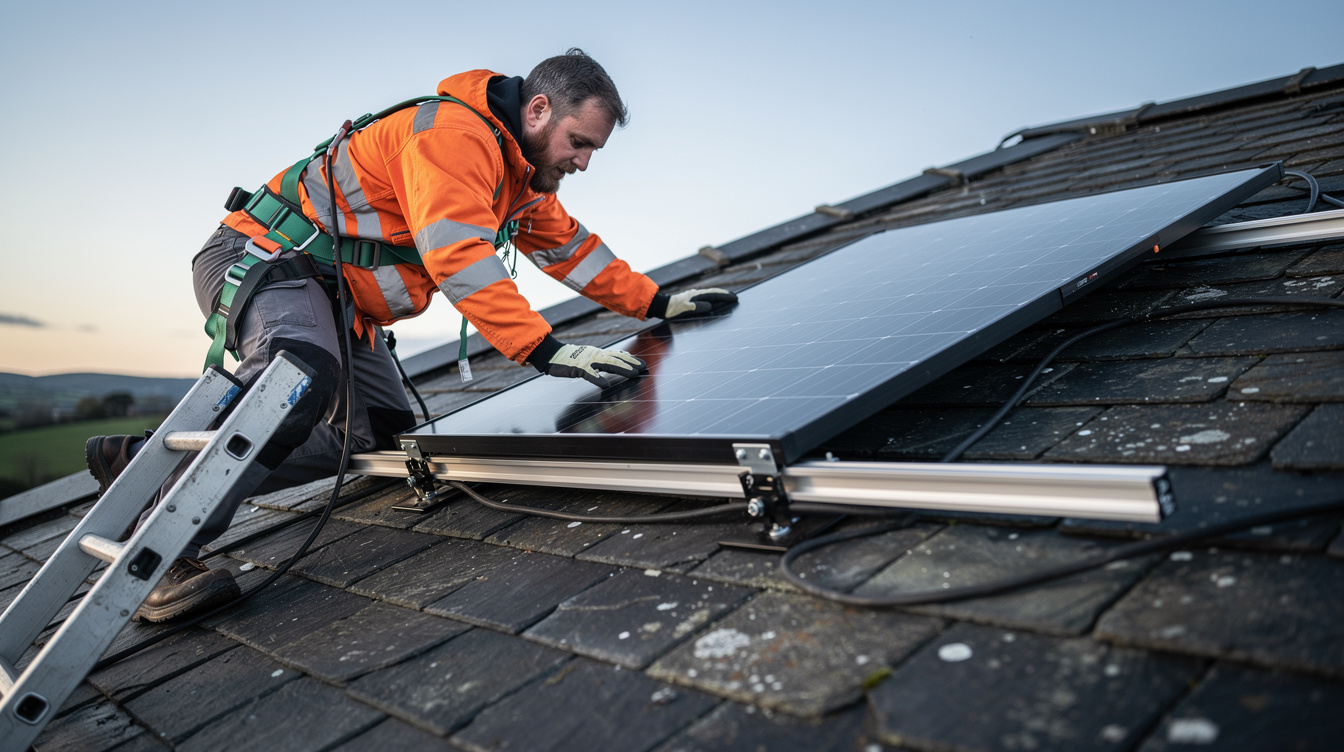
A standard 440 W monocrystalline panel is roughly 1.72 m × 1.13 m — call it 1.95 m² each. Fourteen panels need around 27–28 m² of clear roof plus a small edge margin for wind loading. Practical layouts:
- Two rows of 7 — needs roughly 8 m across and 3.5 m up the pitch. Suits most 3-bed semi-detached homes built after 1970.
- 7 × 2 portrait — same footprint rotated. Common on hipped roofs where width matters more than height.
- Split 8 + 6 across two pitches — often south-east plus south-west. Costs a bit more in rails and cable runs but recovers about 92–95% of a pure south-facing yield.
How much electricity does 14 panels generate in Ireland?
A well-installed 6.2 kWp south-facing array in the Republic of Ireland generates around 5,300–5,900 kWh per year, depending on pitch, shading and county (Cork, Waterford and south Wexford sit at the higher end; north Donegal and Leitrim toward the lower end). Typical monthly split:
| Month | kWh generated (6.2 kWp south) | Notes |
|---|---|---|
| January | 150 – 190 | Short days — battery mostly cycles solar into evening use |
| February | 230 – 290 | Yield doubles vs Jan |
| March | 430 – 510 | First month with meaningful export |
| April | 610 – 720 | Often the sunniest month in Ireland |
| May | 700 – 820 | Peak generation month |
| June | 670 – 780 | Long days but often cloudy on west coast |
| July | 640 – 750 | Panels lose ~4–6% to heat above 25°C |
| August | 560 – 660 | Sun angle starts dropping |
| September | 400 – 480 | Battery starts covering more evening load |
| October | 240 – 310 | Grid import climbs |
| November | 130 – 180 | Second-lowest yield month |
| December | 100 – 140 | Solar covers hot water only on brighter days |
| Annual total | 5,300 – 5,900 | Covers 55–95% of a typical 3–4 bed’s annual electricity |
Rule of thumb: multiply your kWp by 900 for a conservative annual yield in Ireland, or 950 for a well-orientated south-facing roof at 30–35° pitch. 6.2 kWp × 900 = 5,580 kWh, right in the middle of the range above.
What’s the payback on 14 solar panels?
Payback depends on three things: how much of the solar you use in the home vs export, your unit rate, and whether you have a battery. Working from August 2026 tariffs (Electric Ireland 42.6 c/kWh standard urban day rate; SSE Airtricity 42.8 c/kWh; typical Microgeneration Support Scheme export tariff 18 c/kWh):
| Scenario | Self-use share | Yr 1 savings | Net cost (mid-range) | Payback |
|---|---|---|---|---|
| Panels only, both adults out 9–5 | ~30% | €1,410 | €8,600 | 6.1 yrs |
| Panels only, one adult WFH | ~50% | €1,660 | €8,600 | 5.2 yrs |
| Panels + 5 kWh battery, both adults out | ~70% | €1,900 | €11,200 | 5.9 yrs |
| Panels + 5 kWh battery + EV night-charging | ~80% | €2,080 | €11,200 | 5.4 yrs |
| Panels + 10 kWh battery, heat-pump home | ~85% | €2,190 | €13,900 | 6.3 yrs |
The pattern most Irish 14-panel buyers land in is a 5–6 year payback, followed by 19–20 years of near-free generation on the panels’ 25-year performance warranty. Add an Eddi hot-water diverter and payback shortens by another 4–6 months in a household that heats water with immersion.
14 panels vs 12 panels vs 16 panels — which is right?
| Panel count | kWp (440 W) | Annual kWh | Grant eligible | Best for |
|---|---|---|---|---|
| 10 panels | 4.4 | 3,700 – 4,200 | €1,800 | 2–3 bed, no heat pump, no EV |
| 12 panels | 5.3 | 4,500 – 5,000 | €1,800 | 3-bed semi, gas boiler, no EV |
| 14 panels | 6.2 | 5,300 – 5,900 | €1,800 (max) | 3–4 bed, heat pump or EV, family of 4 |
| 16 panels | 7.0 | 6,000 – 6,700 | €1,800 (cap) | 4–5 bed, heat pump + EV, WFH |
| 20 panels | 8.8 | 7,500 – 8,400 | €1,800 (cap) | Large detached, ASHP + 2 EVs |
Above 14 panels the grant no longer scales — you pay full whack for every extra kWp. That doesn’t mean 16 or 20 isn’t worth it (a heat-pump family with two EVs will comfortably use the extra output), but the marginal cost per additional kWh climbs. Fourteen is the last sizing where the grant fully covers the incremental panel cost.
Do you need a battery with 14 panels?
Not to make the system work, but it changes the economics materially. Without a battery you’ll self-consume about 30–50% of what the panels generate; the rest exports to the grid at 18 c/kWh instead of displacing 42.6 c/kWh imports. A 5 kWh battery lifts self-use to 65–75%; 10 kWh gets you to 80–90%.
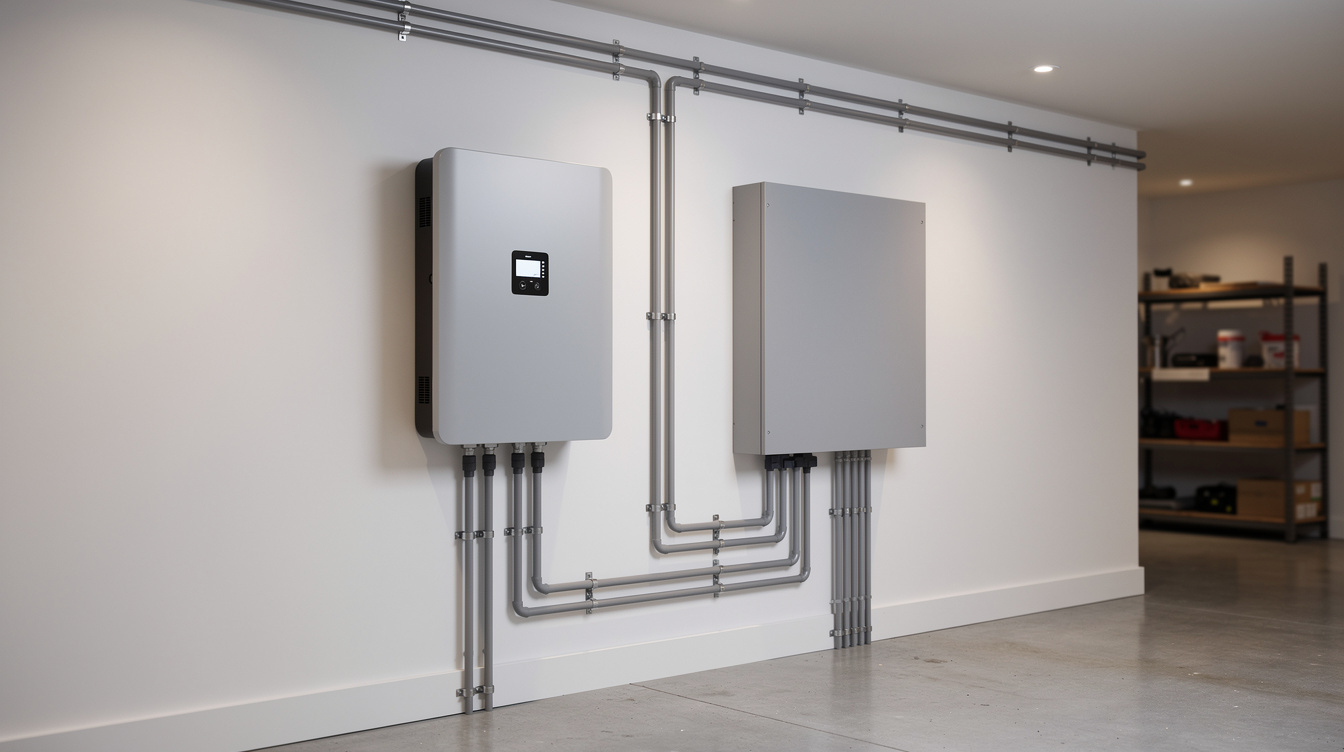
The rough rule most Irish installers apply in 2026: if your annual electricity bill is over €1,600 or you have a heat pump / EV, add a battery. If your bill is under €1,200 and no big loads are on the horizon, the battery may take 8–10 years to pay back on its own — you might get better returns from an Eddi diverter plus more panels instead.
Planning permission for 14 solar panels
Since the 7 October 2022 exemption revision (still current in 2026), rooftop solar is exempt from planning permission across every Irish county for pitched-roof houses, regardless of panel count — provided the panels don’t project more than 15 cm above the roof plane and stop 50 cm short of the roof edge. Fourteen panels comfortably sit within those limits on a standard 3–4 bed semi or detached.
Exceptions to double-check: solar carports, ground-mounted arrays, protected structures, and homes inside an Architectural Conservation Area (ACA) may still need permission. If in doubt, your council’s planning office will confirm in a phone call.
NC6 / grid connection
Any system 6 kWp or under is a straightforward NC6 notification — your installer files it with ESB Networks after commissioning and you get your export MPRN activated within a few weeks. A 14 × 440 W array (6.16 kWp) is a hair over 6 kWp on paper but is inverter-clipped to 6 kW AC output on virtually every 2026 hybrid inverter, keeping it inside the NC6 threshold. Ask your installer to confirm this is set up correctly — going over to an NC7 adds paperwork, time and often a G99 witness test.
Ready to Go Solar?
Get your free personalised quote from SEAI-registered installers.
What panels should the 14 be?
In 2026 the mainstream Irish quote pool is dominated by five brands: Longi Hi-MO 6, JA Solar DeepBlue 4.0, Trina Vertex S+, REC Alpha Pure-R, and Q Cells Q.Peak Duo. All five are N-type mono glass-glass or glass-backsheet, 440–450 W, and carry 25–30 year performance warranties. Real-world differences at 14-panel scale are small (2–4% annual yield spread), and the biggest quality driver is who installs them, not which brand is on the sticker.
What matters more:
- N-type over P-type — better low-light performance in the Irish autumn/winter and lower annual degradation (~0.4% vs ~0.55% per year).
- Full black or all-black frame — if aesthetics matter for a front-facing pitch, ask specifically. Costs about the same as silver-frame now.
- Panel-level optimisers or micro-inverters — only needed if you have shading on part of the array. Adds €600–€1,100 to the job.
What can go wrong with a 14-panel install?
- Oversized inverter — some installers throw a 6 kW inverter at a 6.16 kWp array to leave headroom. Fine for future battery expansion, but on a pure 14-panel installation a 5 kW inverter clipped to the array is typically the better price/performance choice.
- Split-array MPPT mismatch — if you split 8 + 6 across two pitches, each string needs its own MPPT input. Cheap inverters with a single MPPT will drag both strings down to the weakest one.
- Grant timing — the SEAI Solar PV grant application must be approved before works start. If your installer starts the job before your grant offer letter is issued, you lose the grant. Get it in writing from the installer that they’ll wait.
- Post-works BER assessment omitted — the grant is technically conditional on a BER assessment being completed within 6 months. Most installers include this; some “discount” quotes strip it out. Check.
- NC6 not filed — without an active MPRN export contract you can generate, but you won’t get paid the 18 c/kWh export tariff. A shocking number of 2024–2025 systems still aren’t exporting because the paperwork was never lodged. Ask for proof of NC6 acceptance before you make the final payment.
Frequently asked questions
Will 14 panels power my whole house?
In annual kWh terms, yes for most 3–4 bed homes without a heat pump (typical demand 4,200–4,800 kWh). For a heat-pump home (7,000–10,000 kWh) you’ll cover 55–70% of annual demand and still import in December and January. Solar is a bill-reducer, not an off-grid solution.
Can I add more panels later?
Yes, up to your inverter’s max input. A 5 kW hybrid inverter typically accepts up to 7.5 kWp of panels (150% oversize ratio). If you leave headroom, you can add 3–4 panels later without swapping the inverter. Adding panels after grant use, though, means you pay full price for them — the €1,800 grant is one shot per MPRN.
How long do 14 panels last?
25–30 years is the industry norm for N-type panels in 2026, with a typical performance warranty guaranteeing at least 87.4% output after 25 years. Inverters last 10–15 years and are the most likely part to need replacing during the panels’ life — budget €1,400–€2,000 for a hybrid inverter swap somewhere in year 12–15.
Do I need my roof reinforced?
Almost never for a 14-panel install. Total array weight is around 250 kg spread over 27 m² — less than a light snow load. Any roof built to Irish building regulations post-1980 handles this comfortably. Older properties with rotted timbers may need remedial work, which any competent installer will flag during survey.
Are 14 panels enough for an EV?
An average Irish EV drives 15,000 km/year and uses ~3,000 kWh. A 14-panel array generates enough in annual total to cover the EV and normal household use, but you’ll need a battery to time-shift the summer surplus into evening EV charging. Better long term: charge the EV overnight on a €0.08 c night-rate plan and use the panels for daytime household load. Even better: do both — solar for daytime, cheap night-rate for the car.
Bottom line on 14 solar panels in Ireland
Fourteen panels is the modal Irish home install in 2026 for good reason: it’s the largest system that pulls the full €1,800 SEAI grant, it fits on a standard semi or bungalow roof, and it produces enough annual kWh to meaningfully cut electricity bills for a family of four. Expect to pay €10,400–€12,100 net (with 5 kWh battery) and see payback in 5.5–6.5 years. If you have a heat pump, EV, or someone at home most weekdays, add the battery. If your usage is small and irregular, panels-only still stacks up.
Get three free comparison quotes from SEAI-registered installers before you sign anything — price spread on identical 14-panel jobs in 2026 is still €1,600–€2,500, and the cheapest quote isn’t always the best value.
Related reading
Related Articles
12 Solar Panels Ireland 2026: Cost, Output, Battery & Payback
What 12 solar panels cost in Ireland 2026 (€9.1-10.8k after grant), annual kWh output, battery sizing, roof space needed and how 12 stacks vs 10 or 14 panels.
20 Solar Panels Ireland 2026: Cost, Output, Battery & Payback
What 20 solar panels cost in Ireland 2026 (€12.7-18.6k net after grant), 7,600-8,100 kWh output, roof space, battery choice and payback vs 10 or 14 panels.
Best Solar Setup Ireland 2026: Complete System Design Guide
The best solar setup for Ireland 2026 — panels, inverter, battery, diverter and installer — with 4 real-world configurations, prices and paybacks.