
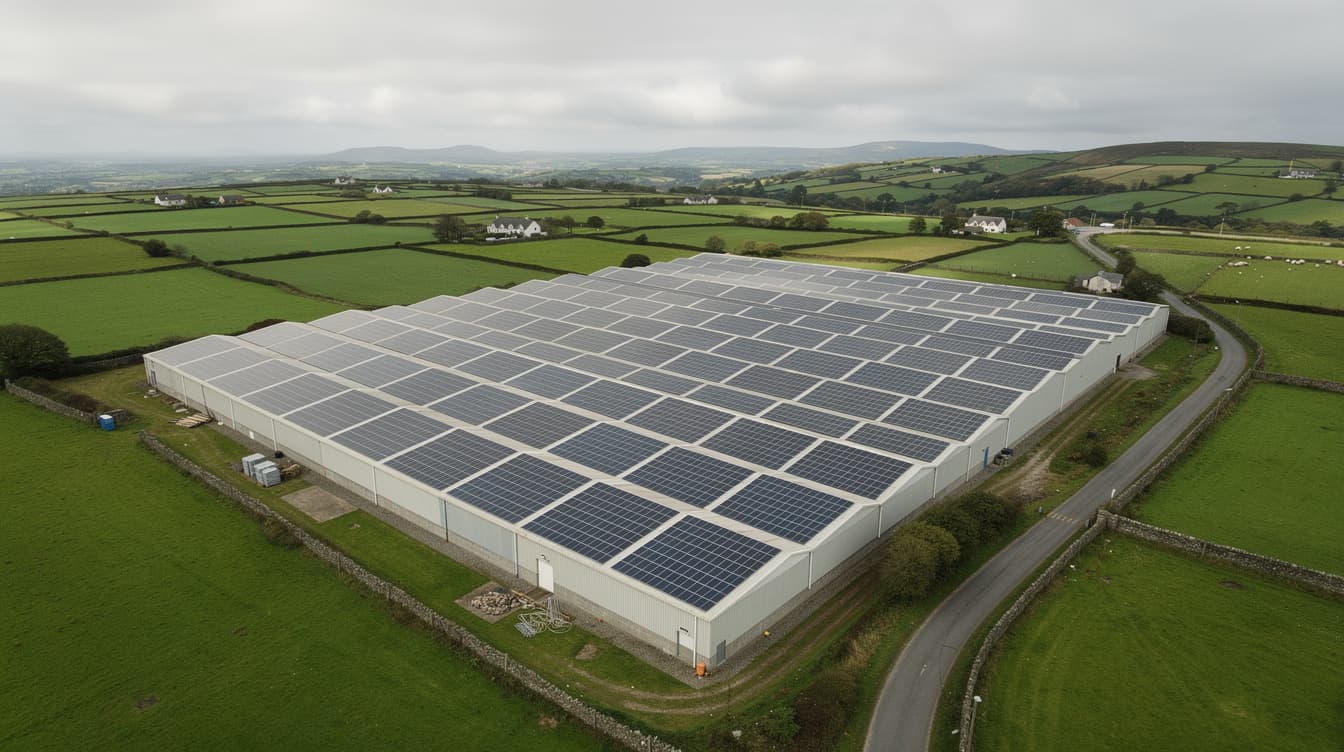
Commercial Solar Panel Installation Ireland 2026: Costs, Grants & Full Process
Commercial Solar Panel Installation Ireland 2026: Costs, Grants & Full Process
A 100 kWp solar PV system on an Irish factory roof now pays for itself in 3–5 years. Between the SEAI Non-Domestic Microgen Grant (up to €162,600), the Accelerated Capital Allowance (100% first-year tax write-off), and electricity prices that refuse to go back down, the commercial business case has never been stronger. Here is what it actually costs, what you get back, and how to size it right.
If you run an Irish SME — a hotel, a dairy farm, a manufacturing unit, a retail park, a coldstore, a hospitality venue — you are probably paying somewhere between €0.22 and €0.32 per kWh for daytime electricity in 2026. That is roughly four times what a kWh of self-generated solar costs over a 25-year system life. The maths is simple. The question is no longer whether commercial solar makes sense in Ireland, but which size system, which grant tier, and which payback approach works for your specific business.
This guide is for finance directors, owner-operators, and facility managers comparing real quotes. It covers system sizing from 10 kWp to 200 kWp, the 2026 grant structure, the ACA tax treatment, the Clean Export Premium for non-domestic exporters, and the most common mistakes businesses make on the way to signing.
Quick Answer: What does commercial solar panel installation cost in Ireland?
A typical 50 kWp commercial install on an Irish SME roof costs €55,000–€72,000 before grants and €45,000–€62,000 after the €10,000 SEAI Non-Domestic Microgen Grant. A larger 100 kWp system runs €95,000–€125,000 gross and €72,400–€102,400 net of the €22,600 grant. Add the Accelerated Capital Allowance (100% first-year tax write-off) and most installs pay back in 3–5 years. The full install process — from desktop survey to grid switch-on — takes 8–14 weeks for a 50–100 kWp system.
The 30-second snapshot
- 10 kWp system — €14,000–€17,000 installed, ~€3,000 grant, 5–7 yr payback
- 50 kWp system — €55,000–€72,000 installed, €10,000 grant, 4–6 yr payback
- 100 kWp system — €95,000–€125,000 installed, €22,600 grant, 3–5 yr payback
- 200 kWp system — €170,000–€220,000 installed, €42,600 grant, 4–6 yr payback
- All systems qualify for the Accelerated Capital Allowance — 100% of cost written off against corporation tax in Year 1
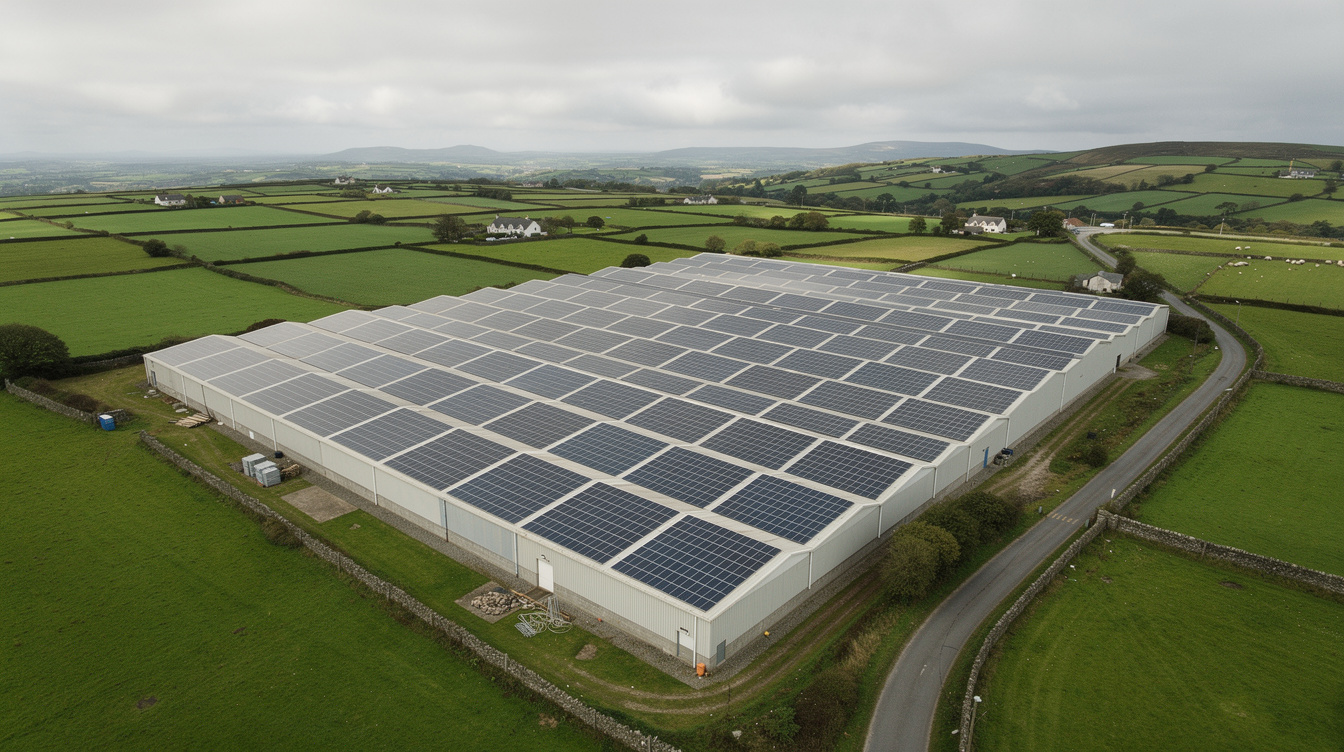
Why commercial solar finally makes sense in 2026
Three things changed in the last 24 months that turned commercial solar from a slow-payback ESG project into a financial no-brainer:
- The NDMG grant cap moved to 1 MWp. In July 2023 the SEAI raised the Non-Domestic Microgen Scheme cap from 6 kWp to 1,000 kWp, with grant support of up to €162,600. Businesses that used to bump against the limit at 30 panels can now grant-fund a serious system.
- Wholesale electricity prices stayed elevated. The post-2022 spike never fully unwound. Commercial day rates settled around €0.22–€0.32 per kWh in 2026 — high enough that every kWh of self-consumed solar saves real money.
- ESB Networks export caps were raised. Non-domestic exporters can now sell surplus generation under the Clean Export Premium at €0.18–€0.22 per kWh — nearly double what households get on the Clean Export Guarantee.
Add the Accelerated Capital Allowance on top, and the effective net cost of a system after grant + tax relief is often 40–55% lower than the headline quote.
The Non-Domestic Microgen Grant explained
The NDMG (sometimes called the Non-Domestic Microgen Scheme, or NDMS) is the main grant for commercial solar PV in Ireland. It is administered by the SEAI and runs alongside their domestic Solar PV grant but with much bigger numbers.
Who is eligible? Businesses, farms, schools, community centres, sports clubs, and not-for-profits with their own ESB MPRN. The premises must have been connected to the grid for at least 6 months before applying. New buildings need to wait.
How much do you get? The grant is tiered by system size:
| System Size | Grant Rate | Grant on This Tier | Cumulative Grant |
|---|---|---|---|
| First 6 kWp | Flat €2,400 | €2,400 | €2,400 |
| 7–20 kWp | €300/kWp | up to €4,200 | up to €6,600 |
| 21–200 kWp | €200/kWp | up to €36,000 | up to €42,600 |
| 201–1,000 kWp | €150/kWp | up to €120,000 | up to €162,600 |
Worked examples:
- 30 kWp system → €2,400 + (14 × €300) + (10 × €200) = €8,600 grant
- 100 kWp system → €2,400 + (14 × €300) + (80 × €200) = €22,600 grant
- 500 kWp system → €2,400 + €4,200 + €36,000 + (300 × €150) = €87,600 grant
- 1,000 kWp system → the maximum €162,600 grant
Critical process points we see businesses get wrong all the time:
- You must apply before works start. SEAI will not grant-aid a system that is already installed.
- The installer must be SEAI-registered and the equipment on the Triple E register.
- You have 12 months from your Letter of Offer to complete works and claim.
- The grant covers the PV system only — batteries, EV chargers, and immersion diverters do not qualify on the commercial scheme.
The Accelerated Capital Allowance — the silent boost
This is the bit your accountant should be the most excited about. The Accelerated Capital Allowance (ACA) scheme lets your business write off 100% of the cost of qualifying energy-efficient equipment in Year 1, instead of the standard 8-year wear-and-tear writedown for plant and machinery.
Commercial solar PV is on the SEAI Triple E register and qualifies in full. For a profit-making business paying corporation tax at 12.5% (trading) or 25% (non-trading), the effective subsidy stacks on top of the NDMG grant:
| Item | 50 kWp Office | 100 kWp Factory | 200 kWp Warehouse |
|---|---|---|---|
| Headline installed cost | €65,000 | €110,000 | €195,000 |
| NDMG grant | −€12,600 | −€22,600 | −€42,600 |
| Net cost after grant | €52,400 | €87,400 | €152,400 |
| ACA Year 1 tax saving (12.5%) | −€6,550 | −€10,925 | −€19,050 |
| Effective net cost | €45,850 | €76,475 | €133,350 |
Two important caveats: the ACA is only useful if your business is making a taxable profit (loss-making businesses can carry the allowance forward, but the cashflow benefit is delayed), and the qualifying expenditure is the cost net of grant. Your tax adviser will know all this — but make sure they actually see the SEAI Letter of Offer when you do your accounts.
Get commercial solar quotes for your premises
Free, no-obligation quotes from SEAI-registered commercial installers. Compare 3 quotes side-by-side.
How big a system can your roof actually hold?
A 2026 commercial solar panel produces around 440–500 watts and occupies roughly 2.0 m² including mounting clearance. Use these rules of thumb when scoping:
| System Size | Roof Space (approx) | Panel Count | Annual Yield |
|---|---|---|---|
| 10 kWp | 50–65 m² | 22–24 panels | 9,000–9,500 kWh |
| 30 kWp | 150–200 m² | 66–72 panels | 27,000–28,500 kWh |
| 50 kWp | 250–325 m² | 110–120 panels | 45,000–47,500 kWh |
| 100 kWp | 500–650 m² | 220–240 panels | 90,000–95,000 kWh |
| 200 kWp | 1,000–1,300 m² | 440–480 panels | 180,000–190,000 kWh |
| 500 kWp | 2,500–3,250 m² | 1,100–1,200 panels | 450,000–475,000 kWh |
Standard Irish industrial sheds are typically 1,500–3,000 m² on the roof. Most have plenty of physical capacity for 200–500 kWp systems. The constraint is usually structural (older sheds may need engineering sign-off) or electrical (your ESB connection may not be rated for export at that scale).
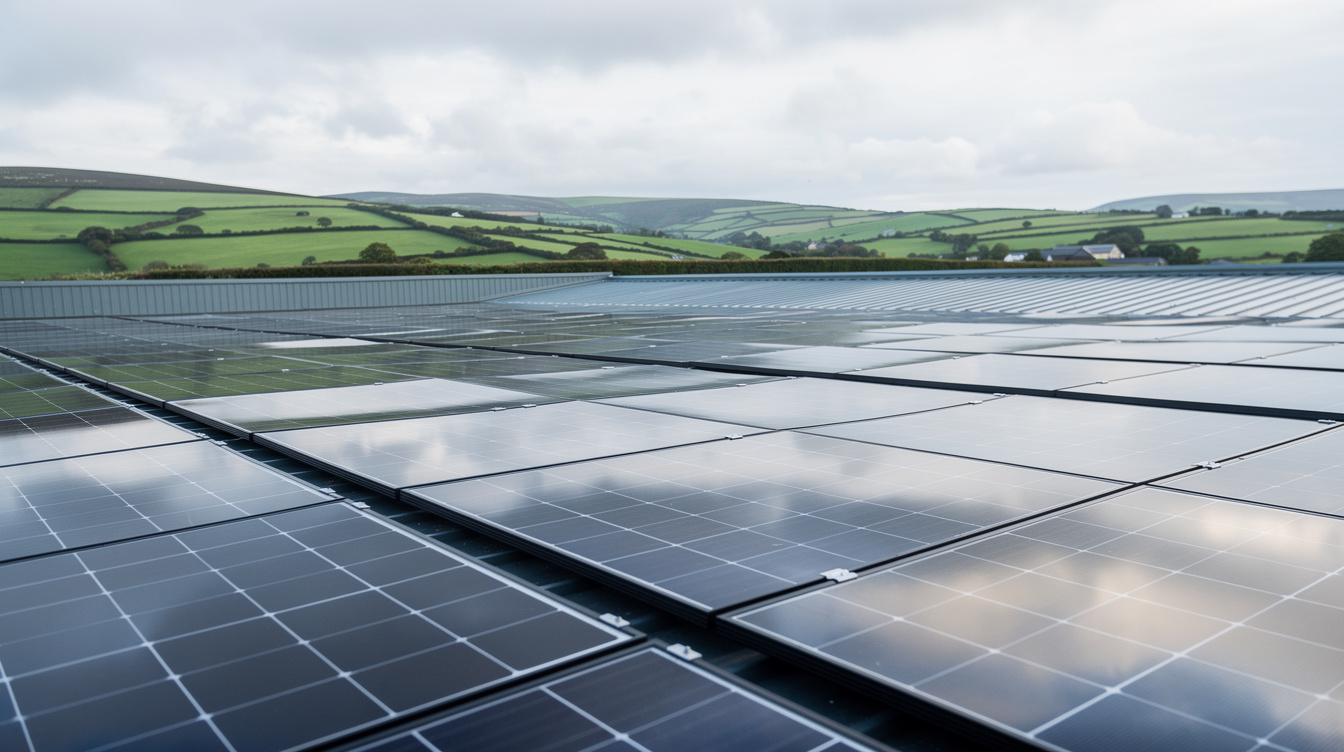
What works for which sector
Manufacturing & cold storage (5-day, daytime load)
Best fit for solar. Production hours overlap exactly with peak generation. Self-consumption rates of 75–90% are common, so you avoid relying on Clean Export Premium pricing. Cold storage in particular sees compressor loads track sunshine.
Typical sweet spot: 100–500 kWp. Payback 3–5 years.
Retail & warehousing
Daytime opening hours, plenty of roof space, fairly predictable consumption profiles. Distribution centres with refrigeration and conveyor systems do particularly well.
Typical sweet spot: 50–200 kWp. Payback 4–6 years.
Hotels, restaurants & hospitality
Load profile peaks evening (kitchens, lighting, EV chargers, rooms) but daytime laundry, refrigeration, HVAC, and pool heating soak up summer generation. Adding a battery raises self-consumption from ~40% to ~70%.
Typical sweet spot: 30–100 kWp + battery. Payback 5–7 years.
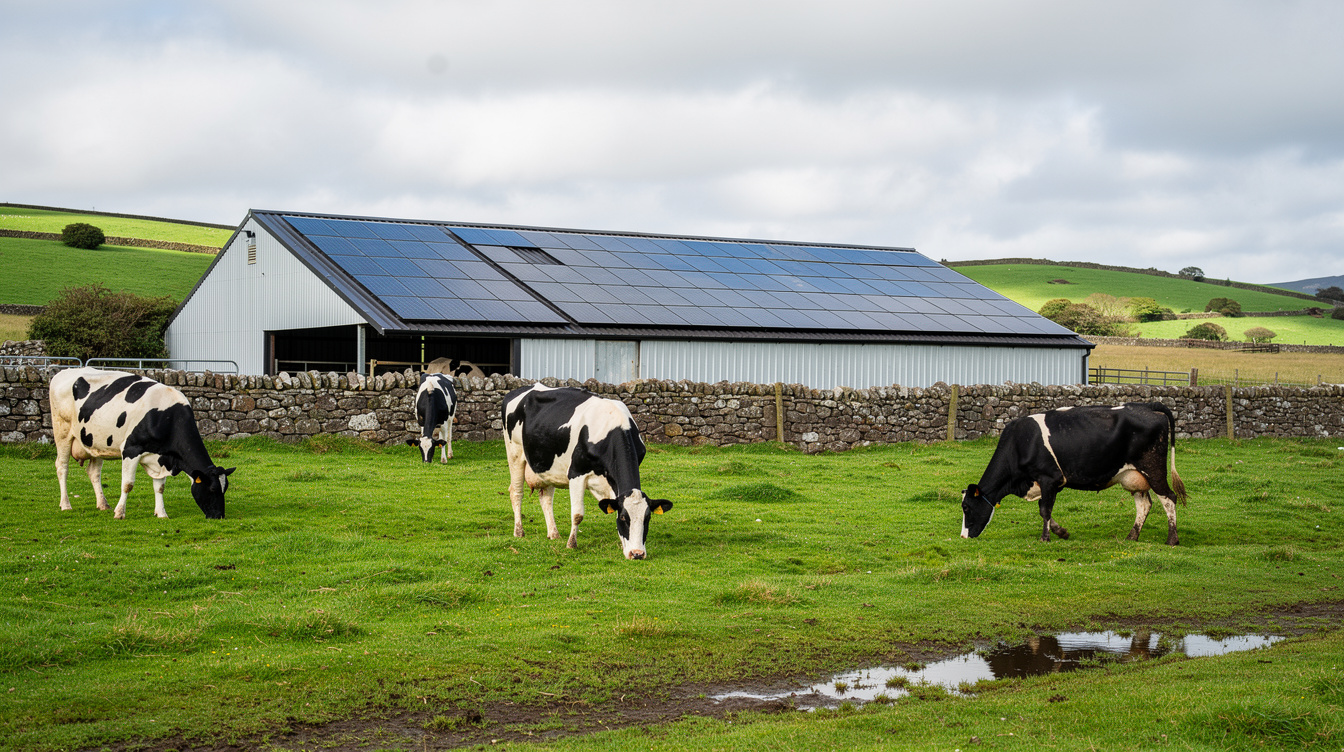
Dairy farms
Morning and evening milking loads, plus continuous bulk tank cooling. Solar plus a milk pre-cooler or hot water diverter can drop electricity bills by 60–80%. The TAMS 3 grant can stack with NDMG for certain on-farm renewable equipment — ask your agri-adviser. See our farms 2026 guide for the full agri picture.
Typical sweet spot: 11–50 kWp. Payback 4–6 years.
Offices (5-day, mostly daytime)
Loads are smaller than manufacturing but very well aligned with generation. The challenge is summer holiday weeks when half the office is empty and self-consumption drops.
Typical sweet spot: 20–75 kWp. Payback 5–7 years.
Schools, community centres, GAA clubs
Eligible for NDMG. Schools have a particular pattern issue (closed in summer when generation peaks), so sizing should target winter day demand rather than summer peak. Many schools work with the Local Enterprise Office or their Education and Training Board on co-funding.
Typical sweet spot: 15–50 kWp. Payback 6–9 years.
Ready to size a system for your premises?
A commercial installer will do a free site survey and produce a sized quote with realistic yield modelling.
Worked example: 100 kWp on a Cork manufacturing unit
A real-world style example, with 2026 numbers. SME manufacturer, single-shift operation, ~340,000 kWh/yr at €0.26/kWh average. 100 kWp PV on a south-east-facing standing-seam roof.
| Item | Value |
|---|---|
| Installed cost (before grant) | €110,000 |
| NDMG grant | −€22,600 |
| ACA Year 1 tax shield (12.5% of €87,400) | −€10,925 |
| Effective net cost | €76,475 |
| Annual generation | 92,000 kWh |
| Self-consumed (85%) | 78,200 kWh × €0.26 = €20,332 |
| Exported (15%) | 13,800 kWh × €0.20 = €2,760 |
| Year 1 savings | €23,092 |
| Simple payback | ~3.3 years |
| 25-year cumulative savings (3% inflation) | ~€850,000 |
That is a return on the effective net investment that no other plant or machinery purchase comes close to matching. And the system keeps producing for at least 10 years beyond that.
The commercial install process — from survey to switch-on
Commercial solar installation in Ireland is materially different from residential. The mechanical roof work alone is faster than a domestic install — bigger crews, ballasted mounts, repetitive panel layout — but the regulatory and grid-connection paperwork is heavier. Here is the realistic week-by-week sequence for a typical 50–100 kWp install on an SME factory or office roof in 2026.
| Week | Stage | What happens | Owner action required |
|---|---|---|---|
| 1 | Desktop survey & quotation | Installer pulls satellite imagery, runs PVsyst yield model, drafts proposal | Share 12 months of MPRN consumption data |
| 2–3 | On-site engineering survey | Structural assessment, electrical infrastructure audit, drone roof scan, shading study | Roof access, switchroom access |
| 3–4 | Contract & deposit | Final design, equipment specification (panels, inverters, optimisers), 25–30% deposit | Sign-off, deposit transfer |
| 4–5 | SEAI NDMG grant application | Installer submits the application on your behalf via the SEAI portal | Provide BER cert, ownership proof, tax clearance |
| 5–8 | ESB Networks NC7 application | For systems above 11 kVA, ESB Networks reviews the connection. NC6 below that threshold | Sign single-line diagram, pay connection fee (if applicable) |
| 6–9 | Procurement & logistics | Panels, inverters, ballast and racking ordered. 4–8 week lead time for hybrid inverters in 2026 | Confirm delivery access window |
| 9–11 | Mechanical install | Ballast or pierce-fixing of mounting rails, panel mounting, DC wiring. 50–100 kWp typically takes 5–8 working days on the roof | Provide on-site welfare, allow rooftop crane lift slot if required |
| 10–12 | Electrical install & commissioning | Inverter mounting, AC cabling to switchroom, isolators, metering, system commissioning by RECI/Safe Electric engineer | Brief planned outage (typically 2–4 hours) |
| 12–13 | ESB Networks witness test | For systems above 11 kVA, ESBN engineer attends to witness grid-protection settings and authorise energisation | Provide ESBN engineer access |
| 13–14 | Switch-on & handover | System energised, monitoring portal handed over, O&M contract signed, grant claim submitted to SEAI | Receive monitoring login, sign off on final invoice |
Total elapsed time for a typical install is 8–14 weeks depending on grid-connection complexity. The two biggest delay risks are (a) ESB Networks queueing for the NC7 review — backlogs of 6–10 weeks were common in late 2025 and are improving but not gone — and (b) hybrid inverter availability if you’re specifying battery-ready architecture. Pure grid-tied installs without battery commission faster.
Three pieces of paperwork that catch businesses out
- SEAI eligibility for the NDMG grant requires the building to have been built before 1 January 2021. Newer premises don’t qualify for this scheme but may be eligible under the Renewable Electricity Support Scheme (RESS) for systems above 200 kWp.
- Tax clearance from Revenue is mandatory before SEAI will release the grant payment. If your tax position is contested or you have outstanding returns, sort that out before applying.
- BER for non-domestic buildings is required to be in date (issued within the last 10 years). If your existing BER cert is over 7 years old, get it renewed before the grant application stage — otherwise you’ll be holding up the install at week 4.
Three ways to fund a commercial install
1. Cash purchase
Simplest, lowest lifetime cost. You own the asset, claim the grant, claim the ACA, and capture 100% of the savings. Suits businesses with strong cash reserves and high taxable profits. Most SMEs above €1m turnover should look here first.
2. Asset finance / green loan
BOI, AIB, Bank of Ireland, and Credit Union groups all offer green business loans at 5–7% APR over 5–10 years for solar PV. The loan structure means you pay for the system from the energy savings rather than cashflow — effectively free solar after Year 1. Most SMEs choose this route.
3. Power Purchase Agreement (PPA)
A third party installs and owns the system on your roof. You buy the electricity it produces at a discounted fixed rate (typically €0.14–€0.18/kWh) for 15–20 years. No upfront cost, no maintenance worries, but you give up the grant, the ACA, and most of the lifetime savings. Suits cash-constrained businesses with predictable consumption — warehouses, data centres, large hotels.
Six expensive mistakes Irish businesses make
- Oversizing for export. Self-consumed kWh are worth €0.26+; exported kWh are worth €0.18–€0.22. Size to consumption, not to roof capacity. Putting 200 kWp on a 50 kW load site makes the maths much worse.
- Ignoring the ESB import capacity. Larger systems (above ~50 kWp) need a Network Connection Application (NC7 / NC8). Lead times can be 3–9 months. Find out your premises’ export capacity before signing a quote.
- Forgetting the roof. Solar systems carry a 25-year design life. If your roof has 8 years left, you are signing yourself up for a panel-removal and re-install bill in Year 9. Re-roof first.
- Not running the ACA past your accountant. Some businesses miss the 100% Year 1 writedown and apply standard wear and tear. Make sure your finance team flags the equipment as ACA-eligible.
- Signing without three quotes. Commercial solar quotes vary by €100–€250 per kWp installed for similar equipment. On a 100 kWp system that is €10,000–€25,000.
- Picking the cheapest installer. A commercial PV system needs a commissioning engineer who can liaise with ESB Networks NC, file the NDMG paperwork, and provide a credible 10-year service contract. Cut-price residential installers often cannot do any of the three.
What to do this week
- Pull your last 12 months of electricity bills. Note the average day rate, total kWh, and the demand pattern (5-day vs 7-day, mostly daytime or evening).
- Measure or estimate available roof area. South-facing pitched roofs are gold. Flat roofs are also fine but use ballasted mounting. Check structural condition.
- Confirm your ESB MPRN, supply rating, and export capacity. A quick call to ESB Networks customer service answers all three.
- Request three commercial quotes. Each should include a sized system, yield model, grant application support, NC7 paperwork, and a 10-year service offer.
- Run the numbers past your accountant for ACA treatment, and your bank or asset finance provider for funding options.
Ready to Go Solar?
Get free commercial solar quotes for your premises from SEAI-registered installers. Three quotes, side-by-side, no obligation.
Further reading
- Solar Panels for Farms in Ireland 2026: TAMS 3 Grants, Costs & What Every Farmer Needs to Know
- Solar Inverters Ireland 2026: Hybrid vs String vs Microinverters
- Clean Export Guarantee Ireland 2026: Selling Electricity to the Grid
- Best Electricity Supplier for Solar Export Ireland 2026
- Solar Panel Calculator Ireland
Related Articles
Solar Panel System Cost by Number of Panels Ireland 2026: 8, 12, 14, 20, 24 Panel Prices
What 8, 12, 14, 16, 20 or 24 solar panels actually cost in Ireland 2026 — net after €1,800 SEAI grant & 0% VAT, output kWh, roof area & battery add-ons.
6kW Solar System Cost Ireland 2026: Real Prices, Output & Payback
6kW solar costs €7,700–€10,500 net after the €1,800 SEAI grant and 0% VAT in Ireland 2026. Real quote, 5,270 kWh/yr output, EV/battery ROI.
5kW Solar System Cost Ireland 2026: Real Prices, Output & 25-Year ROI
5kW solar system costs €6,700–€9,200 net after the €1,800 SEAI grant and 0% VAT in Ireland 2026. Full itemised breakdown, real output data & battery ROI.