

Solar Panels Kilkenny 2026: Costs, Grants, Yields & Installers
Solar panels in Kilkenny do something most of the country can’t: they generate close to the highest annual yield of anywhere in Ireland. The county sits at the same southerly latitude band as Waterford and south Wexford, and the long-term Met Éireann irradiance data puts Kilkenny’s typical PV output at 940–955 kWh per installed kWp — behind only Wexford and Waterford, and roughly 10–13% above the national average. For a 4.4 kWp household array, that’s an extra 350–450 kWh a year compared with the same panels in Donegal or Leitrim, with no change to the kit.
That sounds like Kilkenny’s solar decision should be a no-brainer. For most county homes — the commuter belt around Castlecomer, the dairy land between Bennettsbridge and Thomastown, the Carlow-border villages around Freshford — it is. But the city centre is a different story. Kilkenny’s medieval core sits inside a sprawling Architectural Conservation Area (ACA), and large parts of John Street, High Street, the Parade and the streets feeding off Rose Inn Street are Protected Structures. Rooftop PV inside any of those zones is not automatic-exempt — it needs explicit planning consent, and rules around panel visibility from public roads have tightened in 2026.
This guide walks through 2026 costs, the SEAI grant, where Kilkenny’s heritage planning rules actually bite (and where they don’t), realistic payback for 5 representative county households, and how the cross-border maths works for anyone weighing up Kilkenny vs. moving to a Carlow or Waterford address.
Kilkenny solar costs in 2026 — what you’ll actually pay
Below are the 2026 fitted prices we’re seeing from SEAI-registered installers covering Kilkenny city, Castlecomer, Thomastown, Callan, and the commuter belt to Carlow town and Waterford city. All prices are before SEAI grant, before VAT relief, and assume a tile or slate Irish-standard pitched roof of 30–40°.
| System size | Panels | Fitted cost (before grant) | Net cost after €1,800 grant + 0% VAT | Typical annual yield |
|---|---|---|---|---|
| 2.6 kWp | 6 panels | €6,200–€7,400 | €4,400–€5,600 | 2,440–2,480 kWh |
| 4.4 kWp | 10 panels | €8,400–€9,500 | €6,600–€7,700 | 4,135–4,200 kWh |
| 5.7 kWp | 13 panels | €10,200–€11,400 | €8,400–€9,600 | 5,360–5,440 kWh |
| 5.7 kWp + 5 kWh battery | 13 panels + storage | €13,800–€15,200 | €12,000–€13,400 | 5,360 kWh (60–72% self-use) |
| 8.8 kWp + 10 kWh battery | 20 panels + storage | €18,400–€21,000 | €16,600–€19,200 | 8,270–8,400 kWh |
Two prices in this table are worth noting. The 4.4 kWp quote in Kilkenny tends to run €200–€500 below an equivalent Donegal quote, mostly because Kilkenny installers are concentrated within an hour’s drive of any county address (Carlow, Waterford and south Tipperary firms all cover the area), keeping travel costs compressed. And the 5.7 kWp + 5 kWh battery package — the most popular configuration we see ordered in the county — comes out among the lowest battery-inclusive quotes in Ireland, again because of installer density.
SEAI €1,800 grant in Kilkenny: who qualifies and how to apply
The SEAI Solar PV grant in 2026 covers anyone whose Kilkenny home was built and occupied before 1 January 2021, where the homeowner has never previously claimed a Solar PV grant at that MPRN, and where the installation is done by a SEAI-registered installer using SEAI Triple-E listed equipment. The grant is paid as a fixed structure:
- First 2 kWp installed: €700 per kWp — so the first 2 kWp = €1,400
- Each additional kWp from 2–4 kWp: €200 per kWp = €400 max
- Maximum grant: €1,800 for any system ≥ 4 kWp
For a standard 4.4 kWp Kilkenny system that maxes the grant, you’re also paying 0% VAT (the residential PV VAT rate dropped to zero in 2023 and remains in force in 2026). The grant is paid after installation and Building Energy Rating (BER) certification — usually 4–7 weeks after the installer’s final paperwork. The household needs to BER-rate the property if it doesn’t have a valid one already.
Verify the current grant scheme directly with SEAI here before applying.
Where Kilkenny’s heritage planning rules actually bite
This is the single most asked question from Kilkenny city residents in 2026. The answer is less dramatic than the rumour suggests.
The exempted-development rules introduced under the 2022 Planning and Development (Solar Safeguarding) Regulations — broadly allowing rooftop solar without planning permission — have generally applied in Kilkenny since 2022. But there are three carve-outs that hit the city specifically:
- Protected Structures (full planning required). Any building entered on the Kilkenny County Council Record of Protected Structures (RPS) needs explicit planning consent for rooftop PV, regardless of where the panels go. The RPS covers most of Kilkenny Castle’s curtilage, the Tholsel, St Canice’s, the Black Abbey, several houses on John Street, High Street and the Parade, and a long list of smaller heritage buildings throughout the city and county.
- Architectural Conservation Areas (ACAs). Kilkenny City has the largest ACA in the south-east. PV inside an ACA isn’t automatically banned, but visibility from public roads — particularly main streets, the medieval city walls walk, and views to the Castle — is the test the planners apply. Panels on a rear roof slope are usually fine. Panels on a front roof slope visible from a heritage street will often be refused or require approval as a Section 5 declaration first.
- Heritage village ACAs around the county. Inistioge, Bennettsbridge, Thomastown, Graiguenamanagh and Callan all have heritage village designations affecting their main streets. Similar visibility tests apply but enforcement is less strict than in the city centre.
Practical advice: if you’re in a Kilkenny property and either suspect it’s a Protected Structure or are inside an ACA, request a Section 5 declaration from Kilkenny County Council’s planning department before signing an install contract. The declaration is free, takes 4 weeks, and gives you a written planner’s view on whether your proposal counts as exempted development. Skipping this step is the single most common reason a Kilkenny city PV install gets turned into a planning appeal six months later.

Unsure if Your Kilkenny Property Needs Planning Consent?
SEAI-registered installers covering Kilkenny know the ACA boundaries and will flag heritage issues upfront. Get a free, no-obligation quote.
Solar output: why Kilkenny ranks third in Ireland
Met Éireann’s long-term irradiance data has Kilkenny averaging 940–955 kWh per kWp per year, with the south of the county (around Mooncoin, Piltown and Owning) creeping toward 960. By way of comparison, Dublin sits at 880–900 and Donegal at 830–870. The reasons are straightforward:
- Latitude. At 52.5–52.7°N Kilkenny is about half a degree south of Dublin and nearly two degrees south of Donegal. That alone adds 3–4% to annual yield.
- Lower coastal cloud cover. Kilkenny sits in the “Sunny South-East” rain shadow. South-east Ireland clocks roughly 1,400–1,500 sunshine hours/year vs. the western coast’s 1,100–1,250.
- Inland diffuse-light boost. Even on overcast days, southeast Ireland’s lower aerosol load (it’s downwind of nobody in particular) produces marginally better diffuse irradiance.
Practical implication: a Kilkenny household running a 4.4 kWp array will see roughly 4,150 kWh of generation in a typical year — about 150–200 kWh more than the same array in Dublin, and 400+ kWh more than the same array in Donegal. At 22–28c/kWh import value, that’s an extra €88–€112/year of savings just from location.
Five Kilkenny scenarios — what real households are paying
1. Castlecomer commuter couple, 3-bed semi
Profile: Two adults, both commuting (one to Carlow, one working remote), no kids yet, 3,800 kWh/year usage. South-facing semi with 30° pitch on a 1990s estate roof. EV charging two days a week off the roof. 4.4 kWp panels, no battery.
Cost: €8,800 fitted, €7,000 net after grant. Yield: 4,150 kWh. Self-consumption: 41%. Annual saving (import offset + CEG export): €1,030. Payback: 6.8 years.
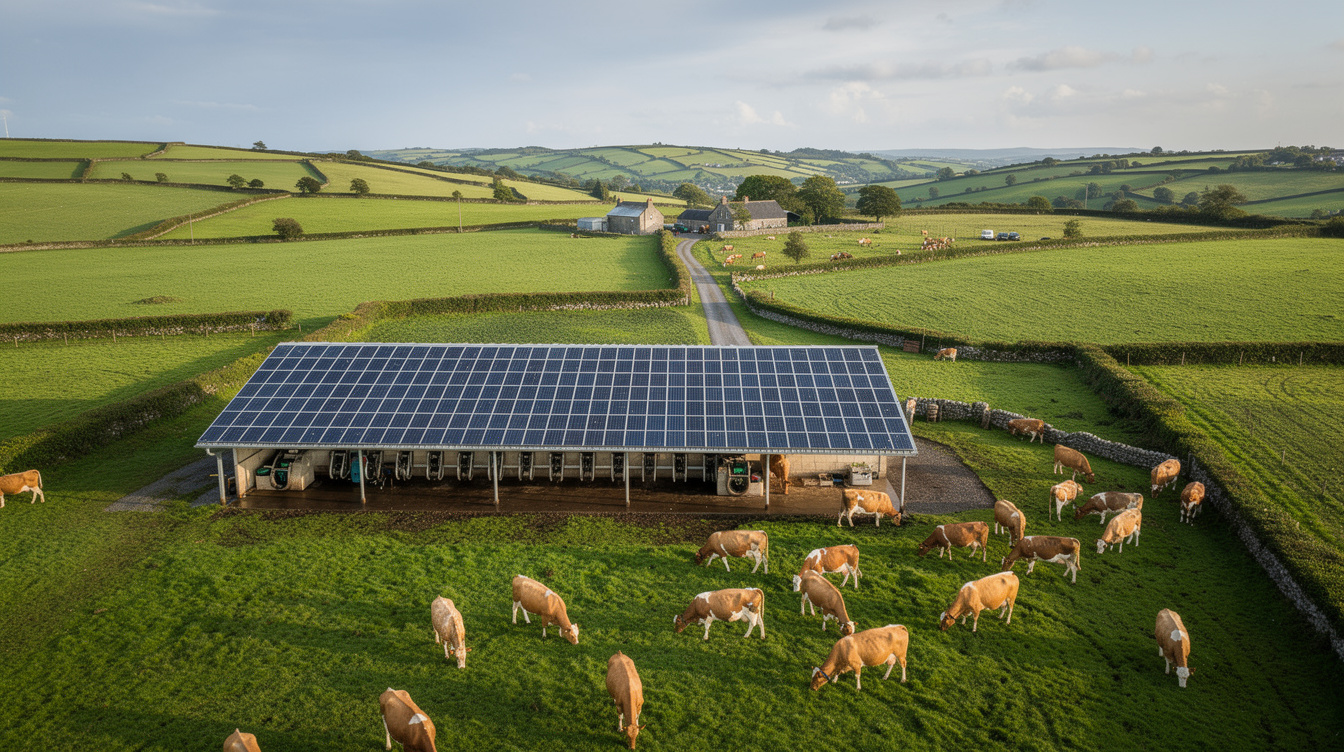
2. Bennettsbridge dairy farm, 80-cow Jersey herd
Profile: South-facing farm shed with 60 m of clear south-pitch slate roof. Bulk tank, milk parlour, two 18 kW dairy washers, ~28,000 kWh/year farm usage. TAMS 3 eligible.
Cost: 18 kWp install €28,500. TAMS 3 covers up to 60% for younger farmers (€17,100 grant) leaving net cost €11,400. Yield: 17,100 kWh. Self-consumption: 86% (farm load profile matches generation curve very closely — the bulk-tank chilling cycle and morning/evening milking parlour washer runs hit the south-peak). Payback: 2.4 years.
3. Thomastown retiree, 4-bed cottage on a heritage street (ACA)
Profile: Retired couple, 5,400 kWh/year (oil-fed central heating supplemented with night-rate electric storage heaters). Front roof faces the main street and is inside the Thomastown ACA. Rear roof faces west onto a private garden and is not visible from any public road.
Outcome: Section 5 declaration confirms rear-roof installation as exempted development. 3.5 kWp west-facing array (suboptimal but planning-clean). Cost: €7,400 fitted, €5,600 net. Yield: 2,925 kWh (90% of equivalent south yield due to 3pm peak alignment with retiree late-afternoon usage actually helping self-use). Self-consumption: 52%. Payback: 7.6 years.
4. Callan family of 4, EV + heat pump
Profile: 1950s detached bungalow, retrofitted to B2 BER, heat pump replacing oil boiler. Family of four, EV in driveway, 9,200 kWh/year electric usage. South-facing rear roof.
Cost: 8.8 kWp + 10 kWh battery, €19,400 fitted, €17,600 net. Yield: 8,360 kWh. Self-consumption with battery: 78%. Annual saving: €2,690 (import offset + CEG export). Payback: 6.5 years.
5. Freshford remote-worker single-occupancy, 2-bed cottage
Profile: One adult, fully remote, lights/laptop/heat-pump-tumble-dryer profile of 2,950 kWh/year. South-facing main roof. No EV.
Cost: 2.6 kWp, €6,800 fitted, €5,000 net. Yield: 2,460 kWh. Self-consumption: 47% (excellent match because the WFH daytime load profile aligns with peak generation hours). Annual saving: €620. Payback: 8.1 years.
Cross-border maths: Kilkenny vs. Carlow vs. Waterford
| County | Avg yield kWh/kWp | Typical 4.4 kWp install € | Annual gen kWh | 10-yr saving (typical 4-person home) |
|---|---|---|---|---|
| Kilkenny | 940–955 | €8,400–€9,500 | 4,135–4,200 | ~€12,400 |
| Waterford | 945–960 | €8,400–€9,400 | 4,160–4,225 | ~€12,500 |
| Wexford | 950–970 | €8,500–€9,600 | 4,180–4,270 | ~€12,600 |
| Carlow | 920–940 | €8,500–€9,700 | 4,050–4,135 | ~€12,150 |
Three things stand out. First, the south-east is genuinely the best PV region in Ireland — Wexford, Waterford, Kilkenny and south Tipperary all out-yield the rest of the country meaningfully. Second, the differences between those top three counties are small enough (€100–€200 over 10 years) that nobody should move address to chase them. Third, Kilkenny’s cost advantage over Carlow comes from installer density rather than yield, and is real but modest.
What kit Kilkenny installers actually use in 2026
The standard 2026 install across Kilkenny SEAI-registered installers comes down to a small number of kit choices:
- Panels. 440–460 Wp n-type TOPCon mono (typically Jinko Tiger Neo, Trina Vertex S+, Longi Hi-MO 6, JA Solar). All Triple-E listed.
- Inverter. Sungrow SH series (hybrid), Solis S6 hybrid, GoodWe ET series, or SolaX X3 hybrid for larger arrays. Almost all are now dual-MPPT hybrid — the standard 2026 spec.
- Battery. GivEnergy AC3, Pylontech Force-H2, Huawei LUNA, Sungrow SBR, or Tesla Powerwall 3 for premium specs. LFP chemistry throughout.
- Mounting. Schletter Rapid2+ or K2 Speed clamp on standard slate/tile roofs. Aluminium rails grade EN AW-6005A-T6, A2 stainless fixings (the south-east doesn’t have the salt-air problem the west coast has, so installers don’t need C5-M corrosion-rated kit).
How long does a Kilkenny solar install take?
From signed contract to commissioned, expected duration in 2026:
- Quote to contract: 1–3 weeks
- If in ACA / suspected Protected Structure — Section 5 declaration: +4 weeks (can run in parallel with kit ordering)
- Kit ordering and scheduling: 3–5 weeks
- Installation: 1–2 days for a 4.4 kWp system, 2–3 days for systems with battery
- NC6 form lodged + ESB Networks approval: 2–4 weeks
- Smart meter swap (if not already done): 4–8 weeks separately, doesn’t block generation
- First CEG export payment hits supplier account: 8–14 weeks after install
Find a SEAI-Registered Installer Covering Kilkenny
We connect you with quality installers covering Kilkenny city, the wider county and the Carlow/Waterford borders. Free quote, no obligation.
Frequently asked questions
Are solar panels allowed on the medieval city streets in Kilkenny?
It depends on whether the building is a Protected Structure and whether the proposed panels are visible from a public street within the ACA. Rear-roof installations on non-protected buildings inside an ACA are routinely approved. Front-roof installations on the Parade, High Street and John Street are rarely approved. The Section 5 declaration process gives you a free written answer in 4 weeks.
How much does the SEAI grant pay for a Kilkenny home?
Up to €1,800 in 2026, the same as everywhere in Ireland. The grant is structured as €700 per kWp for the first 2 kWp (€1,400) plus €200 per kWp from 2–4 kWp, capping at €1,800. A 4.4 kWp Kilkenny install gets the maximum.
What annual generation can I expect from a 4.4 kWp Kilkenny system?
Around 4,135–4,200 kWh in a typical year. South of the county (Mooncoin, Piltown) edges to 4,225 kWh. North (around Castlecomer) sees about 4,100. Real performance depends on roof orientation, pitch, and shading.
Is Kilkenny a good place for a battery as well as panels?
Yes — the high yield means a south-east battery captures more surplus than the same battery in Dublin or further north. A typical 5.7 kWp + 5 kWh setup in Kilkenny averages 60–72% self-consumption vs. 50–62% for the same kit in Donegal, simply because there’s more solar surplus to store on a Kilkenny summer Saturday. See our guide to the best solar batteries in Ireland in 2026 for kit choices.
Will I be able to sell my surplus to the grid in Kilkenny?
Yes — the Clean Export Guarantee covers all SEAI-registered Kilkenny installs the same as the rest of Ireland. Export rates in 2026 are 18–25c per kWh depending on your supplier. See our CEG guide for current rates and the smart-meter swap process.
What if my Kilkenny roof faces east or west, not south?
A dual-MPPT hybrid inverter is the standard 2026 fix. East-west arrays in Kilkenny still deliver around 90–93% of pure-south yield because the south-east cloud profile favours diffuse-light generation even off-axis. Read our east/west roof guide for the detailed yield maths.
Are there finance options for Kilkenny solar installs?
SEAI’s low-cost Home Energy Upgrade Loan (3–3.5% APR, up to €75,000, terms up to 10 years) is available for solar installs in Kilkenny through participating credit unions and AIB/BOI/PTSB. Several Kilkenny installers also offer in-house finance with no-deposit options. Our solar finance guide compares the options.
Bottom line for Kilkenny
Kilkenny’s solar economics are among the best in Ireland. The yield is third-highest in the country, installer competition is tight enough to keep prices below the national average, the €1,800 SEAI grant applies as everywhere else, and the dairy and commercial sectors have first-class TAMS 3 economics on south-facing farm sheds. The one real complication is the heritage city centre, where the ACA and Protected Structure rules can’t be ignored. For the rest of the county, in 2026, the question isn’t whether solar makes sense in Kilkenny — it’s whether to go now or next quarter.
Get Your Free Kilkenny Solar Quote
SEAI-registered installers covering Kilkenny city, county and the Carlow/Waterford borders. Free, no obligation.
Related Articles
4kW Solar System Cost Ireland 2026: Real Prices, Output & Payback
Real 2026 Irish 4kW quotes (€7,210 gross, €5,410 net after €1,800 SEAI grant), 3,600–4,200 kWh/yr output, 4.8yr payback and when 4kW beats 3kW or 5kW.
10kW Solar System Cost Ireland 2026: Price, Output & When It’s Worth It
Real 2026 Irish installer prices for a 10kW solar system (€14,300 gross – €1,800 SEAI grant), three-phase rules, expected output and when 10kW beats 6kW.

Solar Panels on Protected Structures & Listed Buildings in Ireland 2026: Planning, Section 5 & Real Costs
Own a Georgian or listed home in Ireland? Section 5 vs planning permission, what heritage installs actually cost, and what gets approved in 2026.