
Solar Panels Meath 2026: The Commuter County Going Solar — Costs, Grants & What 1,972 Homes Already Know
In 2025, 1,972 homes in County Meath received SEAI solar panel grants — one of the highest uptake rates in Ireland. And it makes perfect sense: Meath is Ireland's fastest-growing county, filled with newer builds that have south-facing roofs practically designed for solar panels. The typical Meath household — commuters with high electricity bills, electric cars to charge, and large detached homes — is exactly the profile that benefits most from solar PV.
This guide covers everything Meath homeowners need to know in 2026: real pricing from installers serving Navan, Ashbourne, Trim, Dunshaughlin and beyond, county-specific output data, and why Meath's housing stock makes it one of the best places in Ireland to go solar right now.
Get Meath Solar Quotes in 24 Hours
Compare prices from SEAI-registered installers serving County Meath — free, no obligation.
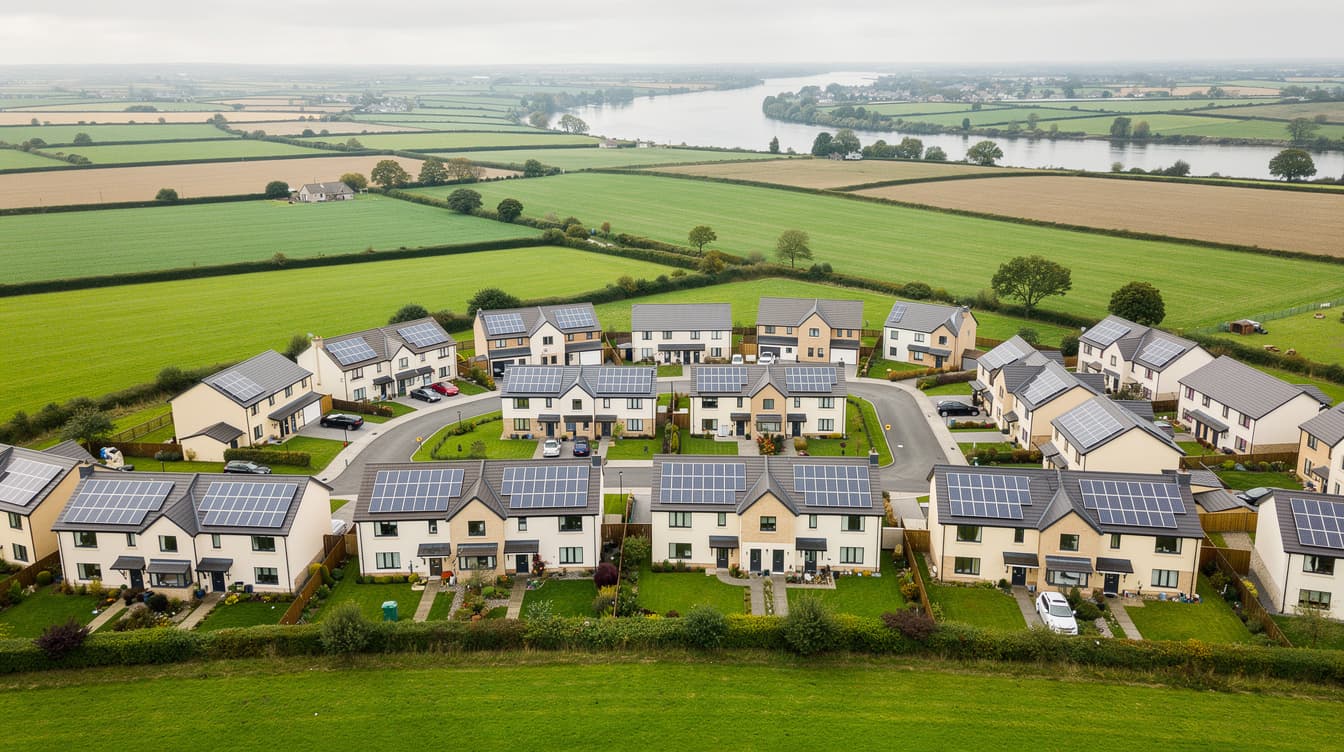
Why Meath's Housing Stock Is Perfect for Solar
Meath isn't Ireland's sunniest county — that honour goes to Wexford. But Meath has something equally valuable: the right kind of houses. The county's population surged 13% to 220,826 between 2016 and 2022, with vast new estates built in Ashbourne, Dunboyne, Ratoath, and Dunshaughlin. These modern homes typically feature:
- Large roof areas — detached and semi-detached homes with 40–60 m² of usable roof space
- South or south-west facing roofs — modern estate design often includes at least one solar-friendly pitch
- Strong electrical infrastructure — newer builds have modern consumer units ready for solar integration
- High electricity consumption — larger homes with heat pumps, EV chargers, and home offices consume 5,000–8,000 kWh/year, meaning more of your solar generation offsets expensive grid electricity
This combination of high consumption and good roof space means Meath homeowners often see better financial returns from solar than households in sunnier but smaller-roofed areas.
Solar Output in Meath: The Numbers
Meath sits in Ireland's midlands-east belt, with respectable sunshine and moderate cloud cover. Here's how the county performs:
| Metric | Meath | National Average | Difference |
|---|---|---|---|
| Sunshine hours/year | 1,280–1,350 | 1,100–1,250 | +8–12% |
| Solar yield (kWh/kWp) | 885 | 884 | On par |
| Annual rainfall (mm) | 850–950 | 1,000–1,200 | Lower rainfall = fewer cloudy days |
| 4 kWp system annual output | 3,540 kWh | 3,400–3,800 kWh | Solid mid-range |
| Peak sun hours/day (annual avg) | 2.6–2.8 | 2.5–2.8 | Average |
Meath's solar yield of 885 kWh/kWp is close to the national average. This is not a disadvantage — it still means a typical 10-panel system generates 3,500+ kWh per year, enough to cover 70–85% of a standard household's electricity. And because Meath homes tend to consume more electricity (EV charging, heat pumps, larger homes), the self-consumption rate is higher, which is where the real savings come from.
What Solar Panels Cost in Meath in 2026
Meath's proximity to Dublin means it's served by a large pool of installers — both Dublin-based companies making the short trip north, and local Meath installers. This competition keeps prices keen. Here's what you'll pay in May 2026, after the €1,800 SEAI grant:
| House Type | Typical System | Before Grant | After €1,800 Grant | Annual Output |
|---|---|---|---|---|
| 3-bed semi (estate) | 10 panels / 4.1 kWp | €5,800–€7,200 | €4,000–€5,400 | 3,630 kWh |
| 4-bed detached (newer build) | 14–16 panels / 5.7–6.6 kWp | €7,800–€9,800 | €6,000–€8,000 | 5,000–5,800 kWh |
| 5-bed executive home | 18–22 panels / 7.4–9.0 kWp | €10,000–€13,500 | €8,200–€11,700 | 6,500–8,000 kWh |
| Farmhouse/rural | 12–16 panels / 5.0–6.6 kWp | €6,500–€8,800 | €4,700–€7,000 | 4,400–5,800 kWh |
| Panels + 5 kWh battery | 10–14 panels + battery | €9,500–€12,500 | €7,700–€10,700 | 3,630–5,000 kWh |
Meath-specific pricing note: Many Meath installations involve newer builds with straightforward roof access and modern electrical systems. This means fewer surprises and lower labour costs compared to older properties in city centres. Scaffolding requirements on estates are also simpler than terraced streets.
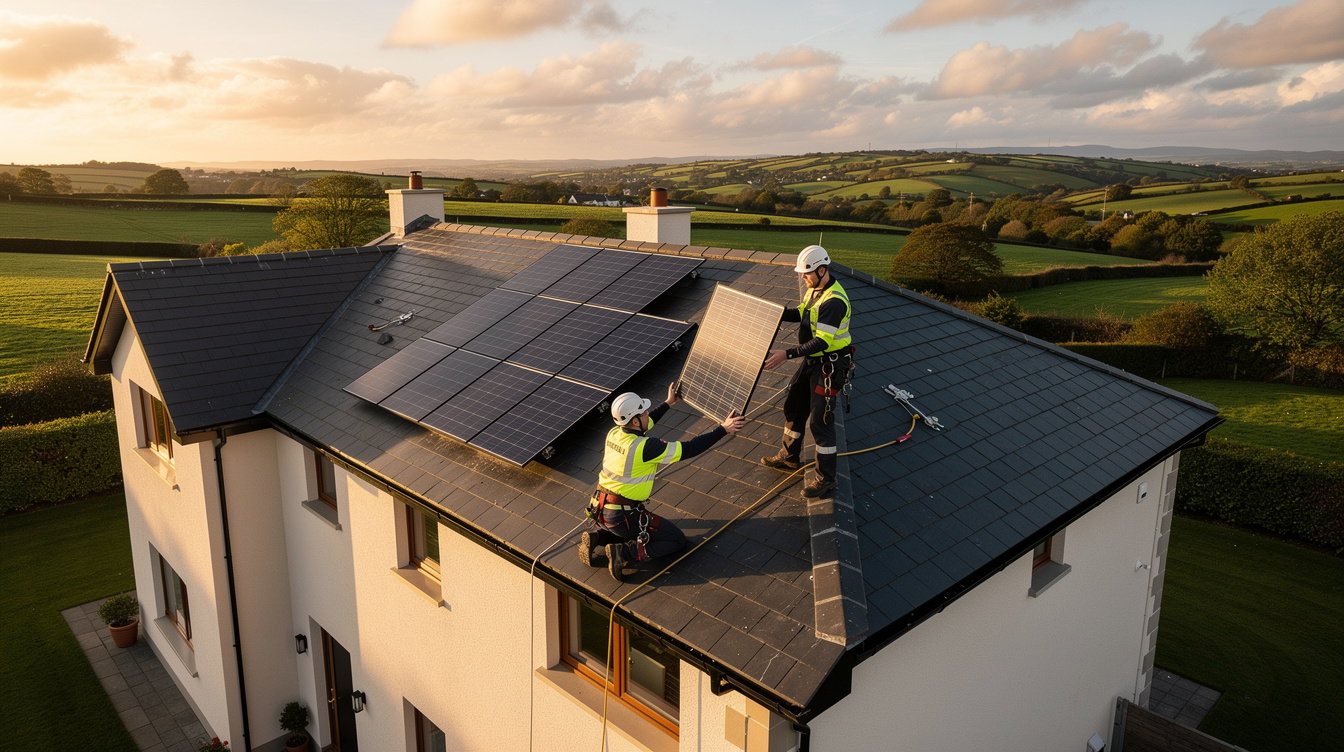
The Commuter Solar Advantage: Why Meath Homes Save More
Here's something that's often overlooked: the financial return from solar panels depends as much on your electricity consumption pattern as on sunshine hours. And Meath commuter households have a consumption profile that's ideal for solar:
| Factor | Typical Meath Home | Why It Helps Solar ROI |
|---|---|---|
| Annual electricity use | 5,500–8,000 kWh | Higher consumption = more solar self-use = fewer exports at lower rates |
| Electric vehicle | Growing rapidly (EV charger penetration above national avg) | Charging an EV with solar saves €600–€1,200/year on fuel |
| Heat pump | Common in new builds (2019+) | Solar offsets heat pump electricity, especially in spring/autumn |
| Home office | Many commuters work from home 2–3 days/week | Daytime presence increases self-consumption from 35% to 55%+ |
A Meath household with an EV and heat pump consuming 7,000 kWh/year will use significantly more of their solar generation directly than a household consuming 4,200 kWh. This means more of your generation displaces expensive grid electricity (24c/kWh) rather than being exported at lower rates (18–25c/kWh).
Real Savings: What to Expect in Meath
Here's a savings breakdown for two typical Meath households:
Scenario 1: 3-bed semi, 4.1 kWp, no battery, no EV
| Income/Saving | Annual Value |
|---|---|
| Bill reduction (self-consumption) | €650–€850 |
| Export payments (CEG) | €180–€300 |
| Total annual benefit | €830–€1,150 |
| Payback period | 4–6 years |
Scenario 2: 4-bed detached, 6.6 kWp, 5 kWh battery, EV charger
| Income/Saving | Annual Value |
|---|---|
| Bill reduction (self-consumption) | €1,100–€1,500 |
| EV charging savings | €400–€700 |
| Export payments (CEG) | €100–€200 |
| Total annual benefit | €1,600–€2,400 |
| Payback period (incl. battery) | 4.5–6.5 years |
The EV + solar combination is particularly compelling for Meath commuters. If you're driving to Dublin and back daily, you're spending €100–€200/month on fuel or grid-charged electricity. Solar brings that close to zero during the sunny months.
Calculate Your Meath Solar Savings
Enter your electricity bill and roof details for a personalised estimate.
The SEAI Grant: What Meath Homeowners Get
Every Meath homeowner installing solar panels can claim the SEAI solar PV grant:
- First 2 kWp: €700 per kWp = €1,400
- 2–4 kWp: €200 per additional kWp = up to €400
- Maximum: €1,800 for systems of 4 kWp or larger
Your home must have been built and occupied before 2021 to qualify. There's no means test and no BER requirement. The grant is paid after installation by an SEAI-registered installer, who handles the application process.
Additional benefits include:
- 0% VAT on solar panel supply and installation (through 2026)
- Tax-free export income — first €400/year of electricity sales is exempt
- Clean Export Guarantee — 18–25c/kWh for surplus electricity
Meath Town by Town: Local Considerations
| Area | Population (2022) | Solar Notes |
|---|---|---|
| Navan | 33,886 | County town; mix of older and newer estates. Older houses may need consumer unit upgrades. Good installer coverage. |
| Ashbourne | Part of 33,516 district | Heavily built up from 2000s onwards. Many south-facing estates ideal for solar. Served by Dublin and Meath installers. |
| Trim | Part of 33,455 district | Historic town — check if your property is in Trim's ACA before installing. Most estates are fine. |
| Dunshaughlin | 6,600+ | Ireland's fastest-growing town (65% growth in 6 years). Almost all newer builds — excellent solar candidates. |
| Dunboyne / Ratoath | Part of 39,326 district | Premium commuter towns. Large detached homes with big roofs — can fit 16–20+ panels easily. |
| Kells / North Meath | Part of 34,575 district | More rural, slightly lower installer density but still well-served. Farmhouses with large roofs are ideal. |
| Laytown / Bettystown | Part of 40,660 district | Coastal area. Benefits from clearer eastern skies. Salt-rated panels recommended for seafront properties. |
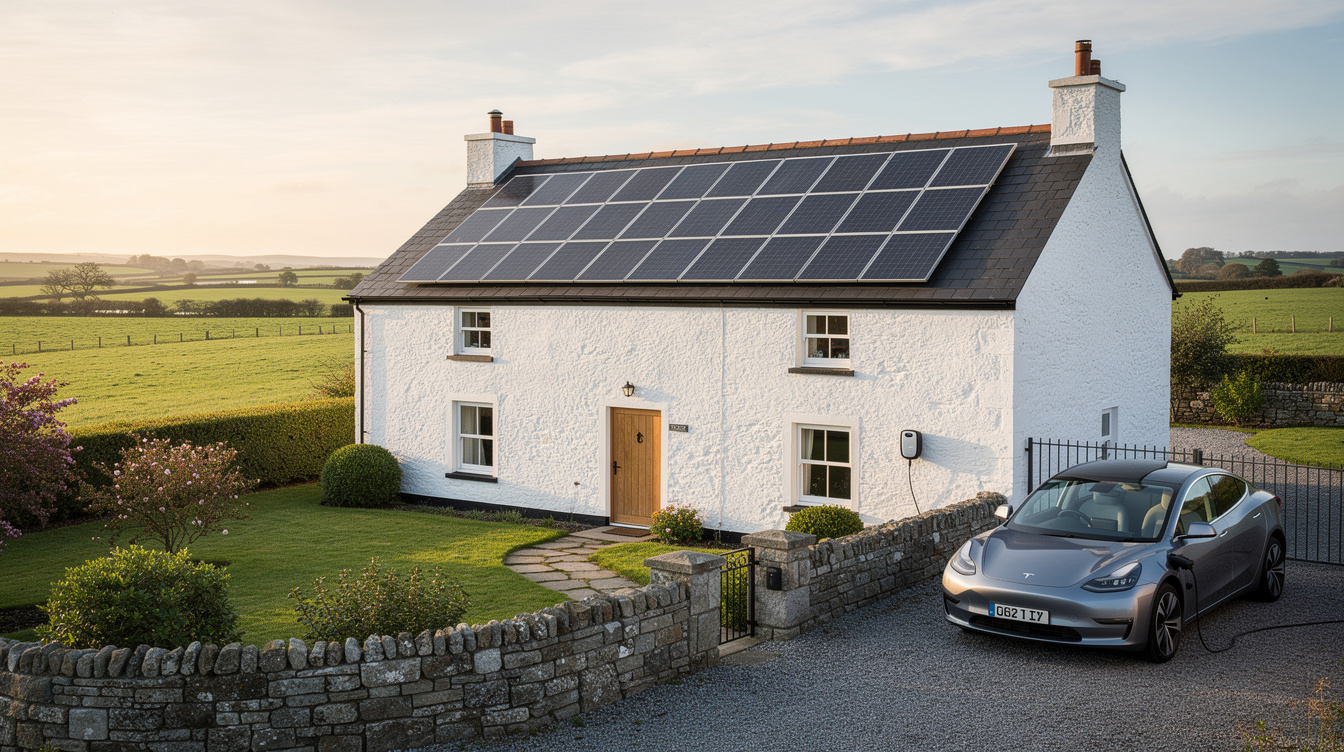
Solar + EV Charging: The Meath Commuter Play
If there's one upgrade that makes solar panels even more valuable for Meath households, it's pairing them with an EV charger. Here's the maths:
- Average Dublin commute from Meath: 50–80 km return trip
- EV consumption: 15–18 kWh per 100 km
- Daily charge needed: 7.5–14.4 kWh
- Grid electricity cost: 24c/kWh = €1.80–€3.46 per day = €650–€1,260/year
- Solar charging cost: effectively free during sunny months (April–September)
If you charge your EV during the day using solar (or store solar in a battery for overnight charging), you can eliminate most of your commuting fuel costs for six months of the year. Even in winter, a smart time-of-use tariff combined with off-peak charging keeps costs low.
How to Choose an Installer in Meath
Meath is well-served by installers from multiple directions: local Meath companies, Dublin-based firms, and companies from Kildare, Louth, and Westmeath. Tips for choosing:
- Get at least 4 quotes — the price range in Meath can vary by €2,000+ for the same system size
- Check SEAI registration — verify at seai.ie. No registration = no grant
- Ask about local experience — installers familiar with Meath estates know the common roof types (concrete tile, slate) and typical consumer unit configurations
- Check panel brands — look for Tier 1 panels (Trina, JA Solar, Longi, Canadian Solar) and reputable inverters (SolarEdge, Enphase, Huawei). See our best solar panels guide
- Warranty matters — 25–30 year panel warranty, 10–15 year inverter warranty, 5–10 year workmanship warranty from the installer
For the full checklist, read our 10 questions and 7 red flags guide.
Planning Permission in Meath
Solar panels are exempt development in most cases. You don't need planning permission if:
- Panels sit within 15cm of the roof surface
- Panels don't extend above the ridge line
- Total area doesn't exceed 12 m² (residential) or 50 m² (commercial)
- Your property isn't a protected structure or in an ACA
Trim and parts of Kells have Architectural Conservation Areas, so check with Meath County Council if you live in a historic area. The vast majority of Meath's suburban estates have no restrictions.
New Builds in Meath: What Developers Include vs What You Should Upgrade
Since the 2021 NZEB (Nearly Zero Energy Building) regulations, all new homes in Ireland must include renewable energy — and most Meath developers install a small solar PV system (typically 1.5–2.5 kWp, or 4–6 panels) to meet the minimum requirement.
The problem? This minimum system is too small for most households. Here's how it compares:
| System | Panels | Output/Year | % of Usage Covered |
|---|---|---|---|
| Developer minimum | 4–6 | 1,300–2,200 kWh | 25–40% |
| Optimal for 3-bed semi | 10–12 | 3,500–4,400 kWh | 70–85% |
| Optimal for 4–5 bed detached | 14–20 | 5,000–7,000 kWh | 85–100% |
If you've bought a new build in Meath with a minimal solar system, adding more panels is straightforward (you can use the same inverter if it has capacity, or add microinverters). And homes built after 2021 do not qualify for the SEAI grant, so factor that into your upgrade budget. For a full breakdown, see our new builds solar guide.
Ready to Go Solar in Meath?
Get your free personalised quote from SEAI-registered installers serving County Meath.
Frequently Asked Questions
How many SEAI solar grants went to Meath in 2025?
1,972 homes in County Meath received SEAI solar panel grants in 2025, making it one of the highest-uptake counties in Ireland. The trend is accelerating in 2026.
Is Meath a good county for solar panels?
Yes. While Meath isn't Ireland's sunniest county (that's Wexford), its solar yield of 885 kWh/kWp is right at the national average, and Meath's housing stock — large, newer homes with big roofs and high electricity consumption — makes the financial returns particularly strong.
Do I need planning permission for solar panels in Meath?
In almost all cases, no. Solar panels are exempt development unless you live in a protected structure or ACA. Most Meath estates have no restrictions. See our exempt development guide.
Can I charge my electric car with solar panels?
Absolutely — and this is one of the biggest advantages for Meath commuters. A 6.6 kWp system generates enough surplus to charge an EV for free most days from April to September. Read our EV + solar guide for the full breakdown.
My new build already has solar panels. Should I add more?
Probably, yes. Most new builds come with a minimal 1.5–2.5 kWp system that covers only 25–40% of usage. Expanding to 4–6 kWp is usually straightforward and significantly increases your savings. Note: homes built after 2021 don't qualify for the SEAI grant, but 0% VAT still applies.
Bottom Line
Meath may not have Wexford's sunshine records, but its housing profile makes it one of the best counties in Ireland for solar ROI. Large roofs, high electricity consumption, EV charging demand, and proximity to Dublin's installer market all work in your favour. With 1,972 homes already claiming grants in 2025 alone, the question isn't whether solar works in Meath — it's why you haven't got it yet.
Related Articles
Solar Panels Wexford 2026: Ireland's Sunniest County for Solar — Costs, Output & Installers
Solar panels in Wexford 2026: Ireland's #1 sunniest county with 965 kWh/kWp yield. Costs from €2,700 after grant. Real data, pricing & installer guide.
Solar Panels Waterford 2026: Ireland's #2 Sunniest County for Solar — Costs, Output & Installers
Solar panels in Waterford 2026: costs from €2,700 after grant, 949 kWh/kWp yield, Ireland's #2 sunniest county. Real output data, pricing and installer tips.
Solar Panels Kerry 2026: Costs, Installers, Output & Why the Kingdom Is a Solar Sweet Spot
Solar panels in Kerry 2026: costs from €2,800 after grant, 1,268 sunshine hours, local installers compared. Kerry-specific output, planning and savings data.