
Solar Carports Ireland 2026: Costs, Planning Permission, EV Charging & Is It Worth It?
Solar carports are one of the smartest solar investments you can make in Ireland in 2026. You get covered parking, clean energy generation, and a built-in EV charging station — all from a single structure on your driveway. A residential solar carport typically costs €8,000–€18,000 depending on size, generates 4–12 kW of power, and pays for itself in 7–12 years through electricity savings and export income.
If your roof is not ideal for solar — maybe it faces north, is shaded by trees, or has dormer windows eating up usable space — a solar carport gives you a south-facing, perfectly angled array without touching your roof at all. And even if your roof is perfect, a carport adds extra generation capacity on top of what is already there.
This guide covers everything Irish homeowners need to know: costs, sizes, planning permission rules, SEAI grant eligibility, EV charger integration, and whether the numbers actually stack up in Ireland’s climate.
Considering a Solar Carport?
Get free quotes from SEAI-registered installers who design and build solar carports.
What Is a Solar Carport?
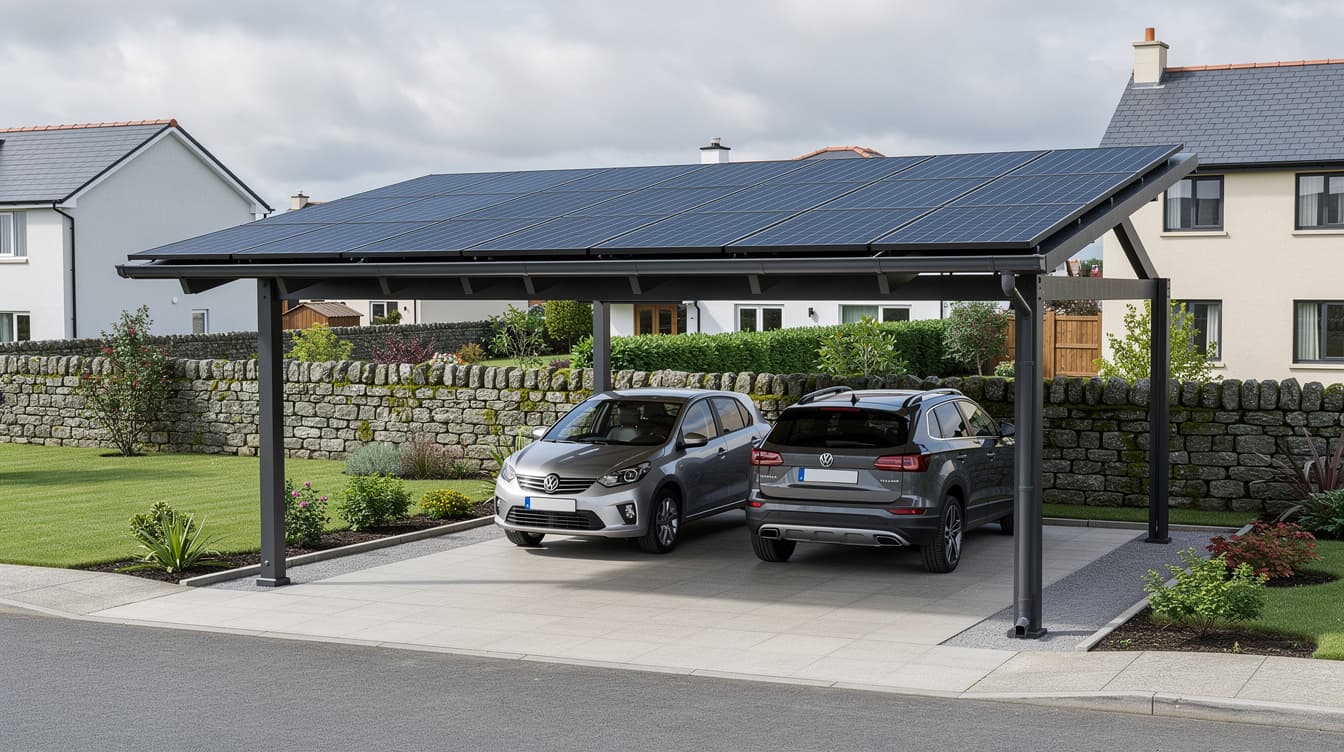
A solar carport is a freestanding canopy structure built over a parking area, with solar PV panels mounted on top as the roof. Unlike a standard carport (which just provides shelter), a solar carport generates electricity while protecting your car from rain, hail, frost, and bird droppings.
The typical residential solar carport in Ireland consists of:
- Aluminium or galvanised steel frame — engineered to withstand Irish wind loads (up to 130 km/h in coastal areas)
- Solar PV panels — mounted at an optimal 30–35° tilt angle for Irish latitudes
- Inverter — converts DC power from the panels to AC for your home
- Optional EV charger — mounted on a carport pillar, charged directly from the panels
- Optional battery storage — stores excess power for evening use
- Integrated drainage — gutters and downpipes built into the frame
Solar Carport Sizes and Costs in Ireland (2026)
Solar carport pricing in Ireland depends on the frame type, number of panels, and whether you add EV charging or battery storage. Here are typical 2026 prices from Irish installers:
| Carport Size | Capacity | Annual Output | Cost (ex. grant) | Cost (after SEAI grant) |
|---|---|---|---|---|
| Single car (3m × 5m) | 3–4 kW | 2,700–3,600 kWh | €6,000–€9,000 | €4,200–€7,200 |
| Two car (6m × 5m) | 5–7 kW | 4,500–6,300 kWh | €10,000–€15,000 | €8,200–€13,200 |
| Three car (9m × 5m) | 8–10 kW | 7,200–9,000 kWh | €14,000–€20,000 | €12,200–€18,200 |
| Two car + EV charger + battery | 6 kW + 5 kWh | 5,400 kWh | €16,000–€22,000 | €14,200–€20,200 |
These prices are 15–25% higher than equivalent rooftop solar systems because the carport frame, foundations, and structural engineering add €2,000–€5,000 to the bill. However, there are significant advantages that justify the premium — more on that below.
Solar Carport vs Rooftop Solar: Which Is Better?
This is the question every homeowner asks. The answer depends on your situation:
| Factor | Rooftop Solar | Solar Carport |
|---|---|---|
| Cost per kW | €1,200–€1,800/kW | €1,800–€2,500/kW |
| Ideal for | South-facing roofs with good space | North-facing roofs, shaded roofs, or extra capacity |
| Planning permission | Usually exempt | May require permission (see below) |
| Roof impact | Penetrations needed (brackets, rails) | Zero roof impact |
| Maintenance access | Needs scaffolding or roof access | Easy ground-level access |
| EV charging | Separate charger needed | Integrated — charge where you park |
| Added property value | Yes | Yes — also adds covered parking |
| Best combo | Both — rooftop for base generation + carport for additional capacity and EV charging | |
If your roof is south-facing with plenty of space, rooftop solar is usually cheaper per kW. But if your roof is compromised in any way — wrong orientation, dormer windows, vents, chimneys taking up space, listed building restrictions — a solar carport is an excellent alternative that often performs better because you control the tilt angle and orientation.
Planning Permission: Do You Need It?
This is where solar carports differ from rooftop panels. Under Irish planning regulations (as updated in October 2022 and further streamlined in 2026):
- Rooftop solar panels are exempt from planning permission in most residential cases
- Solar carports are treated as freestanding structures and may require planning permission depending on size and location
The general rules for exempt development of outbuildings apply:
- Total floor area of all outbuildings (sheds, garages, carports combined) must not exceed 25 m² within the curtilage of the house
- The structure must not be forward of the building line (i.e., not in front of the house facing the road)
- Maximum height of 4 metres for a flat-roof structure, 3 metres if within 2 metres of a boundary
- The structure must not reduce the private open space to less than 25 m²
In practice, a single-car solar carport (around 15 m²) will usually fit within exempt development limits, provided you do not already have large garden sheds or other outbuildings eating into your 25 m² allowance. A two-car carport (30 m²) will almost always require planning permission.
Top tip: Contact your local authority’s planning department before committing. A €20 Section 5 declaration will confirm definitively whether your proposed carport needs planning permission. This saves months of uncertainty.
SEAI Grant: Can You Get a Grant for a Solar Carport?
The SEAI Solar Electricity Grant (up to €1,800 in 2026) applies to solar PV systems installed on residential properties. The grant conditions focus on the PV system itself, not the mounting structure — so a solar carport can qualify, provided:
- Your home was built and occupied before 2021
- You use an SEAI-registered installer
- The system is connected to your home’s electrical supply
- You have not previously received an SEAI solar PV grant for this property
- You obtain grant approval before work begins
One important note: the €1,800 grant is a flat rate regardless of system size. So whether your carport has a 3 kW or 10 kW system, the grant stays at €1,800. This makes the grant less impactful for larger (and more expensive) carport installations compared to a standard rooftop system.
Additionally, Ireland’s 0% VAT on residential solar applies to solar carports, saving you a further 13.5% on the total cost. On a €14,000 carport, that is €1,890 saved compared to the old VAT rate.
The EV Charging Advantage
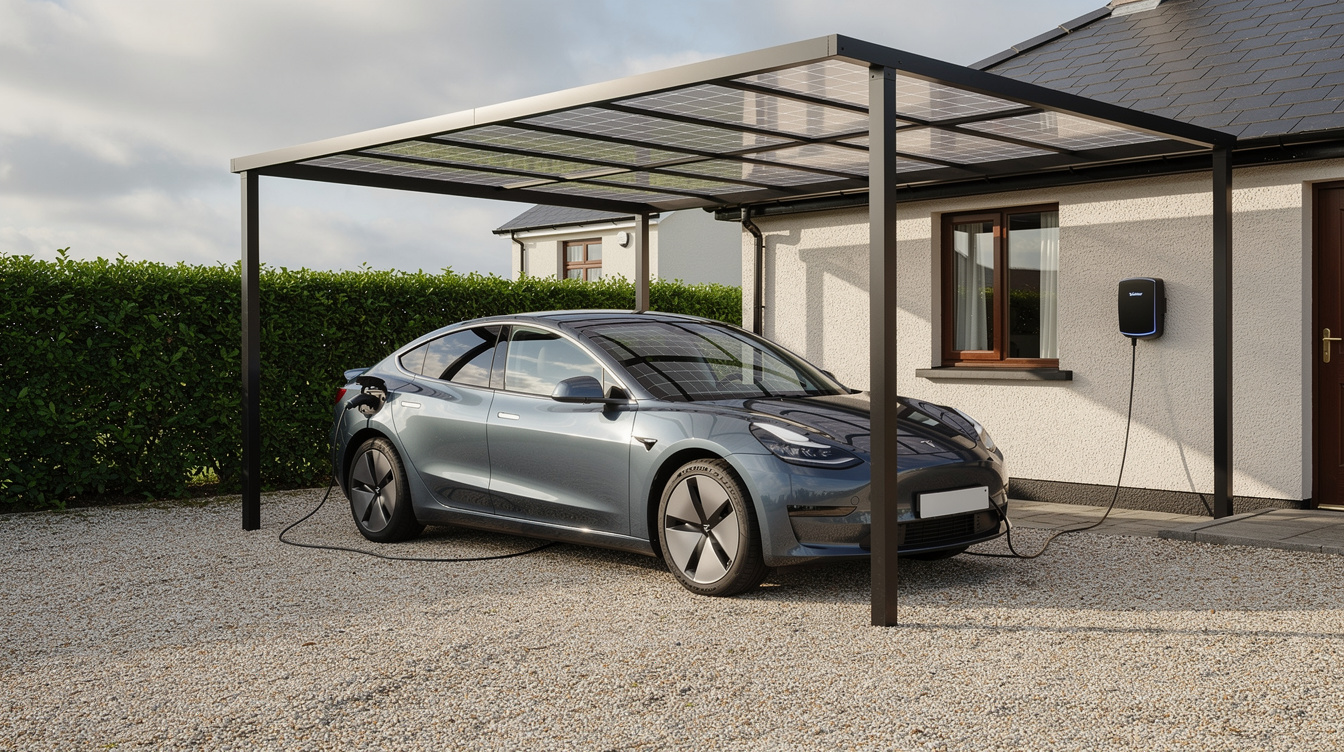
This is where solar carports really shine compared to rooftop solar. With an EV charger mounted directly on the carport pillar, you create a seamless solar-to-car charging loop:
- Panels generate electricity during the day
- The charger feeds power directly into your EV battery
- Your car charges while parked, using free solar energy
- Any excess power goes to your house or back to the grid for payment
The economics are compelling. An average Irish driver covers 15,000 km per year. Charging an EV from the grid costs roughly €550–€650 per year at current electricity rates (35–42c/kWh). Charging from your own solar carport? Effectively free — you have already paid for the panels.
A 6 kW solar carport generates approximately 5,400 kWh per year in Ireland. A typical EV uses 2,000–2,500 kWh per year for 15,000 km of driving. That leaves 3,000+ kWh for your house — or for export at 18–24c/kWh under the Clean Export Guarantee.
Solar Carport + EV Charger?
Get quotes from installers who design complete solar carport and EV charging solutions.
Real-World Payback: Do the Numbers Work in Ireland?
Let’s run the numbers for the most popular option — a two-car solar carport with a 6 kW system:
| Item | Value |
|---|---|
| System cost | €12,000 |
| SEAI grant | –€1,800 |
| Net cost | €10,200 |
| Annual generation | 5,400 kWh |
| Self-consumption (60%) | 3,240 kWh × 38c = €1,231 |
| Export income (40%) | 2,160 kWh × 21c = €454 |
| EV fuel savings | €600/year (vs petrol) |
| Total annual benefit | €2,285 |
| Payback period | 4.5 years (with EV) / 6 years (without EV) |
With an EV, the payback is excellent — under 5 years. Without an EV, you are looking at 6–8 years depending on your electricity usage patterns and export rate. Either way, with panels lasting 25–30 years, the lifetime savings are substantial.
Cork Airport: Ireland’s Largest Solar Carport
In April 2026, Cork Airport announced Ireland’s largest solar carport project — a landmark 1.7 MW installation being built by Greenvolt Next. Key details:
- 3,696 solar panels across 669 car parking spaces
- 1.5 GWh of annual renewable energy generation
- Will supply up to 20% of the airport’s electricity needs
- 355 tonnes of CO&sub2; saved annually
- Over €2 million in Exchequer funding via the Regional State Airports Sustainability Programme
- Phase 1 completion before summer 2026, full completion by August 2027
This project signals that solar carports have moved from niche to mainstream in Ireland. If they make economic sense for an airport, the proportional economics work even better for homeowners who use more of their generation directly (avoiding the lower export rate).
Installation: What to Expect
A residential solar carport installation typically takes 3–5 days and follows this process:
- Site survey (Day 0) — The installer assesses your driveway, ground conditions, orientation, shading, and electrical connection point. They will also check planning permission requirements
- Foundation work (Day 1) — Concrete pad foundations or screw piles are installed. Screw piles are faster and less disruptive — no digging or concrete curing time needed
- Frame erection (Day 2) — The aluminium or steel frame is assembled and bolted to the foundations. Drainage is integrated at this stage
- Panel mounting (Day 3) — Solar panels are mounted on rails attached to the frame. Wiring runs through the frame down to the inverter
- Electrical connection (Day 3–4) — Inverter installation, connection to your consumer unit, EV charger mounting (if included), and commissioning
- ESB notification (Day 5) — Your installer notifies ESB Networks of the microgeneration connection. This is required for export payments
5 Situations Where a Solar Carport Beats Rooftop Solar
- Your roof faces north or east/west — A carport can be oriented perfectly south at 30–35°, generating 20–30% more than a poorly oriented roof
- Your roof is shaded — Trees, neighbouring buildings, or chimneys casting shadows? A carport in the open avoids all of this
- You have a heritage or listed building — Some older Irish homes have restrictions on roof alterations. A freestanding carport avoids any issue with the building fabric
- You want to keep your roof intact — Some homeowners (and insurers) prefer not to make roof penetrations. A carport generates solar power with zero roof impact
- You have an EV and want integrated charging — The convenience of a solar-powered charger right where you park is hard to beat
Things to Watch Out For
Solar carports are not perfect for every situation. Be aware of these potential issues:
- Planning permission headaches — Unlike rooftop solar, carports are not automatically exempt. Budget €100–€500 for a planning application if needed
- Wind loading — Ireland is windy. Your carport frame must be engineered for local wind conditions. Coastal and elevated sites need extra-strong foundations — this can add €1,000–€2,000 to the cost
- Ground conditions — Rocky ground or high water tables can complicate foundations. A site survey will identify any issues before you commit
- Neighbour impact — A large carport structure could overshadow a neighbour’s garden or be considered visually obtrusive. Good design and early communication prevent disputes
- Insurance — Notify your home insurer about the carport just as you would for rooftop panels. The carport structure and panels need to be included in your sum insured
How to Choose a Solar Carport Installer
Not every solar installer offers carport solutions — the structural engineering is different from rooftop work. When choosing an installer, look for:
- SEAI registration — Essential for the €1,800 grant
- Structural engineering credentials — The frame design should come with engineer’s certification
- Carport-specific experience — Ask to see previous carport installations, not just rooftop work
- Complete package — The best installers handle planning, structural design, PV installation, and electrical connection as one project
- Warranty — The frame should have a 10+ year structural warranty, separate from the panel and inverter warranties
The Bottom Line
Solar carports are no longer a luxury or a niche product. With Ireland’s high electricity prices (35–42c/kWh), the SEAI grant, 0% VAT, and growing EV adoption, the business case is strong — especially if your roof is not ideal for solar or you want the added benefit of covered parking.
The sweet spot for most Irish homeowners is a two-car, 5–6 kW solar carport costing €10,000–€13,000 after the SEAI grant. Add an EV charger and you are looking at total annual savings of €1,500–€2,300 with a payback period of 5–7 years.
The Cork Airport project is just the beginning. As more Irish homeowners discover that they do not need a perfect roof to go solar, carports will become as common as rooftop panels. The question is not whether to get one — it is whether to get one now while grants are still available.
Ready to Go Solar?
Get your free personalised quote from SEAI-registered installers.
Related Articles
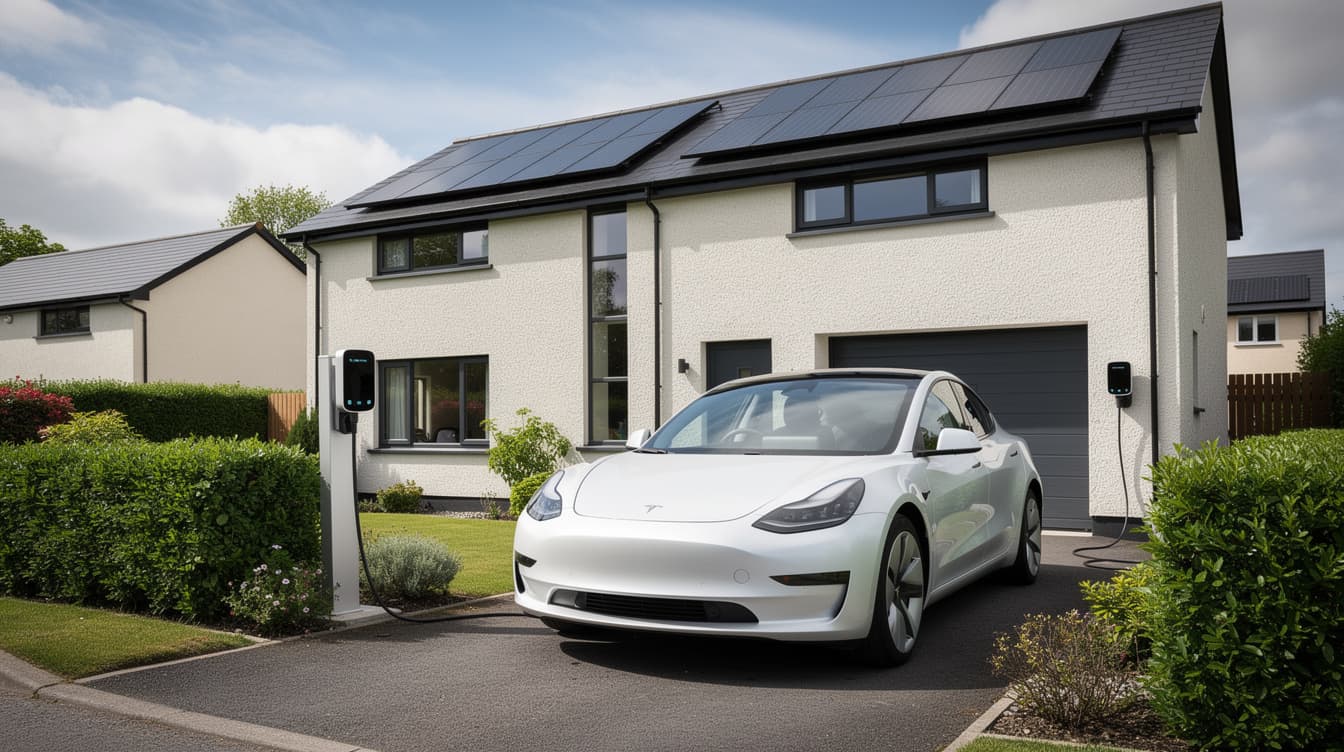
Solar Panels and Electric Cars Ireland 2026: How to Charge Your EV for Free
How to charge your electric car from solar panels in Ireland. Costs, charger options, panel requirements and real savings for 2026.
Community Solar Projects Ireland 2026: How to Benefit from Solar Without Your Own Roof
How community solar works in Ireland. Join an SEC, switch to Community Power, or invest in a solar farm. SEAI grants up to €162,600 for community projects.
Solar Panel Grants for Landlords in Ireland 2026: SEAI Grant, Tax Relief & BER Rules
Landlords can claim the SEAI solar grant plus up to €10,000 tax relief per rental property. Full 2026 guide to eligibility, BER rules, and ROI.