
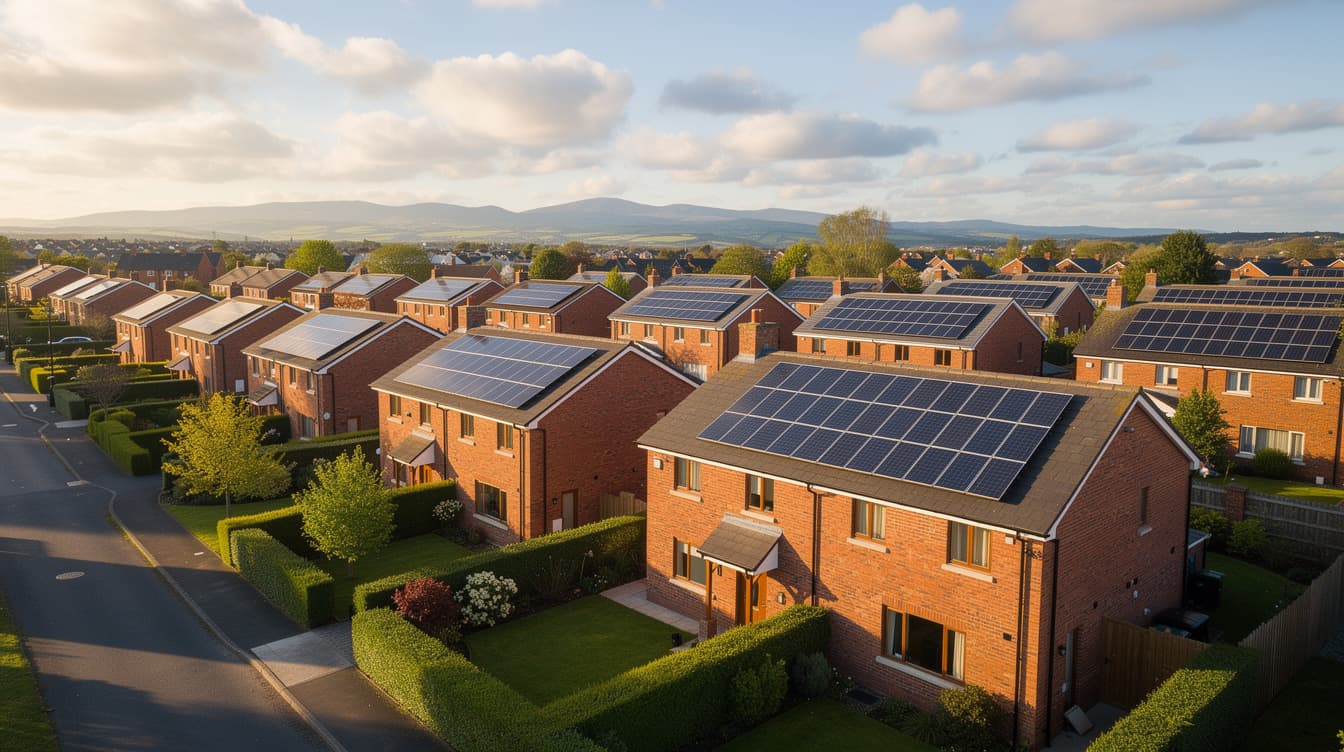
Solar Panels Dublin 2026: Costs, SEAI Grant, Planning Rules & Best Local Installers
Dublin homeowners installed more SEAI-grant-funded solar PV systems in 2025 than any other county – over 4,800 grants paid out, up 31% on 2024. With electricity prices still hovering around 38c per kWh, a €1,800 SEAI grant, 0% VAT on installations, and the Clean Export Guarantee paying you for surplus power, the maths for Dublin solar has rarely been clearer.
But Dublin homes also come with their own quirks: terraced rows pointing east-west, conservation-area restrictions in parts of the city, party-wall fire-protection rules, and scaffolding access that’s far easier in Lucan than it is in Phibsborough. This guide covers what every Dublin homeowner actually needs to know in 2026 – real costs from real local installers, expected output for the Dublin Bay region, planning permission rules under SI 92 of 2022, conservation-area exemptions, and which SEAI-registered installers are actually doing the work.
Quick Answer: Solar Panels Dublin 2026
A typical 4kWp Dublin install costs €7,500–€9,500 before the SEAI grant, or ~€5,700–€7,700 net after €1,800 grant. Annual output: ~3,640 kWh (910 kWh/kWp). Most Dublin homes save €900–€1,400 per year. Payback period: 5–8 years. Full PV exemption from planning permission for dwellings under SI 92 of 2022 – except in Architectural Conservation Areas and protected structures.
Does Solar Actually Work in Dublin?
Dublin sits at roughly 53.3° N latitude – further north than London, further north than Vancouver. People assume that means weak solar performance. The DEAP yield data tells a different story.
| Region | Annual Yield (kWh/kWp) | % of Best Irish Region | 4kWp Annual Output |
|---|---|---|---|
| Wexford (best) | 965 kWh/kWp | 100% | 3,860 kWh |
| Cork | 935 kWh/kWp | 97% | 3,740 kWh |
| Dublin | 910 kWh/kWp | 94% | 3,640 kWh |
| National average | 884 kWh/kWp | 92% | 3,536 kWh |
| Donegal | 817 kWh/kWp | 85% | 3,268 kWh |
Dublin produces roughly 94% of what the best Irish counties generate. It actually performs slightly better than the national average. The east coast catches more clear-day hours than the wetter west and south-west – on annual irradiance, Dublin is closer to Cork than to Galway.
A 4kWp Dublin system generates about 3,640 kWh per year. An average Dublin three-bed semi-detached uses roughly 4,500 kWh of electricity annually. With panels covering ~80% of demand and a 5kWh battery covering most evening use, most Dublin households can cut grid electricity to around 25–35% of what it was – saving €900–€1,400 per year at 2026 unit rates.
What Does Solar Cost in Dublin in 2026?
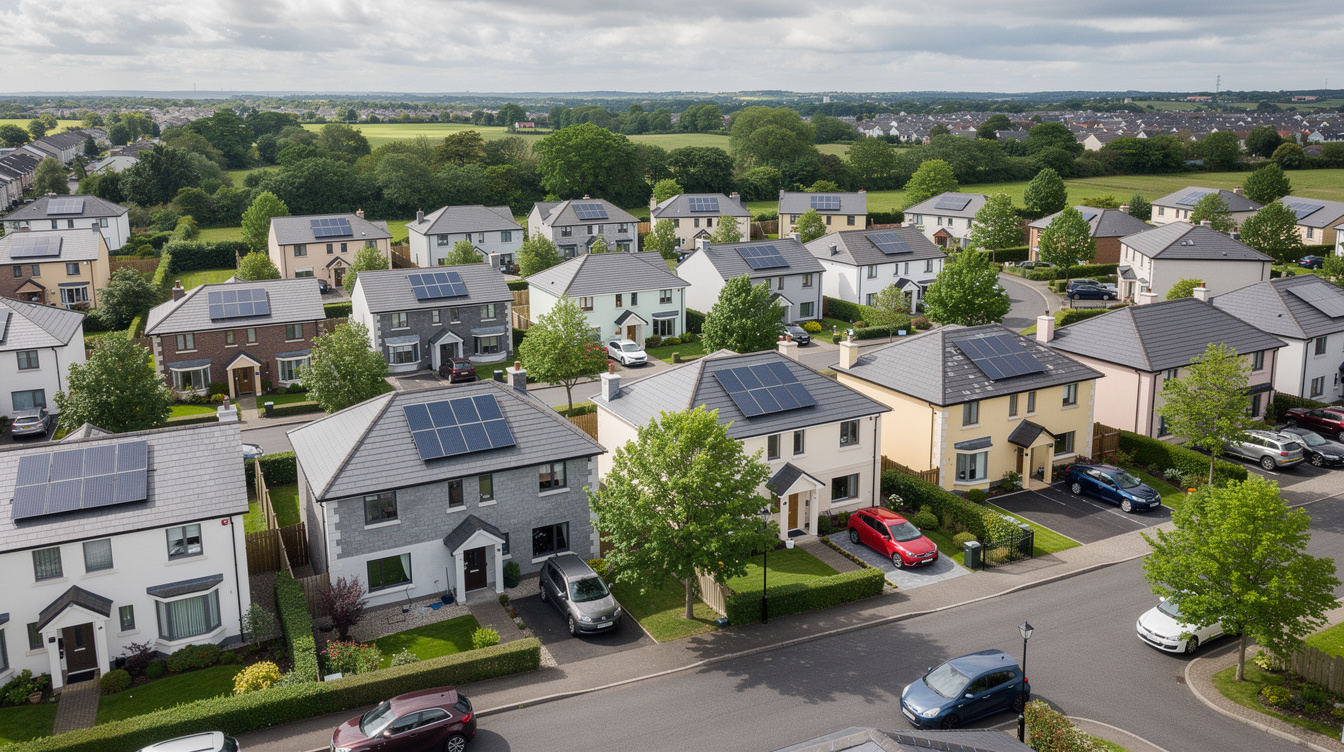
Dublin pricing in 2026 sits at, or just above, the national average. Labour rates are a little higher than rural counties, and scaffolding for terraced or three-storey homes adds €200–€500 vs a detached bungalow. But the higher density also means installers don’t have to travel far – a Lucan-based installer can hit five Dublin jobs a week with minimal van mileage, which keeps quotes competitive.
| System Size | Dublin Cost (before grant) | SEAI Grant | Net Cost | Annual Output |
|---|---|---|---|---|
| 2 kWp (5 panels) | €4,500–€5,500 | €1,400 | €3,100–€4,100 | ~1,820 kWh |
| 3 kWp (7–8 panels) | €5,500–€7,000 | €1,600 | €3,900–€5,400 | ~2,730 kWh |
| 4 kWp (10 panels) – most common | €7,500–€9,500 | €1,800 | €5,700–€7,700 | ~3,640 kWh |
| 6 kWp (15 panels) | €10,000–€12,500 | €1,800 | €8,200–€10,700 | ~5,460 kWh |
| 4 kWp + 5 kWh battery | €11,000–€13,500 | €1,800 | €9,200–€11,700 | ~3,640 kWh + 70% self-use |
All prices reflect 0% VAT on qualifying domestic supply-and-install contracts and include compliant inverter equipment, SEAI BER assessment, scaffolding, ESB Networks notification and installer commissioning. They do not include €200–€400 for an EV-ready consumer unit upgrade if your fuse board predates 2010.
Planning Permission for Solar Panels in Dublin
This is the question we get asked most. The short answer: for a typical Dublin home, you do not need planning permission – thanks to SI 92 of 2022, which abolished the previous 12 m² / 50% roof-area cap for dwellings.
But there are three exceptions every Dublin homeowner should know about:
| Situation | Planning Permission Needed? | Dublin Areas Most Affected |
|---|---|---|
| Standard dwelling, not in ACA | No – exempted | 90%+ of Dublin homes |
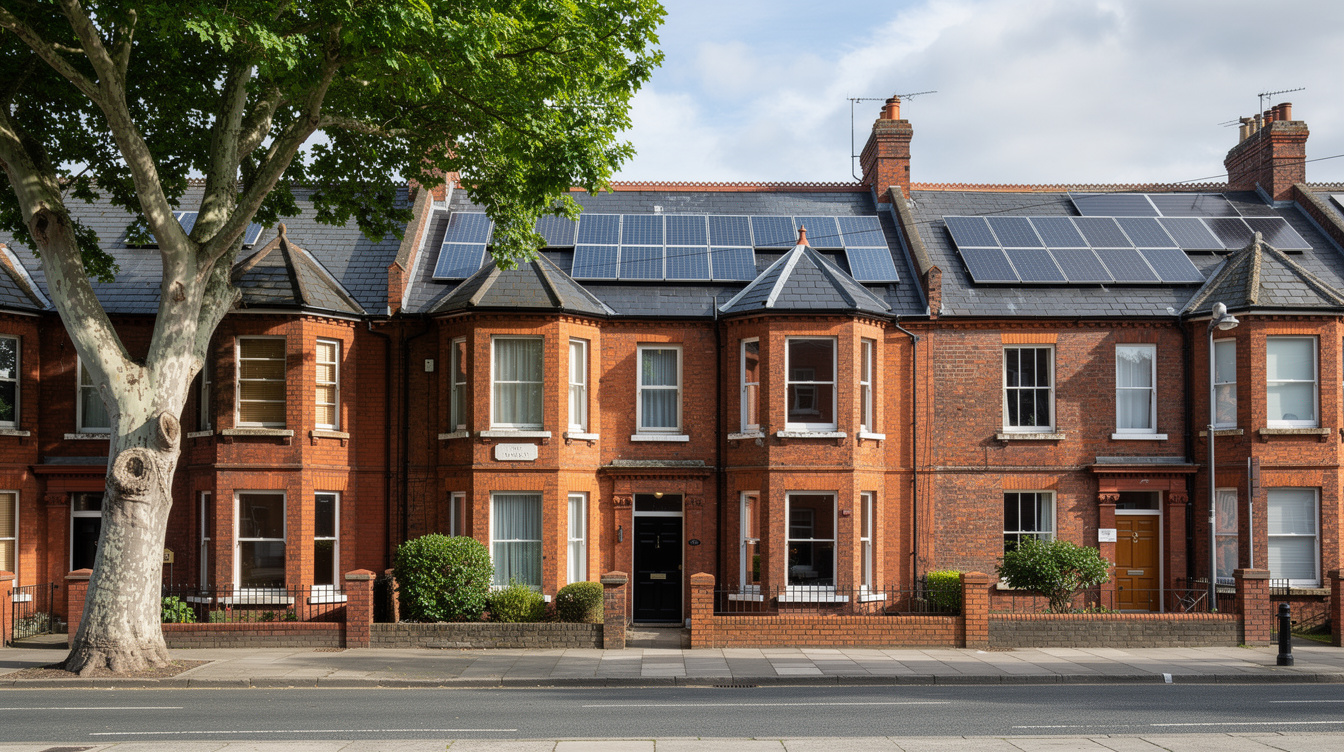
| Architectural Conservation Area (ACA) | Yes if visible from public road | Georgian D1/D2/D7, Killiney, Dalkey, Howth Old Village, Phibsborough conservation pockets |
| Protected Structure | Yes always | Listed Georgian/Victorian houses across D1–D8 |
| Ground-mount panels >25 m² | Yes over the threshold | Detached homes with large gardens in Lucan, Castleknock, Foxrock |
Each of Dublin’s four local authorities – Dublin City Council, Fingal, South Dublin and Dún Laoghaire-Rathdown – publishes its own ACA map. Check yours at the council planning portal before you sign a contract. If your home is in an ACA but the proposed panels go on a back-pitched roof not visible from the street, councils have consistently granted Section 5 declarations confirming the work is exempted development.
Dublin Housing Stock and What It Means for Solar
Roughly 47% of Dublin’s housing stock is semi-detached, 21% terraced, 14% detached, and 18% apartments or other. Each type has its own solar profile:
| Home Type | Typical Roof Area | Best System Size | Dublin-Specific Note |
|---|---|---|---|
| Semi-detached (3-bed) | 30–40 m² per pitch | 4–5 kWp | Roof orientation matters – many Dublin estates lay houses E/W |
| Detached (4-bed+) | 50–80 m² per pitch | 6–10 kWp | Best ROI; common in Castleknock, Malahide, Foxrock |
| Mid-terrace (Victorian) | 15–25 m² per pitch | 2–3 kWp | Party-wall fire setback rules cost you 1–2 panel positions |
| Bungalow | 40–60 m² single pitch | 4–6 kWp | Easiest installs; lowest scaffolding cost |
The Dublin Terraced-Estate Problem
If you live in a 1970s/1980s estate in Tallaght, Clondalkin, Coolock, Donaghmede or similar, your house may face east or west rather than south. Many Dublin developers laid estates along east-west axes because it maximised front-garden depth and street parking, not solar exposure.
The good news: east-west splits are now the second-best solar configuration after due-south. An east-west split array (5 panels east, 5 panels west) generates around 88% of what a south-facing equivalent would produce – and crucially, it produces electricity earlier and later in the day, which means more of it gets used at home rather than exported. For most Dublin households, an east-west split delivers better self-consumption than south, even if total kWh is slightly lower. See our guide on east-facing solar in Ireland for the full numbers.
SEAI Solar Grant for Dublin Homes
The SEAI grant is identical across the country, but Dublin’s high density means a few practical things you should know:
- Grant amount (2026): €700 per kWp for the first 2 kWp, plus €200 per kWp for the next 2 kWp. Maximum €1,800. There is no separate battery grant.
- Eligibility: Home must have been built and occupied before 31 December 2020. New-builds after this date do not qualify.
- BER assessment: A post-works BER is mandatory. SEAI subsidises this. Most Dublin BER assessors charge €150–€200.
- Timeline: Apply for grant approval first (10–15 business days for SEAI to issue), then install within 8 months, then submit completion documents within 6 weeks of install.
- Cash flow: For an individual grant application, SEAI pays the grant to the applicant after the completed documentation is processed. Confirm the payment schedule in the installation contract.
Roughly 4,800 Dublin homes claimed an SEAI solar grant in 2025. Even at the slower January start of 2026 the pace has held. Full eligibility detail in our SEAI grant guide.
Want to Check if Your Dublin Home Qualifies?
Get a free no-obligation quote from SEAI-registered Dublin installers. The eligibility check takes 60 seconds.
Real Payback Example: Dublin 3-Bed Semi-Detached
Here’s a worked example using actual 2026 numbers for a typical Dublin household. Three-bed semi in Templeogue, two adults plus two children, annual electricity use 4,800 kWh, south-facing rear roof, 32 m² usable area.
| Line Item | Value |
|---|---|
| System size | 4.2 kWp (10 × 425W TOPCon) |
| Hybrid inverter + 5 kWh battery | Included |
| Annual generation | 3,822 kWh |
| Gross cost | €11,800 |
| SEAI Solar PV grant | -€1,800 |
| Net cost | €10,000 |
| Self-consumption (with battery) | ~70% (2,675 kWh) |
| Bill savings @ 38c | €1,017/yr |
| Export earnings @ 19c (CEG) | €218/yr |
| Total annual benefit | €1,235/yr |
| Simple payback | 7.6 years |
| 25-year lifetime value | ~€31,000 net of cost |
Even at the conservative end – assuming no electricity-price inflation over 25 years, which is implausible – this system pays back in under eight years and delivers over €30,000 of net benefit across its lifetime.
How to Choose an Installer in Dublin
There are over 60 SEAI-registered solar installers operating in Dublin in 2026. The grant pool concentrates in a few dozen, but the actual install quality varies enormously. Six things to insist on:
- Verify SEAI registration on the public list at seai.ie. If the company isn’t listed, the grant cannot be paid. Some companies trade as a brand name but are registered under a parent company – ask for the registered company name.
- Get three written quotes with the same specification: panel brand and wattage, inverter brand and model, battery capacity, included monitoring app, warranty terms.
- Check Safe Pass and Solas certification for installers working at height. Dublin Council’s health and safety enforcement is the strictest in the country.
- Confirm the exact inverter model in writing and ask the installer to verify that its documentation is accepted for the ESB Networks notification.
- Ask for two references from jobs within 10 km of yours, completed in the last 12 months. Drive past them. Look at the install quality.
- Get the warranty terms in writing: panels 25 yr performance / 12 yr product, inverter 10 yr, battery 10 yr, workmanship minimum 5 yr.
Our Dublin installer directory lists companies serving the four Dublin local authority areas, with ratings, reviews and contact details. If you are planning a new installation, you can also request a free solar quote for your home.
Common Dublin-Specific Pitfalls
| Pitfall | What to Watch For |
|---|---|
| Pebble-dash and slate-effect tile roofs | Common in 1960s–70s Dublin estates. Confirm installer has the right hooks/flashing – not all do. |
| Chimney shading | Many Dublin semi-d’s have a chimney mid-roof. Even partial shading cuts string-inverter output 15%+. Demand microinverters or panel-level optimisers if shading exists. |
| Three-phase electricity supply | Newer Dublin builds (post-2018) often have three-phase. You need a three-phase inverter – about €400 more than single-phase. |
| Apartment conversions | Lots of Victorian Dublin homes have been split. You need written owner-of-roof consent before any installer will quote. |
| Tree shading from urban planting | South Dublin neighbourhoods like Terenure, Ranelagh and Rathgar have mature street trees. Confirm shade analysis was done – use SunSeeker or installer’s drone survey. |
Where Solar Pays Back Fastest in Dublin
Based on roof exposure, average shading, and typical home size, these Dublin areas tend to see the best solar returns:
- Fingal (North County Dublin): Lusk, Rush, Skerries, Donabate – lots of large detached homes with unshaded south-facing roofs. Best raw output in the county.
- Castleknock / Carpenterstown / Clonsilla: 1990s+ detached estates, mostly south or south-west orientation, low neighbour shading.
- Lucan / Adamstown: Newer A-rated homes already have the wiring for solar; battery retrofits are easy.
- Foxrock / Stillorgan / Killiney (Dún Laoghaire-Rathdown): Larger homes, larger systems (6–8 kWp common); biggest absolute savings.
- South Dublin (Tallaght, Firhouse, Knocklyon): Mixed orientation but generous roof area on the semi-d stock. East-west split installs work well here.
If you’re in a conservation area in the Georgian core (D1, D2, D7) or in Howth Old Village, Killiney Avenue, or a Phibsborough conservation pocket, expect to need planning permission – budget an extra €1,000 and 6–10 weeks for the process.
Frequently Asked Questions
Do I need planning permission for solar panels in Dublin?
For 90%+ of Dublin homes, no – SI 92 of 2022 removed the roof-area cap for dwellings. You need permission if your home is a protected structure, sits in an Architectural Conservation Area and the panels would be visible from a public road, or you’re ground-mounting more than 25 m² in your garden.
How long does a Dublin solar install take?
The physical install is one or two days. The full timeline from signed contract to commissioned system is typically 6–10 weeks – the bottleneck is SEAI grant approval (10–15 working days) and the NC6 connection notification with ESB Networks (up to 20 working days).
What about apartments?
If you own a top-floor apartment with exclusive roof rights and an OMC (owner management company) agreement, you may be able to install. In practice this is rare in Dublin apartment blocks. Most apartments are not eligible.
Can I install solar myself?
Legally yes, but you lose access to the SEAI grant (you must use a registered installer), 0% VAT, and the CEG payment (your inverter must be commissioned by a Safe Electric registered electrician with a Cert No. 3). DIY makes economic sense for nobody except off-grid sheds. See our DIY solar guide for the full breakdown.
Are solar panels worth it in Dublin specifically?
For a home built before 2020 with reasonable roof exposure, yes. With 38c/kWh electricity, a €1,800 grant, 0% VAT, and 7–8 year payback periods, Dublin households see strong returns. The only homes where solar is not worth installing are those with severe shading, very low electricity use (<2,000 kWh/yr), or homes already scheduled for demolition or major reconstruction.
Planning a New Solar Installation in Dublin?
Tell us about your home and request a free, no-obligation solar installation quote for your Dublin property.
Last updated: June 2026. SEAI grant amounts and CEG tariff rates verified from seai.ie and CRU.ie. Pricing data drawn from three quotes obtained from Dublin-area installers in May 2026.
Related Articles
Solar Panel System Cost by Number of Panels Ireland 2026: 8, 12, 14, 20, 24 Panel Prices
What 8, 12, 14, 16, 20 or 24 solar panels actually cost in Ireland 2026 — net after €1,800 SEAI grant & 0% VAT, output kWh, roof area & battery add-ons.
6kW Solar System Cost Ireland 2026: Real Prices, Output & Payback
6kW solar costs €7,700–€10,500 net after the €1,800 SEAI grant and 0% VAT in Ireland 2026. Real quote, 5,270 kWh/yr output, EV/battery ROI.
5kW Solar System Cost Ireland 2026: Real Prices, Output & 25-Year ROI
5kW solar system costs €6,700–€9,200 net after the €1,800 SEAI grant and 0% VAT in Ireland 2026. Full itemised breakdown, real output data & battery ROI.