
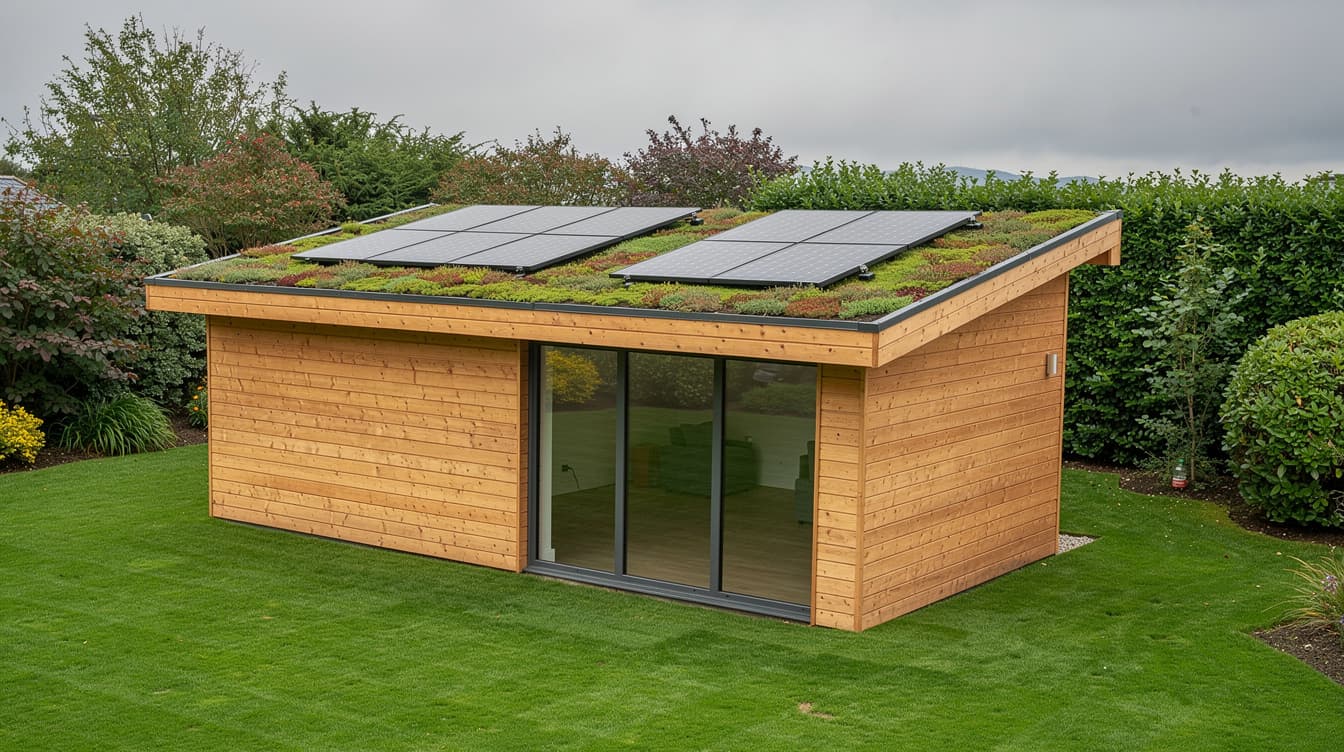
Solar Panels for Garden Rooms & Home Offices Ireland 2026: Costs, Options & What Actually Works
Garden rooms are Ireland’s biggest home improvement trend — but they come with a hidden cost nobody talks about: electricity. A well-insulated garden office draws 2,000–4,000 kWh per year for heating, lighting, and equipment. At today’s rates of 36–38c/kWh, that’s €720–€1,520 added to your annual electricity bill. Solar panels on your garden room — or on your house feeding power to it — can eliminate most or all of that cost.
This guide covers every option for powering an Irish garden room or home office with solar in 2026: roof-mounted panels on the garden room itself, panels on your main house, plug-in solar kits, and hybrid approaches. We’ll break down costs, planning rules (including the new 30m² exemption proposals), electrical requirements, and real payback figures.
Planning a Solar-Powered Garden Room?
Get free quotes from SEAI-registered installers who can design a system for your garden room or home office.
How Much Electricity Does a Garden Room Actually Use?
Before sizing a solar system, you need to know what you’re powering. Here’s a realistic breakdown for a typical 15–25m² insulated garden room used as a home office in Ireland:
| Load | Daily Usage | Annual kWh | Annual Cost |
|---|---|---|---|
| Electric panel heater (1.5 kW, 6 hrs/day Oct–Apr) | 9 kWh | 1,890 | €680 |
| Laptop + monitor + peripherals | 0.8 kWh | 200 | €72 |
| LED lighting (6 hrs/day) | 0.15 kWh | 55 | €20 |
| Kettle + mini fridge | 0.5 kWh | 180 | €65 |
| Wi-Fi extender/router | 0.15 kWh | 55 | €20 |
| Total | 10.6 kWh | 2,380 | €857 |
The heating is the killer. Electric panel heaters or fan heaters are by far the biggest draw. If you use an underfloor heating system with a heat pump, the heating cost drops dramatically — but that’s a bigger investment. An air-to-air heat pump (mini-split) is the sweet spot for garden rooms: €1,200–€2,000 installed, with a COP of 3–4, cutting heating electricity use by 65–75%.
Three Ways to Power Your Garden Room With Solar
There’s no single “right” approach. Your best option depends on your garden room size, roof orientation, budget, and whether you already have solar on your house.
Option 1: Solar Panels on the Garden Room Roof
Best for: New garden rooms with flat or south-facing roofs, and homeowners who want the garden room to be self-sufficient.
A typical 20m² garden room with a flat or low-pitch roof can accommodate 4–6 panels (1.8–2.7 kWp). With Ireland’s average solar yield of 900–1,050 kWh per installed kWp, that generates roughly 1,600–2,800 kWh per year — enough to cover 67–100% of a garden office’s electricity needs.
| Garden Room Size | Panels (approx.) | System Size | Annual Output |
|---|---|---|---|
| 12–15m² | 2–4 | 0.9–1.8 kWp | 810–1,890 kWh |
| 15–20m² | 4–6 | 1.8–2.7 kWp | 1,620–2,835 kWh |
| 20–25m² | 6–8 | 2.7–3.6 kWp | 2,430–3,780 kWh |
Cost: A standalone 2 kWp system on a garden room (with its own microinverter) costs €3,500–€5,500 installed. This is typically not eligible for the SEAI solar PV grant (which covers the main dwelling only), though some installers have successfully claimed it when the system feeds back into the house’s consumer unit. Check with your installer and SEAI before assuming grant eligibility.
Key consideration: The garden room roof must be structurally rated for the additional weight (approximately 12–15 kg per panel plus mounting hardware). Most reputable garden room suppliers now offer solar-ready roof options as standard.
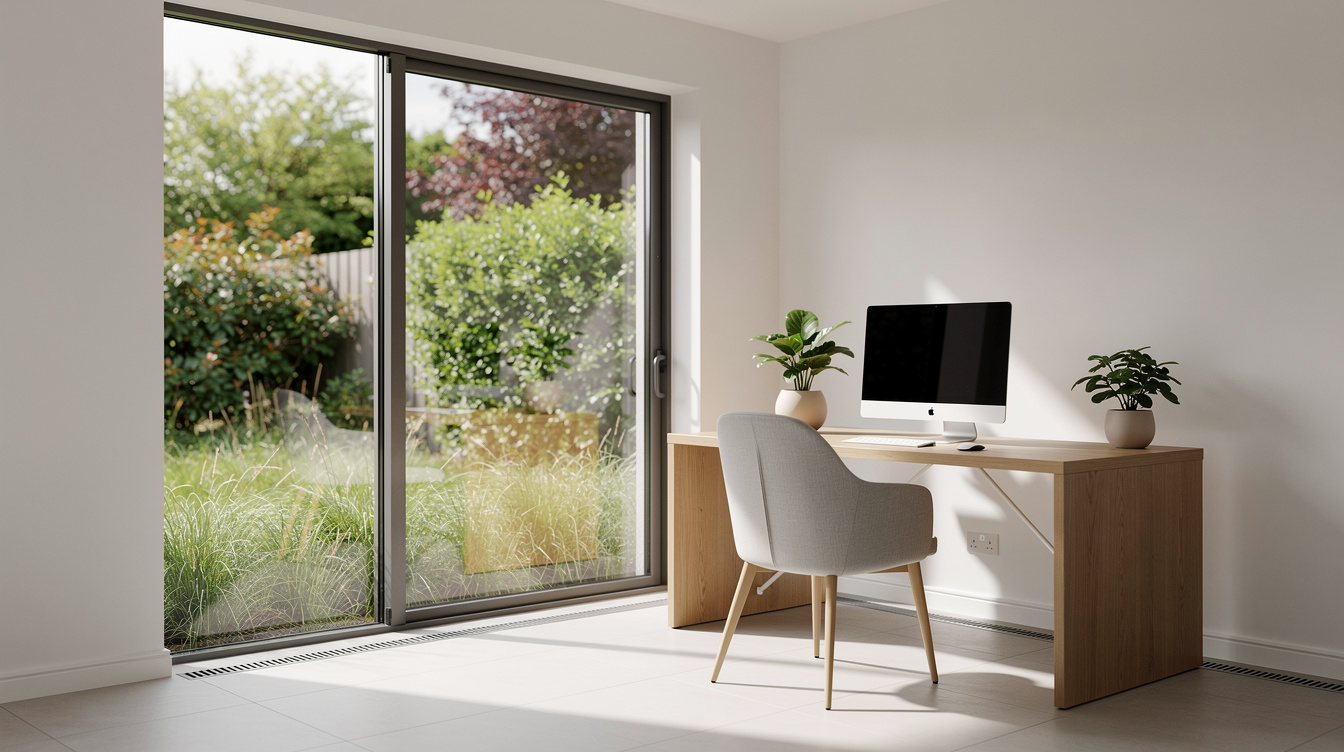
Option 2: Panels on Your Main House, Feeding the Garden Room
Best for: Homeowners who already have (or are planning) solar on their house, and want to run the garden room from the same system.
This is the most common and often most cost-effective approach. Your main house roof is almost always larger, better oriented, and structurally stronger than a garden room roof. A 5 kW system on your house generates roughly 4,500–5,000 kWh/year — more than enough for both house and garden room.
The garden room simply draws power from the house via its dedicated electrical supply cable. Any excess solar generation that the house doesn’t use flows to the garden room automatically, and any surplus beyond that gets exported to the grid under the Clean Export Guarantee at 18–24c/kWh.
Cost: A 5 kW system costs €8,300–€9,000 before the SEAI grant, or €6,500–€7,200 after the €1,800 grant. You’re fully eligible for the SEAI grant since it’s on your main dwelling. The electrical supply to the garden room is a separate cost (€1,500–€3,500 depending on distance and trenching).
Advantage: Full SEAI grant eligibility, bigger roof area for more panels, and the house uses any solar power the garden room doesn’t need (and vice versa).
Option 3: Plug-In Solar Kits (No Electrician Needed)
Best for: Renters, budget-conscious homeowners, or those who want to start small and test the concept.
A plug-in solar panel kit (800W–2,000W) can sit on the ground beside your garden room or lean against a south-facing wall. These kits include panels and a micro-inverter — you simply plug them into a standard socket. Under Ireland’s proposed 2026 regulations, systems up to 800W will be fully legal to plug in without an electrician.
Cost: €400–€1,500 for an 800W–2,000W kit. Annual generation: 700–1,800 kWh. Won’t cover heating, but easily handles electronics, lighting, and appliances.
Not Sure Which Option Suits You?
Tell us about your garden room and we’ll match you with solar installers who can advise.
Full Cost Breakdown: Solar for a Garden Room (2026)
Here’s what each approach costs for a typical 20m² garden office, including all the bits people forget:
| Cost Item | Option 1: Garden Room Roof | Option 2: House Roof | Option 3: Plug-In Kit |
|---|---|---|---|
| Solar panels + inverter | €3,500–€5,500 | €8,300–€9,000 | €400–€1,500 |
| SEAI grant | Unlikely (€0) | –€1,800 | €0 |
| Electrical supply to garden room | €1,500–€3,500 | €1,500–€3,500 | €0–€500 |
| Battery storage (optional) | €4,000–€6,000 | €4,000–€6,000 | N/A |
| Net total (without battery) | €5,000–€9,000 | €8,000–€10,700 | €400–€2,000 |
Option 2 looks more expensive, but remember: a 5 kW system on your house powers everything — the house, the garden room, and exports the rest. The garden room is just one beneficiary. Option 1 only powers the garden room itself.
Planning Permission: What the Rules Say in 2026
Two sets of planning rules apply: one for the garden room structure, and one for the solar panels.
The Garden Room Itself
Under current exempt development rules (as of May 2026), you can build a garden room without planning permission if:
- Total floor area of all outbuildings is under 25m²
- Height is under 4m (pitched roof) or 3m (flat roof)
- It’s behind the front wall of the house
- At least 2m from all boundaries
- At least 25m² of open garden space remains
- Used for purposes incidental to the enjoyment of the house (home office, gym, hobby room — not a separate dwelling)
2026 update: In April 2026, the Government approved proposals to increase the exempt development limit to 30m² (and up to 45m² for modular extensions). These changes have not yet been signed into law, so the 25m² limit still applies as of May 2026. Watch this space.
Solar Panels on the Garden Room
Solar panels on a house are exempt development under current rules (up to 12m² on the roof, or 25m² freestanding in the garden). But solar panels on an outbuilding are a grey area. Most planners treat panels on a garden room roof as part of the outbuilding’s exempt development — provided the total structure still meets the height and boundary requirements. If in doubt, apply for a Section 5 declaration from your local authority (free, takes 4 weeks).
Electrical Requirements: What You Need to Know
A garden room used as a year-round home office needs a proper electrical supply — not an extension lead from the kitchen. Here’s what’s required:
- Dedicated supply cable from your house’s main board (or a new sub-board) to the garden room. This is typically a 6mm² or 10mm² SWA (steel wire armoured) cable buried at least 450mm deep in a trench across your garden.
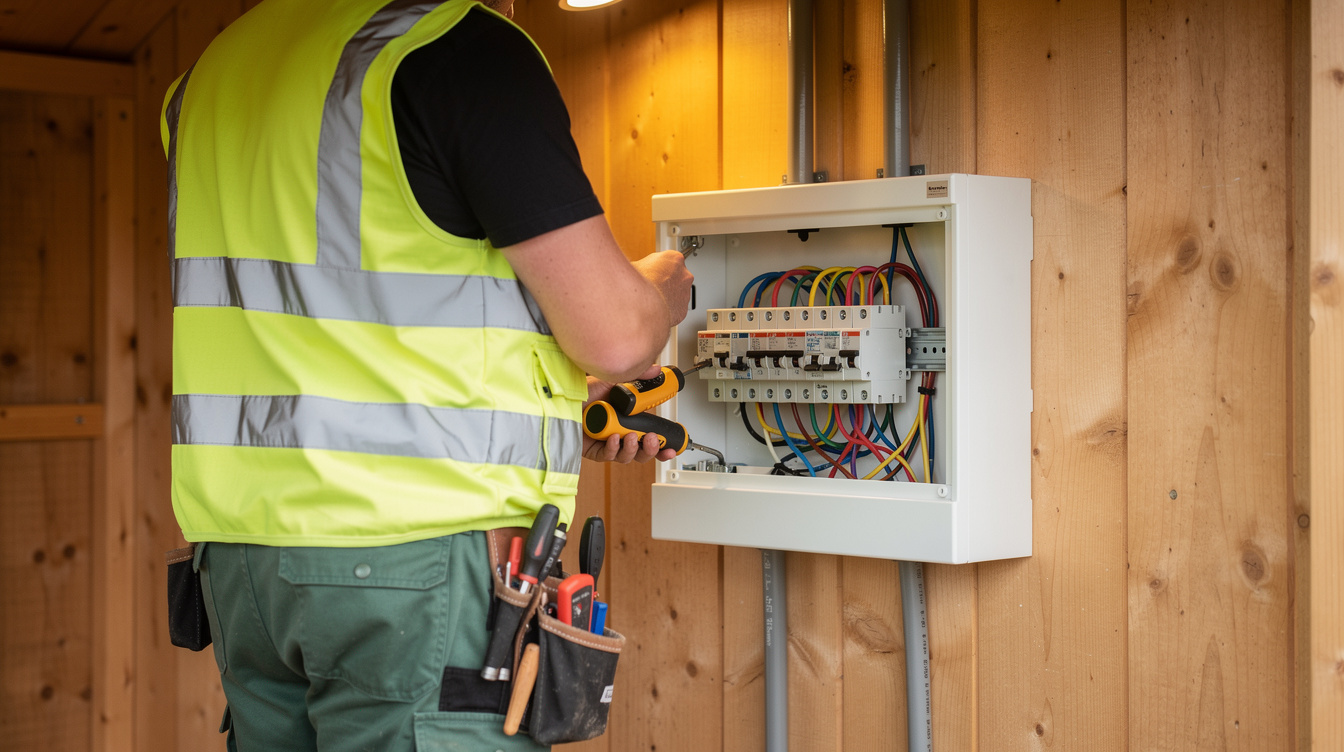
- Separate consumer unit inside the garden room with its own RCD protection, MCBs for each circuit (lighting, sockets, heating), and an isolator switch.
- Earthing and bonding compliant with IS 10101 (the Irish wiring rules). The garden room’s earth must connect back to the house’s main earthing terminal.
- All work must be done by a registered electrical contractor (RECI or ECSSA registered). They’ll issue a completion certificate you’ll need for insurance purposes.
Cost for electrical supply: €1,500–€3,500, depending on the distance from your house (every extra metre of trenching adds €30–€50). A 10m run is standard; a 30m run at the bottom of a long garden gets expensive fast.
If you’re adding solar panels on the garden room roof, the inverter connects to the garden room’s consumer unit. If the panels are on your house roof, the solar feeds into your house’s supply and the garden room draws from that via the SWA cable.
Payback: When Does Solar Pay for Itself?
The payback calculation depends entirely on which option you choose and how much electricity you self-consume (use directly rather than export):
| Scenario | Net Cost | Annual Savings | Payback Period |
|---|---|---|---|
| Option 1: 2 kWp on garden room roof | €5,000–€7,000 | €540–€720 | 7–13 years |
| Option 2: 5 kWp on house roof (grant-aided) | €8,000–€10,700 | €1,100–€1,500 | 5–8 years |
| Option 3: 800W plug-in kit | €400–€800 | €210–€280 | 1.5–3 years |
Option 3 pays back fastest in pure ROI terms, but it only covers a fraction of your electricity needs. Option 2 delivers the highest total savings because the 5 kW system serves both house and garden room, and you get the €1,800 SEAI grant. That’s the recommendation for most homeowners.
5 Mistakes to Avoid
- Running an extension lead from the house. Fire risk, insurance void, and not compliant with wiring regulations. Always install a dedicated SWA cable with a registered electrician.
- Sizing solar for summer only. Your garden room uses the most electricity in winter (heating), when solar generation is lowest. Size for annual balance, not peak summer output. Consider a battery to store summer surplus.
- Forgetting about heating. A 2 kWp solar array won’t keep your garden room warm in January. Budget for an air-to-air heat pump (€1,200–€2,000) — it cuts heating costs by 65–75% and makes solar viable year-round.
- Assuming the SEAI grant covers garden room panels. The SEAI solar PV grant is for panels on your main dwelling. Panels on a separate outbuilding are typically not eligible. Always confirm with SEAI before committing.
- Skipping insulation. No amount of solar will help if your garden room leaks heat through thin walls and single glazing. Insulate to a minimum U-value of 0.21 W/m²K for walls and 0.16 W/m²K for the roof — this is where garden rooms differ from garden sheds.
What About Battery Storage?
A battery makes particular sense for garden rooms because of the timing mismatch: you’re generating solar power during the brightest part of the day but using the most electricity for heating in the morning (when you start work) and late afternoon (when it gets dark).
A small 5 kWh battery (€4,000–€5,000) can store enough surplus solar to cover your evening and morning heating needs. For a garden room-only setup, you don’t need a full 10–13 kWh household battery — 5 kWh is plenty.
That said, if you’re installing panels on your main house (Option 2), a larger battery serves the whole household. See our guide to whether batteries are worth it in Ireland for the full analysis.
Can You Go Fully Off-Grid With a Garden Room?
Technically, yes. A 3 kWp solar array with a 10 kWh battery and a small air-source heat pump could make a garden room energy-independent. But in practice, it’s rarely worth it in Ireland:
- December and January solar generation in Ireland drops to 30–40% of summer levels
- You’d need a massive battery (15+ kWh) to bridge multi-day overcast periods
- The cost of off-grid storage (€8,000–€12,000) exceeds years of grid electricity
- You’d still need a backup (generator or grid connection) for reliability
Our recommendation: Stay grid-connected. Use solar to reduce your electricity costs to near-zero, but keep the grid as backup. It’s cheaper, more reliable, and lets you earn export payments for surplus power.
Ready to Power Your Garden Room With Solar?
Get free quotes from SEAI-registered installers in your area.
Frequently Asked Questions
Do I need planning permission for solar panels on a garden room?
Solar panels on a garden room are generally treated as part of the outbuilding’s exempt development, provided the total structure meets height limits (4m pitched, 3m flat) and boundary setbacks (2m). If your garden room is already at the maximum exempt size, adding panels that increase the height could trigger a planning requirement. Ask your local authority for a Section 5 declaration if unsure.
Can I claim the SEAI grant for panels on my garden room?
The SEAI solar PV grant (up to €1,800) is designed for panels on your main dwelling. Panels on a separate garden room are unlikely to qualify. However, if your solar system is on your house roof and simply feeds the garden room via the electrical supply, you’re fully eligible.
How many solar panels do I need for a garden room?
A typical home office garden room uses 2,000–3,500 kWh/year. To cover that fully, you’d need a 2–4 kWp system (4–8 panels). In practice, 4–6 panels on the garden room roof covers most needs, with the grid filling the gaps in winter.
Is it cheaper to put panels on the garden room or the house?
Panels on the house are almost always more cost-effective: larger roof area, SEAI grant eligibility, and the system serves the entire household. Garden room panels only make sense if your house roof is unsuitable (north-facing, heavily shaded, or structurally weak) or if you want a completely self-contained setup.
What about plug-in solar panels for a garden room?
An 800W plug-in solar kit is perfect for covering electronics, lighting, and small appliances. It won’t handle heating, but at €400–€800 with a 1.5–3 year payback, it’s the lowest-risk way to start. You can always add a proper rooftop system later.
Related Articles
Solar Panels Louth 2026: Ireland's Smallest County With Big Solar Potential — Costs, Grants & Installers
Solar panels in Louth 2026: costs from €6,500 after SEAI grant, 1,432 sunshine hours, 5-7 year payback. Drogheda, Dundalk & Ardee installer guide.
Solar Panels and Underfloor Heating Ireland 2026: The Complete System Guide (Costs, Grants & Running Costs)
Solar panels + underfloor heating Ireland 2026: full system costs from €10,100 after €14,900 in SEAI grants. Running costs, sizing & 5 mistakes to avoid.
Solar Panels Kilkenny 2026: The Marble City Goes Solar — Costs, Grants & Installer Guide
Solar panels in Kilkenny 2026: costs from €1,800 after SEAI grant, 905 kWh/kWp yield. Real pricing, output data & how to choose an installer.