
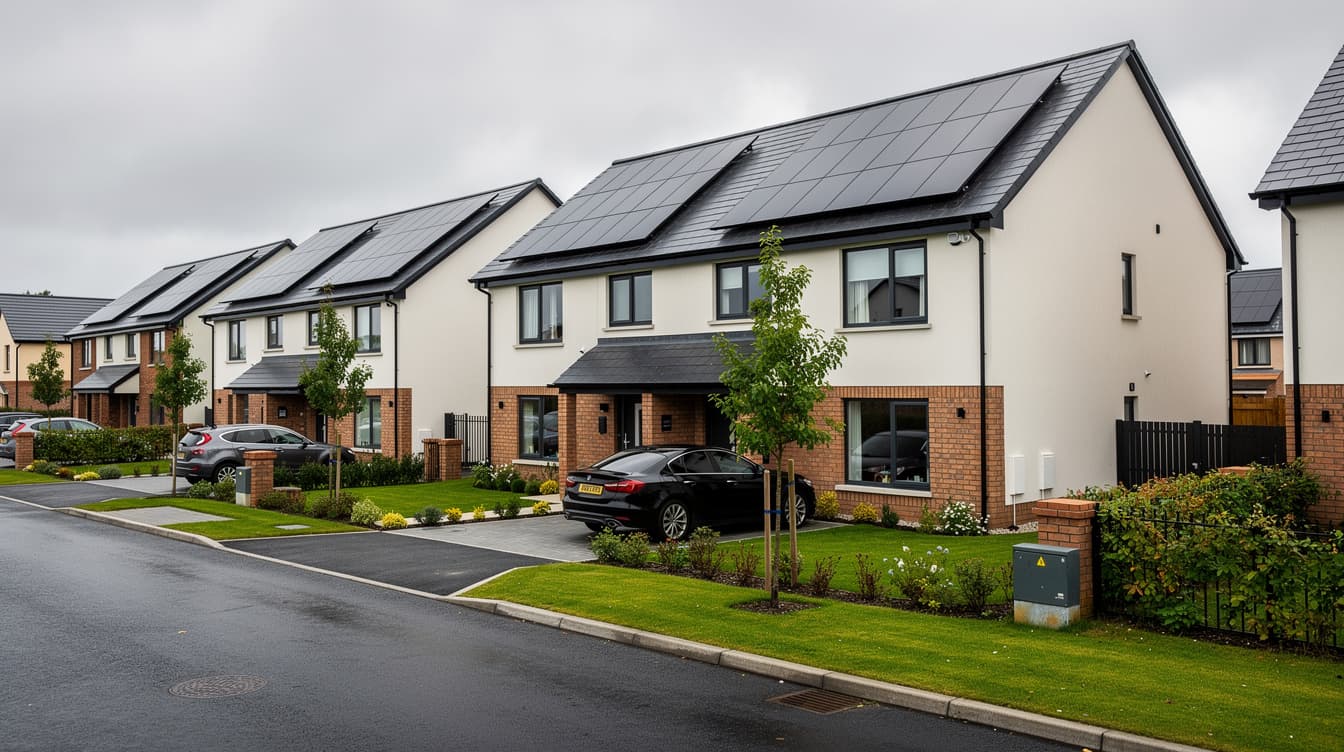
Solar Panels for New Builds in Ireland 2026: NZEB Rules, Costs & What Developers Won’t Tell You
Every new home built in Ireland must meet NZEB standards — and solar panels are the easiest way to get there. But the SEAI grant does not apply to new builds, and what your developer installs may not be enough. Here is what you actually need to know.
If you are buying a new-build home or planning a self-build in Ireland in 2026, solar panels are not optional — they are practically mandatory. Since November 2019, every new dwelling must meet Nearly Zero Energy Building (NZEB) standards under Part L of the Building Regulations. In practice, this means at least 20% of your home’s energy must come from on-site renewable sources.
Solar PV is by far the most common way builders meet this requirement. But there is a catch that surprises many buyers: the SEAI solar panel grant does not cover new builds. And the system your developer installs may be the bare minimum needed for compliance — not the size that would actually slash your electricity bills.
This guide covers everything: what the regulations require, what developers typically install, what you should push for, how much it costs, and why self-builders have a significant advantage.
What Are the NZEB Requirements?
NZEB stands for Nearly Zero Energy Building. It is the minimum energy performance standard that every new building in Ireland must meet, set by Part L (Conservation of Fuel and Energy) of the Building Regulations.
The key requirements for new dwellings are:
- Maximum Energy Performance Coefficient (EPC) of 0.30 — meaning the home must use no more than 30% of the energy of a reference building
- Maximum Carbon Performance Coefficient (CPC) of 0.35 — limiting carbon emissions to 35% of the reference
- Minimum 20% of energy from on-site renewables — this is where solar panels come in
- Minimum BER rating of A2 — all new homes should achieve this or better
Meeting these targets requires a combination of excellent insulation, airtightness, high-efficiency heating (typically a heat pump), and renewable energy generation (typically solar PV).
| NZEB Requirement | What It Means | How Solar Helps |
|---|---|---|
| EPC ≤ 0.30 | 30% of reference building energy use | Solar reduces net energy consumption |
| CPC ≤ 0.35 | 35% of reference carbon emissions | Solar displaces grid electricity (mostly gas-generated) |
| 20% renewables | On-site renewable energy contribution | Solar PV is the most cost-effective way to meet this |
| BER A2 minimum | High energy rating certificate | Solar can push a home from A2 to A1 |
What Developers Typically Install (and Why It May Not Be Enough)
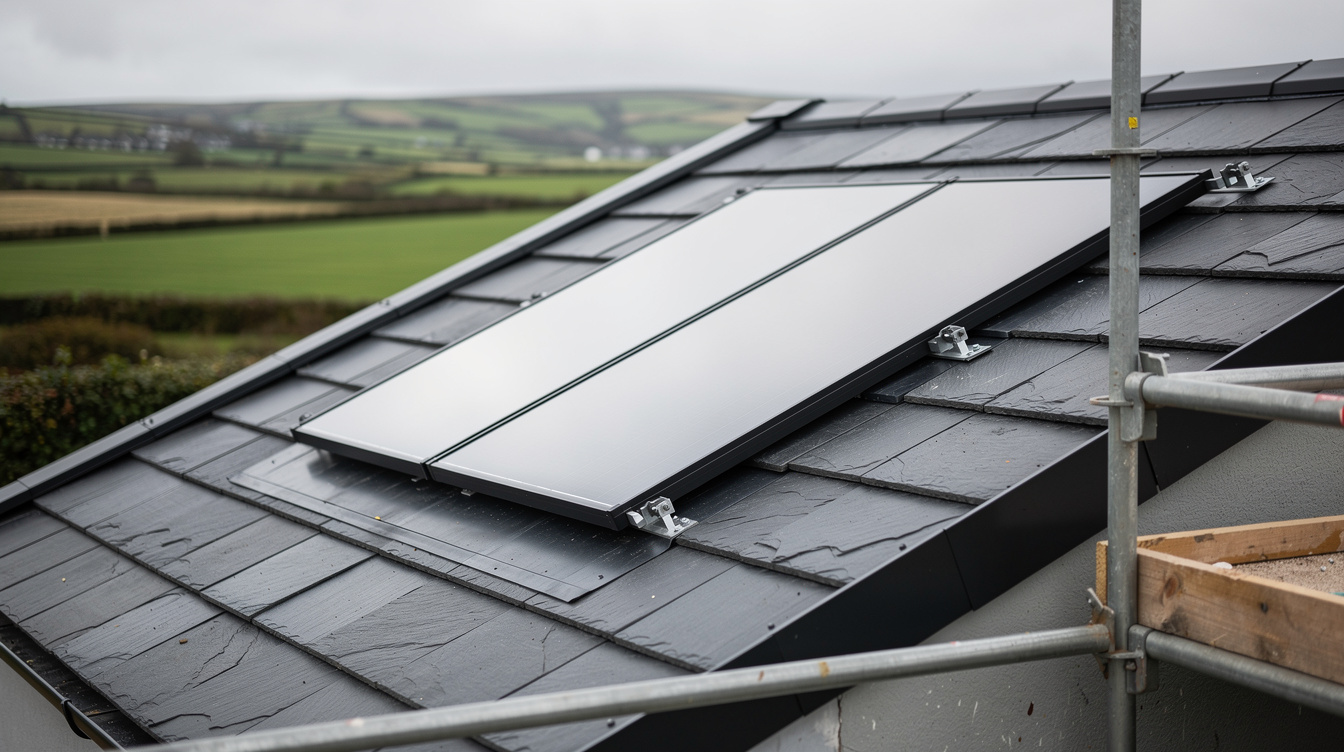
Here is where it gets interesting. A developer building an estate of 3-bed semi-detached houses needs to meet NZEB compliance as cheaply as possible. The most common approach is to install a small solar PV system — typically 1.5–2.5 kWp (3–6 panels) — alongside a heat pump and good insulation.
This is enough to tick the NZEB box. But is it enough for the people actually living in the house? Usually not.
| Scenario | System Size | Annual Generation | Annual Savings |
|---|---|---|---|
| What developers typically install | 1.5–2.5 kWp (3–6 panels) | 1,350–2,250 kWh | €350–€600 |
| What actually matches typical usage | 4–5 kWp (9–12 panels) | 3,600–4,500 kWh | €800–€1,200 |
| Optimal for 4-bed with heat pump + EV | 6–7 kWp (14–16 panels) | 5,400–6,300 kWh | €1,200–€1,800 |
The average Irish household uses about 4,200 kWh of electricity per year. A new-build home with a heat pump uses more, because the heat pump runs on electricity instead of gas. So the 2 kWp system the developer installs covers maybe 30–40% of your actual electricity needs. You are still paying for 60–70% from the grid.
The takeaway: developers install the minimum for compliance, not the optimum for savings. If you have the option, always negotiate for a larger system during the build.
Buying a New Build? Get the Right Solar System
Get a free assessment from SEAI-registered installers to see what size system your new home actually needs.
The SEAI Grant Does NOT Apply to New Builds
This is the single biggest misconception. The SEAI solar PV grant (worth up to €2,100) is only available for homes built and occupied before 1 January 2021. The date is determined by when your electricity meter (MPRN) was first connected by ESB Networks, not the construction completion date.
This means:
- Buying a new-build estate house? No SEAI grant available — the solar system cost is rolled into the house price
- Doing a self-build? No SEAI grant — but you can specify the exact system you want during construction
- Buying a house built before 2021 that already has solar? No grant (already claimed or not applicable to new owner)
- Buying a pre-2021 house without solar? You CAN apply for the grant to add panels after purchase
The logic is straightforward: new builds must include renewables under NZEB anyway, so the government does not see the need to subsidise something that is already required by law.
How Much Does Solar Cost in a New Build?
Solar is significantly cheaper when installed during construction rather than retrofitted later. The roof is already being built, scaffolding is already up, and the electrician is already on site. Costs are typically 20–30% lower than retrofit.
| System Size | New Build Cost | Retrofit Cost (before grant) | Savings vs Retrofit |
|---|---|---|---|
| 2 kWp (5 panels) | €2,800–€3,500 | €4,000–€5,000 | ~30% |
| 4 kWp (9 panels) | €4,800–€6,000 | €7,000–€8,500 | ~25% |
| 6 kWp (14 panels) | €6,500–€8,000 | €9,500–€11,000 | ~25% |
| 8 kWp (18 panels) | €8,000–€10,000 | €11,500–€14,000 | ~25% |
Note: New-build solar installations are zero-rated for VAT since May 2023, the same as retrofit installations. All prices above include 0% VAT.
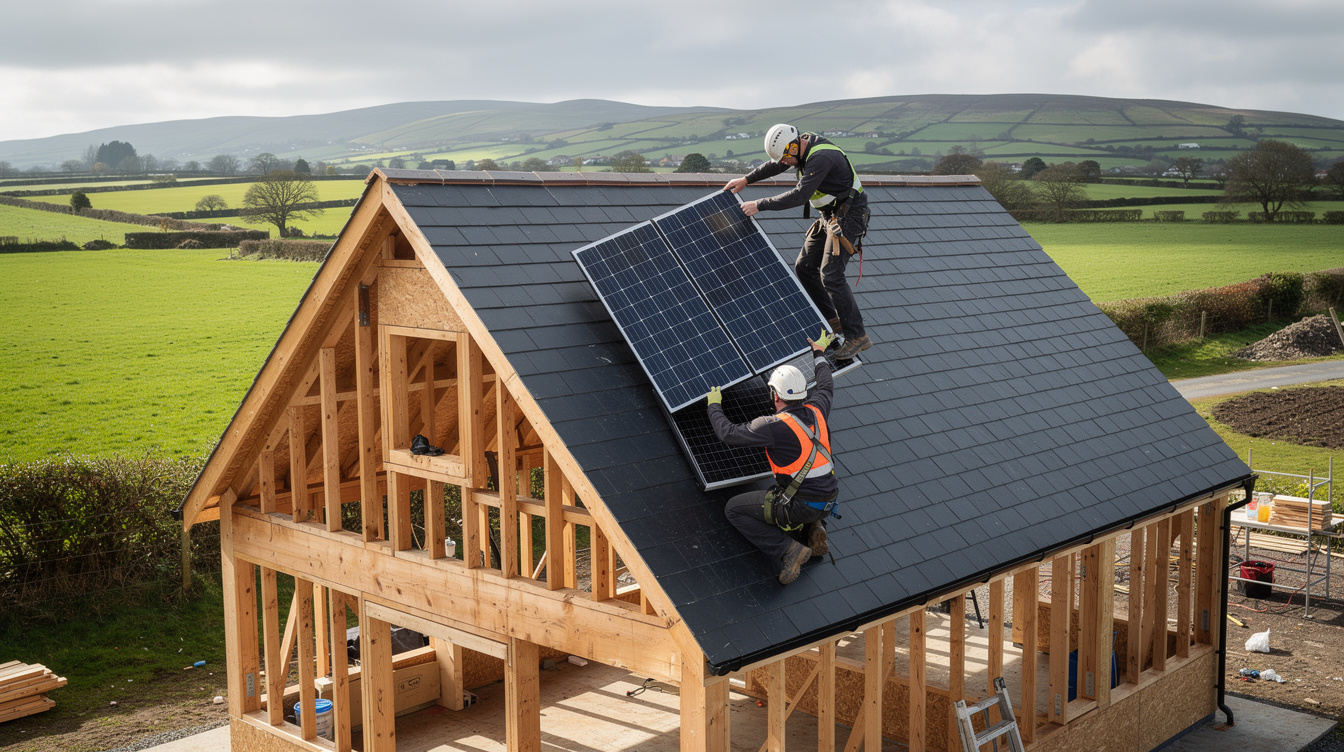
Self-Build vs Developer Build: A Very Different Experience
The solar experience for a self-builder versus someone buying from a developer is fundamentally different. Here is how they compare:
Buying from a developer
- Solar system chosen by the developer to meet minimum NZEB compliance
- You have limited or no say in panel brand, system size, or inverter type
- Cost is embedded in the house price — you cannot see what you are paying for solar specifically
- The developer uses bulk-purchased equipment (usually decent quality but rarely premium)
- System is typically 1.5–2.5 kWp — the minimum for compliance
- Adding more panels later is possible but means paying retrofit prices and arranging scaffolding again
Self-building
- Full control over system size, panel brand, inverter choice, and battery storage
- Can install the optimal system from day one at new-build prices
- Can run conduit and cabling during construction, even if you delay panel installation
- Can position the house to maximise south-facing roof area
- Can integrate solar with your heat pump, EV charger, and battery storage as a single system
- Your architect and energy consultant can optimise the design from the start
If you are self-building, the single best piece of advice is: plan your solar system at the design stage, not as an afterthought. Roof pitch, orientation, shading analysis, and electrical planning should all be considered before the foundations are poured.
What to Negotiate When Buying a New Build
If you are buying an estate house, you may have more negotiating power than you think — especially before contracts are signed. Here is what to push for:
- Larger solar system. Ask the developer to upgrade from their standard 2 kWp system to 4–6 kWp. The incremental cost during construction is much less than retrofitting later. Expect to pay €2,000–€4,000 extra.
- Battery-ready wiring. Even if you do not want a battery now, ask for the wiring and conduit to be installed during construction. Adding a battery later is much simpler if the infrastructure is already in place.
- EV charger pre-wiring. New builds are increasingly required to include EV charging infrastructure. Make sure yours is wired for a proper 7 kW charger, not just a 3-pin socket.
- Panel specifications. Ask what brand and wattage of panels will be used. Prefer monocrystalline panels rated 400W+ from a reputable manufacturer with a 25-year product warranty.
- Inverter brand. The inverter is the brain of the system. Good brands include SolarEdge, Enphase, Fronius, and Huawei. Avoid unbranded or unknown inverters.
- Warranty documentation. Ensure you receive full warranty certificates for panels, inverter, and installation workmanship at handover.
What About the New EU Solar Mandate?
The EU’s recast Energy Performance of Buildings Directive (EPBD) is pushing for mandatory solar PV on all new residential buildings by 2028–2029, where technically and economically feasible. Ireland is expected to transpose these rules, but as of May 2026, the specific implementation details have not been finalised.
What this means in practice: Ireland’s existing NZEB standards already effectively require solar on new builds (since it is the cheapest way to hit the 20% renewables target). The EU mandate may formalise what is already happening and potentially increase the minimum system size required.
If you are building or buying in 2026, do not wait for the EU rules. Install the right-sized system now — future regulations will only push the baseline higher.
Can You Add More Solar Panels to a New Build Later?
Yes, but it costs more than getting it right first time. Here is what is involved:
- Scaffolding costs: €400–€800 for a standard semi-detached house
- Inverter compatibility: If the existing inverter can handle additional panels, you can expand. If not, you may need a new or additional inverter (€800–€1,500)
- Retrofit pricing: Adding panels later costs 20–30% more per kWp than during the build
- ESB Networks application: Increasing system capacity requires a new NC6 application
- SEAI grant: Still not available for homes built after 1 January 2021
The message is clear: it is significantly more cost-effective to install the right size system during construction. Every kWp you add at build stage saves you money compared to retrofitting the same capacity later.
Planning a Self-Build?
Get expert advice on the right solar system for your new home from SEAI-registered installers.
How Solar Affects Your New Build’s BER Rating
All new homes in Ireland must achieve a minimum BER rating of A2 under NZEB standards. Solar panels help achieve this, but the size of the system makes a real difference to the final rating:
| System Size | Typical BER Impact | Likely BER Result |
|---|---|---|
| 2 kWp (developer minimum) | Meets A2 threshold | A2 |
| 4 kWp | Comfortably A2, borderline A1 | A2–A1 |
| 6+ kWp | Solid A1 territory | A1 |
An A1 rating adds measurable value when selling the house — buyers pay a premium for homes with the highest energy ratings. One recent study from the ESRI found that each BER grade improvement adds approximately 1.5–2% to a property’s value.
The Bottom Line: Getting It Right First Time
Solar panels in a new build are not a nice-to-have — they are a regulatory requirement and a financial no-brainer. The question is not whether you will have solar, but how much.
Here is the decision framework:
- Buying from a developer? Negotiate the largest system possible before signing contracts. An extra €2,000–€4,000 at build stage saves you €4,000–€6,000 versus retrofitting later.
- Self-building? Design solar into the project from day one. Aim for 5–8 kWp depending on your expected electricity usage, and pre-wire for a battery and EV charger.
- Already in a new build with a small system? Get quotes to expand. The sooner you add panels, the sooner the savings start.
And remember: the SEAI grant does not apply to new builds, but the 0% VAT does. Factor this into your planning from the start.
Ready to Go Solar?
Get your free personalised quote from SEAI-registered installers.
Related Articles
Solar Panel System Cost by Number of Panels Ireland 2026: 8, 12, 14, 20, 24 Panel Prices
What 8, 12, 14, 16, 20 or 24 solar panels actually cost in Ireland 2026 — net after €1,800 SEAI grant & 0% VAT, output kWh, roof area & battery add-ons.
4kW Solar System Cost Ireland 2026: Real Prices, Output & Payback
Real 2026 Irish 4kW quotes (€7,210 gross, €5,410 net after €1,800 SEAI grant), 3,600–4,200 kWh/yr output, 4.8yr payback and when 4kW beats 3kW or 5kW.
10kW Solar System Cost Ireland 2026: Price, Output & When It’s Worth It
Real 2026 Irish installer prices for a 10kW solar system (€14,300 gross – €1,800 SEAI grant), three-phase rules, expected output and when 10kW beats 6kW.