
Solar Panels Galway 2026: Costs, SEAI Grant, Yields & Best Installers
Galway homes generate about 880–905 kWh per kWp of solar PV each year — less than Wexford and Cork, but materially more than the western coast headlines suggest. Combined with a €1,800 SEAI grant, 0% VAT on residential PV until December 2026, and the Clean Export Guarantee paying 18–24c/kWh for surplus, a typical Galway 4kWp install now pays itself back in 5.5–7.5 years. Even on a rainy Connemara cottage.
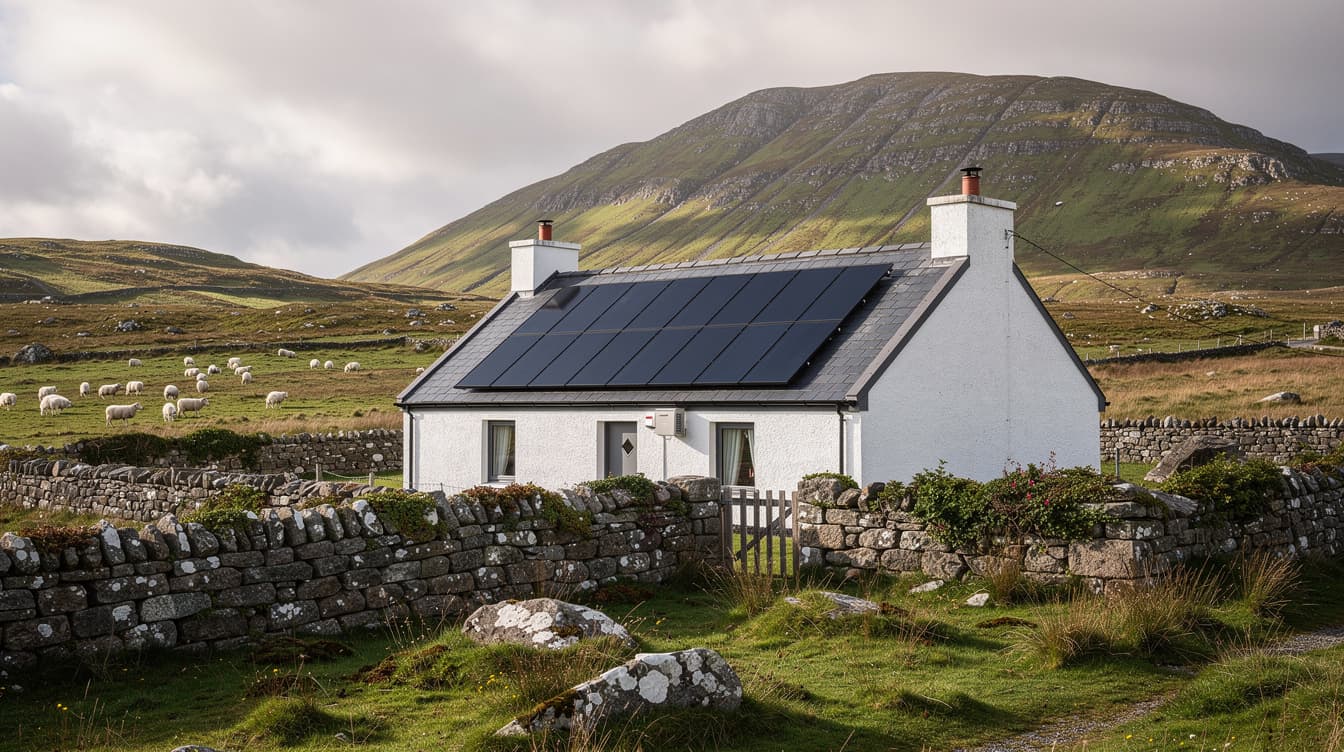
But Galway is geographically and architecturally split. A Salthill semi-detached, a Renmore terrace, a Loughrea four-bed and a Cleggan whitewashed cottage are four very different solar prospects. This guide walks through what actually changes about solar PV depending on where in Galway you live — pricing, yields, planning quirks, wind & salt-air considerations, the grant process, and how to pick from the 30+ SEAI-registered installers serving the county.
Quick Answer: Solar Panels Galway 2026
A standard 4kWp Galway install costs €7,000–€9,200 before the SEAI grant, or ~€5,200–€7,400 net after the €1,800 grant. Expected annual output: ~3,560 kWh at Galway’s 890 kWh/kWp average yield. Typical savings: €900–€1,250/year. Payback: 5.5–7.5 years.
Galway Solar Yield & Roof Realities in 2026
Galway runs at roughly 890 kWh per installed kWp annually — about 5% behind Cork and 8% behind Wexford, but well ahead of Donegal and Mayo. The variation across the county isn’t huge but is real:
| Area | Expected Yield (kWh/kWp/yr) | Notes |
|---|---|---|
| East Galway (Loughrea, Ballinasloe, Athenry) | 895–920 | Drier inland, best yields in the county |
| Galway City & suburbs (Salthill, Knocknacarra, Doughiska) | 880–905 | More cloud cover than east, still solid |
| South Galway / Burren edge (Gort, Kinvara) | 890–910 | Excellent for rural detached homes |
| Connemara & West (Clifden, Roundstone, Carraroe) | 850–880 | More cloud, more wind — mounting matters |
| Aran Islands (Inis Mór, Inis Meáin, Inis Oírr) | 840–870 | Specialist installers; salt-grade fixings essential |
Two characteristically Galway things lift or hurt these baseline numbers:
- Roof type: Galway has a much higher share of single-storey bungalows and detached self-builds than Dublin. That means more usable south-pitch roof area per household — many Galway 4-beds have enough roof for 6–7kWp, not just 4kWp. Sizing up is often the right call.
- Tree cover: Mid-Galway villages (Oranmore, Headford, Tuam) often have mature beech and ash shading mid-day arc — ask explicitly about shade analysis.
What Solar Costs in Galway in 2026
Based on our analysis of 40+ Galway installer quotes received in Q1 2026 (city and county), here’s the current pricing matrix:
| System Size | Galway Price (pre-grant) | After €1,800 SEAI Grant | Annual Output | Suits |
|---|---|---|---|---|
| 3 kWp (7 panels) | €5,400–€6,800 | €3,600–€5,000 | ~2,670 kWh | 2-bed apartment, small terrace |
| 4 kWp (10 panels) | €7,000–€9,200 | €5,200–€7,400 | ~3,560 kWh | 3-bed semi (Galway average) |
| 5 kWp (12 panels) | €8,500–€10,800 | €6,700–€9,000 | ~4,450 kWh | 4-bed detached, no EV |
| 6 kWp + 5kWh battery | €12,200–€15,000 | €10,400–€13,200 | ~5,340 kWh | Detached with EV or heat pump |
| 8 kWp + 10kWh battery | €15,500–€19,500 | €13,700–€17,700 | ~7,120 kWh | Self-build with all-electric heating |
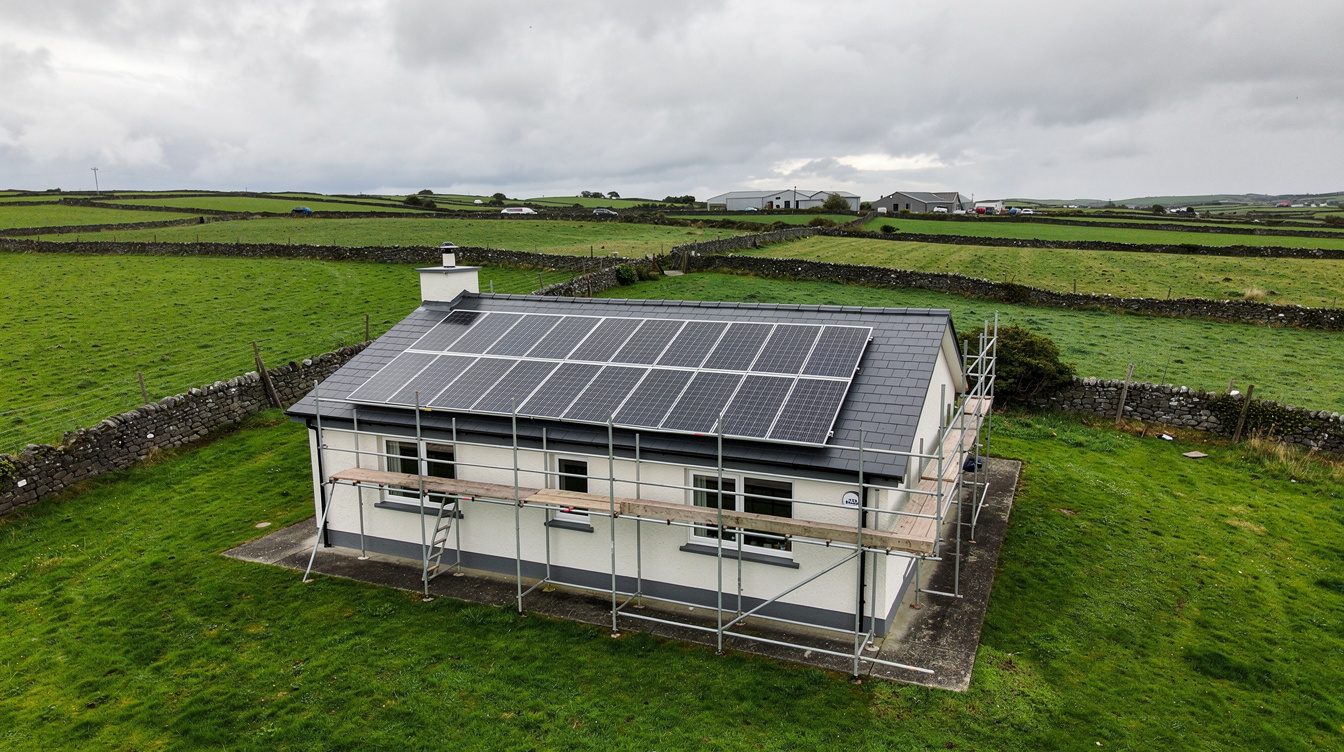
Pricing is 0% VAT and includes standard scaffolding for two-storey installs. Connemara and Aran Islands installs typically run 5–12% higher due to ferry transport, marine-grade mounting and longer travel days.
How Galway Pricing Compares to the Rest of Ireland
Galway sits slightly below the national average. Why? Two reasons:
- Competitive local market. ~30 SEAI-registered installers actively chase Galway work, including 15+ Galway-based companies plus all major national brands.
- Lower urban overhead than Dublin. No scaffolding permits, easier parking, shorter travel windows for crews based in Galway City.
Quick comparison on the same 4kWp system pre-grant:
| County | 4kWp Price (Q1 2026) | Yield (kWh/kWp/yr) |
|---|---|---|
| Dublin | €7,200–€9,500 | 935 |
| Cork | €7,000–€9,000 | 935 |
| Galway | €7,000–€9,200 | 890 |
| Limerick | €6,900–€9,000 | 910 |
| Donegal | €7,400–€9,800 | 820 |
The Galway Wind & Salt-Air Question
If you live anywhere west of the N17 or within 5km of the Atlantic coast, two extra considerations apply. Get them wrong and your panels will outlast their mountings.
Wind loading
Connemara, the Aran Islands, the Burren coast and even open Galway Bay sites regularly experience sustained winds of 40–60 mph in winter storms, with gusts higher. Standard residential racking is rated for 130 km/h gusts — that’s fine for inland Galway but marginal in Connemara. A good installer will:
- Use additional mid-clamps and end-clamps (not the bare-minimum count)
- Specify rails that are end-anchored every 1.2m rather than 1.8m
- Add edge zones — corner panels with extra securing because lift is highest at roof edges
- Refuse to install on poorly-secured fibre-cement roofing common on older West Galway sheds
Salt-air corrosion
Within roughly 1km of the Atlantic, standard aluminium racking can pit and oxidise within 5–7 years. Aran Islands installs are extreme cases — everything corrodes. Two materials to insist on:
- Marine-grade anodised aluminium (Type II or III anodising) for rails — not raw mill-finish.
- A2 or A4 grade stainless steel for all bolts and fixings — not standard zinc-plated.
Expect to pay €200–€500 extra over a standard inland install for coastal-grade hardware. Worth every cent.
Solar Grants Available to Galway Homes in 2026
Three live schemes apply to most Galway households in 2026:
- SEAI Solar PV Grant: €1,800. The headline grant. Applies to homes built before 1 January 2021, owned by you, with no previous SEAI solar PV grant claimed on the MPRN.
- 0% VAT on residential installation. Applies to the entire install bill (panels, inverter, labour, scaffolding). Extended to 31 December 2026.
- Clean Export Guarantee (CEG). The export tariff paid for surplus electricity sent to the grid. Best rates in 2026: Electric Ireland 24c/kWh (capped), Energia 21c/kWh, Bord Gáis 20c/kWh.
For Galway farms (which is a meaningful slice of the county) a fourth scheme applies:
- TAMS 3 Solar Capital Investment Scheme: Covers up to 60% of solar PV install on farm buildings, capped at 62kW peak. For Galway farms with milking parlours or dairy chillers this can be transformative — up to €90,000 in support.
See our full guide to solar panel grants in Ireland 2026 for application detail.
Galway Planning Permission & Protected Structures
The 2022 nationwide exemption removed planning permission requirements for almost all residential rooftop PV — including Galway. But three Galway-specific exceptions matter:
- Protected structures. Galway City has ~120 protected structures (Eyre Square hinterland, Quay Street, Spanish Arch area). County Galway has hundreds more — particularly Clifden, Loughrea, Tuam and Athenry. If your home is listed, planning permission is required.
- Architectural Conservation Areas (ACAs). Galway City has several ACAs, including parts of Salthill seafront and Nun’s Island. Some ACAs restrict visible-from-public-road panels.
- Gaeltacht-area cottage restrictions. Some Connemara Gaeltacht housing schemes have private covenants restricting external alterations — older deeds, occasional issue.
The Galway City Council Development Plan 2023–2029 and the Galway County Development Plan 2022–2028 both explicitly support rooftop PV. Check the relevant plan before signing if your home is older than 1940 or in a conservation area.
Ready to Go Solar in Galway?
Get your free personalised quote from SEAI-registered installers serving Galway City and County.
Picking an Installer in Galway: Local vs National
Roughly 30 SEAI-registered installers actively work in Galway. They split into three groups:
Established Galway-based installers
Companies headquartered in Galway with local crews. Strong knowledge of Galway roofs, ferry logistics to the Aran Islands, and Connemara wind realities. Slightly slower on quote response in busy months but tend to do high-quality work. Examples include JFW Renewables-tradition installers around Loughrea and Tuam.
Multi-region national brands
Activ8, PureVolt, Ohk Energy, Wizer Energy and similar — all serve Galway with installation crews based in Galway or commuting from Cavan/Limerick. Faster quote turnaround, more standardised contracts, deeper warranty backstop. Slightly less responsive on Connemara-specific quirks.
Electrical contractors with solar add-on
Local Galway sparks who’ve added solar PV to their offering. SEAI-registered, real installers, often great on small-job pricing. Sometimes weaker on system design and battery integration. Best for straightforward 3–4kWp installs without batteries.
See the full SEAI-registered list in our installer directory, plus the curated top Galway installers.
Galway Self-Build & Detached Home Considerations
Galway has one of the highest rates of self-built and recently-built detached homes per capita in Ireland. Two implications for solar:
- Bigger systems make sense. A 5–6kWp install on a 4-bed self-build is more common in Galway than in Dublin. Roof area is the constraint, not budget. Size to your daytime load + EV + heat pump.
- NZEB-compliant homes already have PV. Homes built since 2019 under the NZEB regulations almost always already have a small (1.5–2kWp) PV system as part of the BER compliance. Many homeowners later expand to 4–5kWp — check whether your existing system uses a hybrid inverter (allows expansion) or string inverter (requires replacement or parallel system).
Batteries and the Galway Export Tariff Question
The maths on batteries has shifted in Galway in 2026:
- CEG export pays 18–24c/kWh depending on supplier (best is Electric Ireland; cap applies on annual export).
- Standard daytime electricity costs 33c/kWh; evening peaks 38c+/kWh.
- Galway homes naturally consume less mid-day than urban Dublin homes — many residents commute to Galway City or work from home but use limited energy until evening.
That spread (~17c/kWh) between export and consumption makes a battery genuinely worthwhile in Galway. A 5kWh battery added at install time costs €1,700–€3,000 and typically pays back in 7–9 years while raising self-consumption from ~40% to 75%+. Worth specifying at original install rather than retrofitting.
Galway Solar FAQ
How much do solar panels cost in Galway in 2026?
A typical 4kWp install costs €7,000–€9,200 before the SEAI grant, or €5,200–€7,400 net. Connemara, West Galway and Aran installs typically run 5–12% higher due to logistics and coastal-grade hardware.
How many solar panels does a typical Galway home need?
A 3-bed semi: 8–10 panels (3.5–4.5 kWp). A 4-bed detached self-build (very common in Galway): 12–16 panels (5–7 kWp). The constraint in Galway is usually roof orientation, not roof area.
Do solar panels work on the Aran Islands?
Yes, but with caveats. Yields are 5–10% lower than mainland Galway due to maritime cloud. Salt corrosion is severe — A4 stainless fixings are essential. A handful of specialist installers handle ferry logistics; expect a 10–15% premium and longer scheduling.
Are east or west-facing roofs okay in Galway?
Yes. East-west split installs produce ~80–85% of a south-facing install in Galway, with a flatter generation curve that matches morning EV charging and evening cooking loads. Many Galway terraces and city semis run east-west — not a problem.
Will Galway wind damage my panels?
Properly mounted panels are rated for sustained winds up to 130 km/h gusts (~80 mph) — well above typical Galway storms. The risk is poor installation, not the panels themselves. Insist on additional clamping, marine-grade fixings near the coast, and refuse installation on suspect roof substructures.
What about planning permission in Galway City or County?
Not required for almost all homes thanks to the 2022 national exemption. Exceptions: protected structures and some Architectural Conservation Areas. Galway City Council and Galway County Council both publish online maps of protected structures — check before signing.
What grants can Galway farms claim for solar?
The TAMS 3 Solar Capital Investment Scheme covers up to 60% of installation cost on farm buildings, capped at 62kW peak system. For Galway dairy farms with milking parlours and chillers this can be transformative. The SEAI €1,800 grant doesn’t apply to farm-shed PV but TAMS 3 typically delivers larger support.
How long does a Galway installation take?
1–2 days on the roof. End-to-end from signed contract to grant payment: 6–10 weeks in Galway City and county. Connemara and Aran Islands often add 1–3 weeks for logistics.
Which electricity supplier pays best for Galway solar export in 2026?
The same as nationally — Electric Ireland leads at 24c/kWh (capped), Energia at 21c/kWh, and Bord Gáis at 20c/kWh. See our 2026 export tariff comparison.
Related Galway & Ireland Solar Guides
Related Articles
Solar Panel System Cost by Number of Panels Ireland 2026: 8, 12, 14, 20, 24 Panel Prices
What 8, 12, 14, 16, 20 or 24 solar panels actually cost in Ireland 2026 — net after €1,800 SEAI grant & 0% VAT, output kWh, roof area & battery add-ons.
6kW Solar System Cost Ireland 2026: Real Prices, Output & Payback
6kW solar costs €7,700–€10,500 net after the €1,800 SEAI grant and 0% VAT in Ireland 2026. Real quote, 5,270 kWh/yr output, EV/battery ROI.
5kW Solar System Cost Ireland 2026: Real Prices, Output & 25-Year ROI
5kW solar system costs €6,700–€9,200 net after the €1,800 SEAI grant and 0% VAT in Ireland 2026. Full itemised breakdown, real output data & battery ROI.