
Solar Panels for Terraced Houses in Ireland 2026: Roof Space, Costs & What Mid-Terrace Owners Need to Know
Solar Panels for Terraced Houses in Ireland 2026: Roof Space, Costs & What Mid-Terrace Owners Need to Know
Terraced houses are everywhere in Dublin, Cork, Limerick and Galway — but most solar guides ignore them. Here is a practical guide to installing solar panels on a terraced house in Ireland, covering roof space, system sizing, planning rules, and real costs.
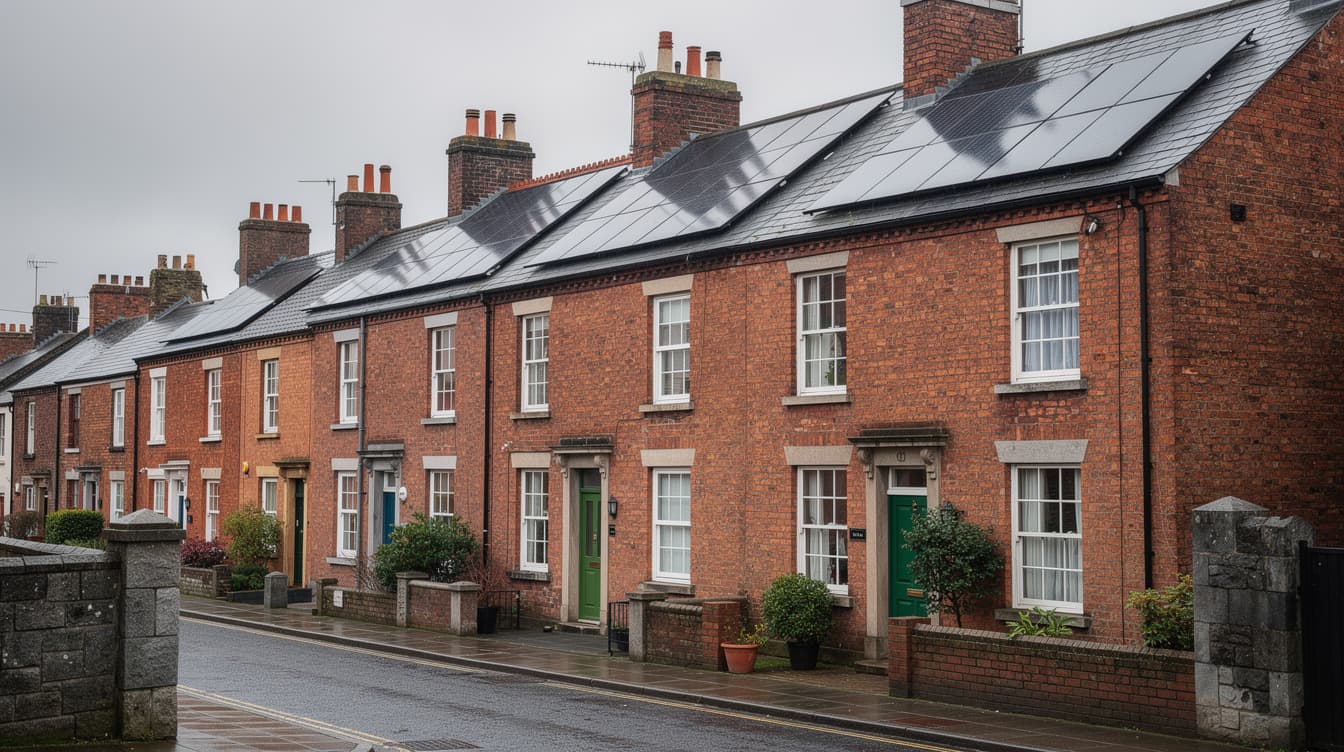
If you live in a terraced house and have wondered whether solar panels are even possible on your roof, you are not alone. Most solar panel guides in Ireland focus on detached or semi-detached homes with big south-facing roofs. But terraced houses — from Victorian redbricks in Dublin to 1970s estates in every town — are actually excellent candidates for solar, with a few specific considerations.
This guide covers everything a terraced house owner needs to know: how much roof space you really have, what system size makes sense, the special planning permission advantages mid-terrace homes enjoy, and honest cost and savings numbers for 2026.
How Much Roof Space Does a Terraced House Have?
This is the first question every terraced house owner asks — and the answer is usually better than you expect.
A typical Irish terraced house has a usable roof area of 20–35 m² per side. That is enough for 6–10 solar panels on a single roof slope, depending on chimneys, vents, and velux windows.
Here is how it breaks down by house type:
| Terraced House Type | Typical Roof Area (per slope) | Panels That Fit | System Size |
|---|---|---|---|
| 2-bed Victorian (Dublin redbrick) | 18–22 m² | 6–8 | 2.6–3.5 kWp |
| 3-bed 1970s–1990s estate | 22–28 m² | 8–10 | 3.5–4.4 kWp |
| 3-bed modern terraced | 25–35 m² | 8–12 | 3.5–5.3 kWp |
| End-of-terrace (side roof available) | 30–45 m² (both sides) | 10–16 | 4.4–7.0 kWp |
Each modern 440W panel measures roughly 1.9 m × 1.1 m (about 2.1 m²). So even a smaller 2-bed redbrick can usually fit 6–8 panels — which is a perfectly good system for a household of 2–3 people.
Tip: If chimneys or velux windows eat into your roof space, an installer can often work around them. Modern panel layouts are flexible, and micro-inverters or optimisers let each panel operate independently even in partial shade.
Mid-Terrace vs End-of-Terrace: Key Differences
Where your house sits in the terrace makes a real difference to your solar options:
Mid-Terrace Advantages
- No setback rules on shared party walls — you can install panels right to the edge of the roof
- Sheltered from crosswinds, so panels face less wind uplift stress
- Better thermal efficiency (less heat loss) means your electricity consumption is often lower
End-of-Terrace Advantages
- Access to side roof slope — potentially double the panel area
- More flexibility in panel layout and orientation
- Can often fit a larger system (5–7 kWp)
The big takeaway: mid-terrace homes have a hidden advantage. Because you share walls on both sides, you do not need to leave free space at the edges of your roof (unlike detached homes). This means you can often fit as many panels as the roof physically allows.
Ready to Go Solar?
Get your free personalised quote from SEAI-registered installers.
What System Size Should You Get?
The right system size depends on two things: your electricity usage and your roof space. Here is a quick guide:
| Household Size | Annual Usage | Recommended System | Panels Needed |
|---|---|---|---|
| 1–2 people | 2,500–3,500 kWh | 2.6–3.1 kWp | 6–7 |
| 2–3 people | 3,500–4,500 kWh | 3.5–4.0 kWp | 8–9 |
| 3–4 people | 4,200–5,500 kWh | 4.0–4.4 kWp | 9–10 |
| 4+ people | 5,000–7,000 kWh | 4.4–5.3 kWp | 10–12 |
For most terraced house owners, an 8–10 panel system (3.5–4.4 kWp) is the sweet spot. It fits comfortably on one roof slope and generates 3,200–4,000 kWh per year — enough to cover 40–60% of a typical household’s electricity needs.
Costs & SEAI Grant Breakdown
Solar panel prices in Ireland have stabilised in 2026 thanks to zero-VAT and global panel oversupply. Here is what terraced house owners can expect to pay:
| System Size | Panels | Cost Before Grant | SEAI Grant | You Pay |
|---|---|---|---|---|
| 2.6 kWp | 6 | €5,200–€6,000 | €1,520 | €3,680–€4,480 |
| 3.5 kWp | 8 | €6,400–€7,400 | €1,700 | €4,700–€5,700 |
| 4.4 kWp | 10 | €7,300–€8,500 | €1,800 | €5,500–€6,700 |
| 5.3 kWp (end-terrace) | 12 | €8,500–€9,800 | €1,800 | €6,700–€8,000 |
How the SEAI grant works: You get €700 per kWp for the first 2 kWp, then €200 per kWp after that, up to a maximum of €1,800. The grant is paid directly to the installer, so you only pay the “You Pay” amount above. All prices include zero-VAT (0% since May 2023).
These prices are fully installed — panels, inverter, mounting hardware, wiring, ESB notification, and BER assessment included. No hidden extras.
East-West Roofs: Not a Problem
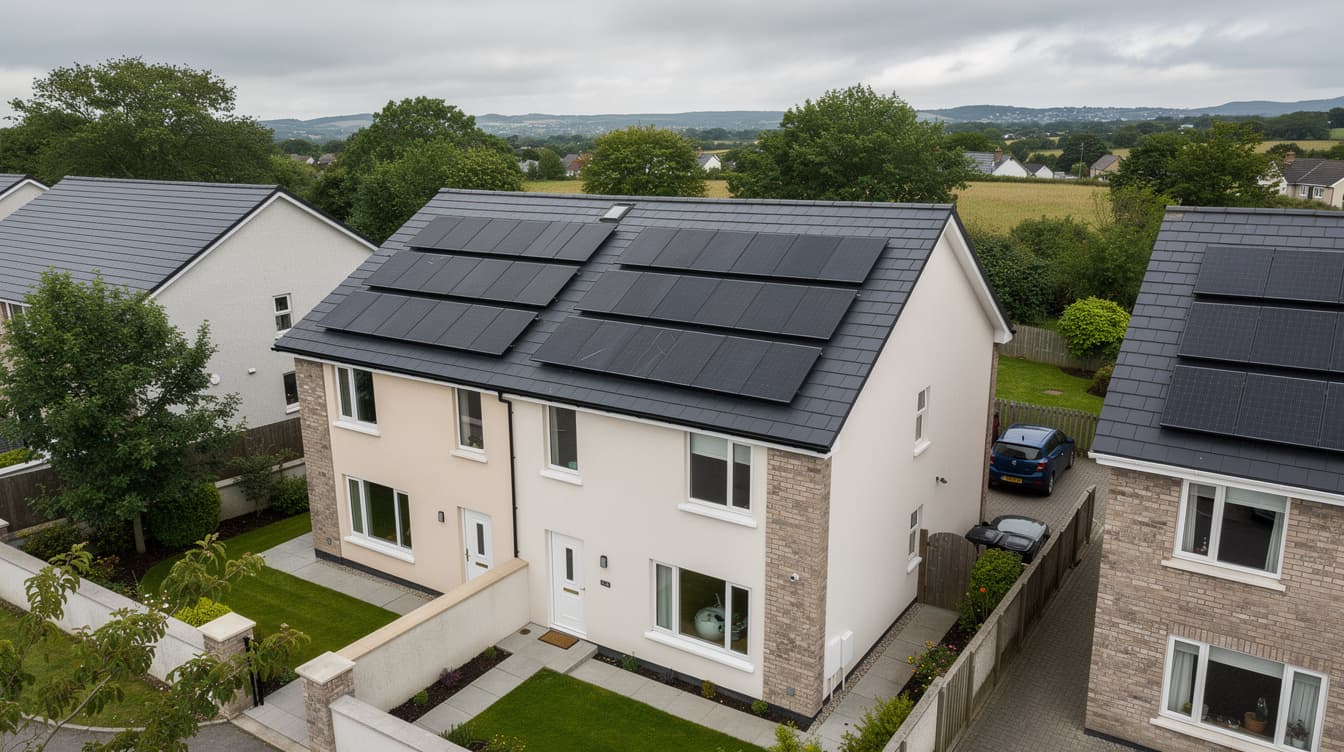
Many terraced houses — especially in estate developments — have roofs that face east and west rather than the ideal south. This is not a dealbreaker. In fact, east-west systems are increasingly popular in Ireland for good reasons:
- More even generation throughout the day. East panels produce well in the morning, west panels in the afternoon. This spreads your generation across more hours, which means you use more of what you produce.
- Self-consumption is often higher. A south-facing system generates a big peak around midday (when you might not be home). East-west systems avoid this peak and better match typical household usage patterns.
- Total output is only 10–15% less than an equivalent south-facing system. With a slightly larger system, you can compensate entirely.
If your terraced house has an east-west roof, an installer can put panels on both sides, effectively doubling your available roof space. This is actually an advantage — you might fit 14–16 panels across two slopes where only 8 would fit on one.
Real-world example: A 3-bed mid-terrace in Lucan with an east-west roof installed 12 panels (6 on each side) for a 5.3 kWp system. Annual generation: 4,200 kWh. The east-west split means the family uses 55% of the electricity directly — higher than the 35–40% typical of a south-only system.
Planning Permission & Party Walls
Good news: most terraced house solar installations do not need planning permission. Since the 2022 planning exemption changes, roof-mounted solar panels are exempt development provided:
- Panels do not protrude more than 15 cm above the roof surface
- Panels do not extend beyond the roof edges
- The house is not a protected structure or in an architectural conservation area (ACA)
Mid-terrace bonus: Unlike detached houses, mid-terrace homes have no setback requirement on shared party walls. You can install panels right up to the adjoining wall on both sides. This maximises your usable roof area.
Party wall considerations: Solar panels sit on the roof, not on or against the party wall itself, so the Party Walls etc. Act does not apply. However, it is good practice to let your neighbours know before scaffolding goes up — the installers may need access from the front street only.
If your terraced house is in a conservation area (parts of Dublin, Limerick, and other city centres), you will need planning permission. Your installer can advise, and many conservation officers are now familiar with solar applications.
Ready to Go Solar?
Get your free personalised quote from SEAI-registered installers.
Installation Day: What to Expect
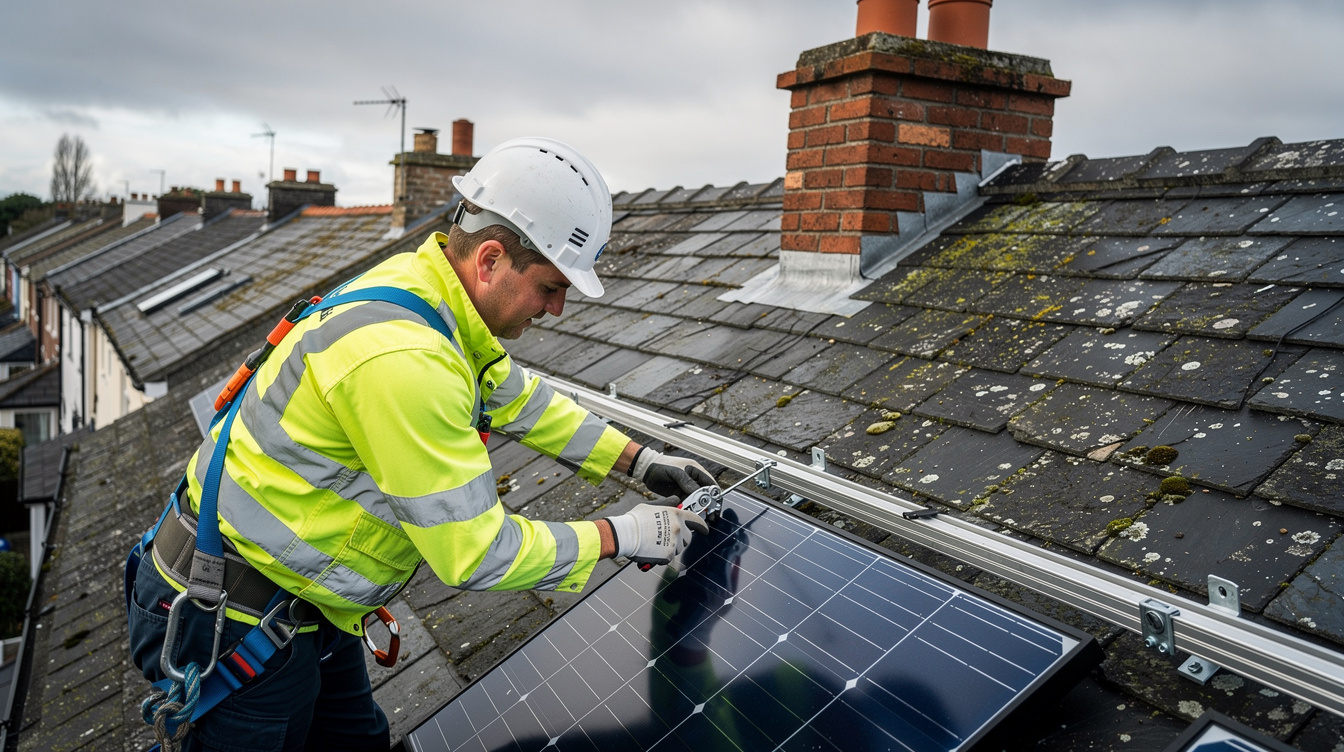
Installing solar panels on a terraced house is a straightforward job, but there are a few things specific to terrace installations you should know:
- Scaffolding goes up at the front (usually). Terraced houses rarely have rear garden access for scaffolding lorries, so the scaffold is erected from the street. Your installer handles this, including any road permissions if needed.
- Installation takes 1 day. A typical 8–10 panel system on a terraced house takes 4–6 hours of roof work plus 2–3 hours of electrical work inside. Most installers complete everything in a single day.
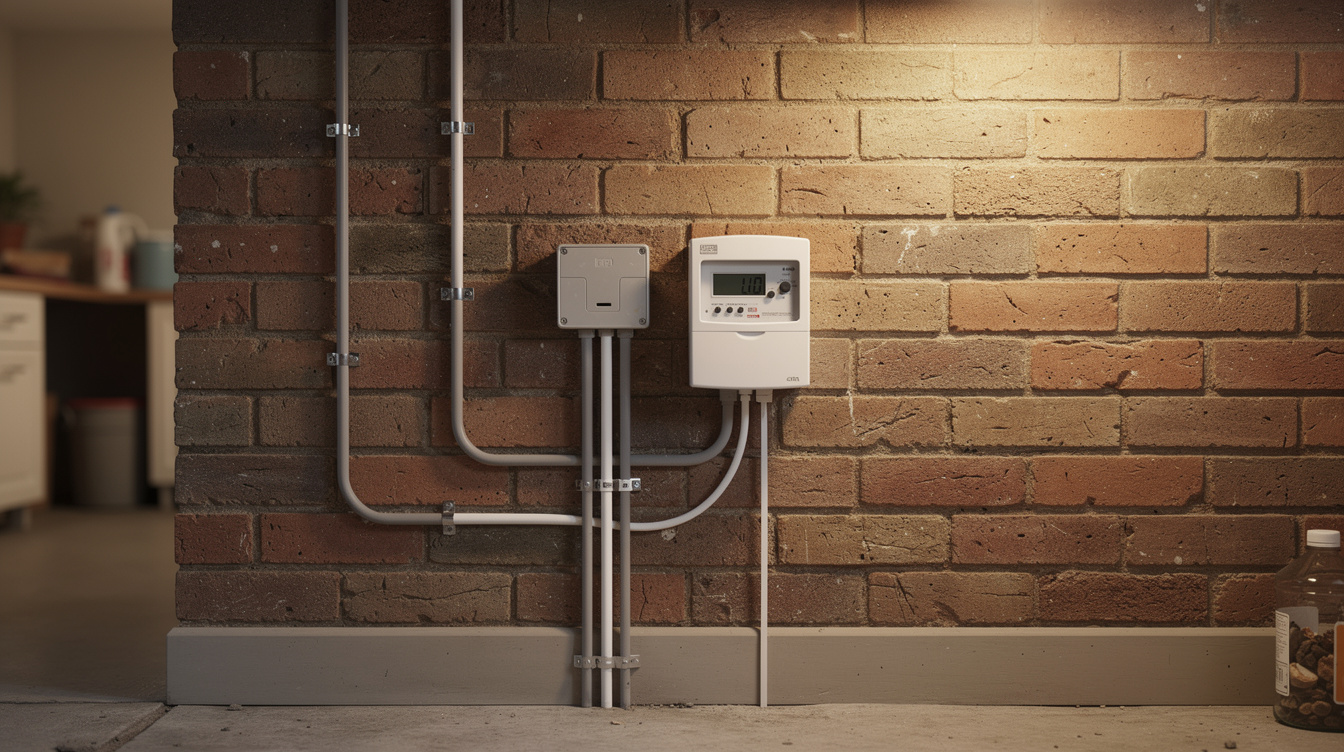
- The inverter goes indoors. In terraced houses, the inverter is usually wall-mounted in the utility room, under the stairs, or in the attic. It is about the size of a small suitcase and makes very little noise.
- Your electricity stays on. There is a brief shutdown (30–60 minutes) when the installer connects to the consumer unit, but that is it.
- ESB Networks notification. Your installer files the NC6 form with ESB Networks on your behalf. Once approved, your export meter is installed (free of charge) and you can start earning from excess electricity.
Access note: If your terraced house has a narrow rear lane or back alley, ask the installer whether rear scaffolding is possible — it can be more convenient for you and your neighbours.
Realistic Savings & Payback
Let us run the numbers for the most common terraced house scenario: a 3-bed mid-terrace with 10 panels (4.4 kWp).
| Item | Value |
|---|---|
| Annual generation | 3,800–4,000 kWh |
| Self-consumption rate | 35–45% |
| Electricity saved (at 38c/kWh) | €505–€685/yr |
| Export income (at 19.5c/kWh) | €410–€480/yr |
| Total annual benefit | €915–€1,165/yr |
| System cost after SEAI grant | €5,500–€6,700 |
| Payback period | 5–7 years |
After payback, those savings are pure profit for the remaining 20+ years of panel life. Over 25 years, a €6,000 investment returns €23,000–€29,000 in total savings.
Boost your savings further:
- Add a solar immersion diverter (€450–€640) to heat your water with surplus electricity — saves an extra €350–€600/yr
- Switch to a higher-paying export supplier — Pinergy pays 25c/kWh vs the average 18.5c/kWh
- Run your dishwasher, washing machine, and EV charger during peak solar hours (10am–3pm)
Should You Add a Battery?
A battery lets you store surplus daytime solar electricity to use in the evening. For terraced houses, the decision comes down to your usage pattern:
Battery makes sense if:
- Nobody is home during the day
- You use 5,000+ kWh/year
- You plan to add an EV
- You want maximum independence from the grid
Skip the battery if:
- Someone is home during the day
- You have an immersion diverter
- Budget is tight — panels alone payback faster
- You are happy with export payments
A 5 kWh battery adds €3,500–€5,000 to your system cost (no SEAI grant for batteries in 2026). At current prices, battery payback is 8–12 years — viable, but panels alone are the better investment for most terraced house owners. See our full battery storage guide for more detail.
Ready to Go Solar?
Get your free personalised quote from SEAI-registered installers.
Common Questions
Will solar panels damage my shared party wall or roof?
No. Solar panels are mounted on rails attached to the roof rafters, not the party wall. A properly installed system does not affect the structural integrity of your roof or the shared wall. Reputable installers use weatherproof roof hooks that maintain the watertight seal of your existing slates or tiles.
Do I need my neighbours’ permission to install solar panels?
No. Solar panels on your roof are your property, just like your roof tiles. You do not need your neighbours’ consent. However, it is courteous to let them know in advance — particularly about scaffolding, which may briefly affect pavement or parking space access.
My terraced house has a dormer extension. Can I still get panels?
Usually yes. Panels can be fitted on the original roof slope above the dormer, or in some cases on the dormer roof itself (if it has enough area). Your installer will assess this during the site survey.
Is shading from neighbouring chimneys a problem?
It can reduce output slightly, but modern systems handle this well. Micro-inverters or power optimisers ensure that shade on one panel does not drag down the others. Your installer will model shade patterns during the site survey. Read our full guide on how shading affects solar panel efficiency.
Will solar panels improve my BER rating?
Yes. Solar panels typically improve a BER rating by 1–2 grades. For a terraced house, this can mean moving from a C3 to a B2 or better. This adds value if you are selling or renting. See our BER and solar panels guide for specifics.
How do I apply for the SEAI grant?
You do not apply directly. Choose an SEAI-registered installer, get a quote, and the installer handles the grant application on your behalf. The grant amount is deducted from your final bill. Full step-by-step details in our SEAI grant application guide.
Next Steps
Your terraced house is almost certainly a good fit for solar panels. Whether you are in a Victorian redbrick in Rathmines, a 1980s estate house in Tallaght, or a modern terrace in Adamstown, the numbers work. The combination of the €1,800 SEAI grant, zero VAT, and strong export payments means 2026 is one of the best years yet to make the switch.
The first step is getting a site survey from an SEAI-registered installer. They will measure your roof, check your electrical setup, and give you a fixed-price quote — no obligation.
Get Your Free Solar Quote
Find out exactly how many panels your terraced house can fit and what it will cost.
Related guides:
Related Articles
Solar Panel System Cost by Number of Panels Ireland 2026: 8, 12, 14, 20, 24 Panel Prices
What 8, 12, 14, 16, 20 or 24 solar panels actually cost in Ireland 2026 — net after €1,800 SEAI grant & 0% VAT, output kWh, roof area & battery add-ons.
6kW Solar System Cost Ireland 2026: Real Prices, Output & Payback
6kW solar costs €7,700–€10,500 net after the €1,800 SEAI grant and 0% VAT in Ireland 2026. Real quote, 5,270 kWh/yr output, EV/battery ROI.
5kW Solar System Cost Ireland 2026: Real Prices, Output & 25-Year ROI
5kW solar system costs €6,700–€9,200 net after the €1,800 SEAI grant and 0% VAT in Ireland 2026. Full itemised breakdown, real output data & battery ROI.