
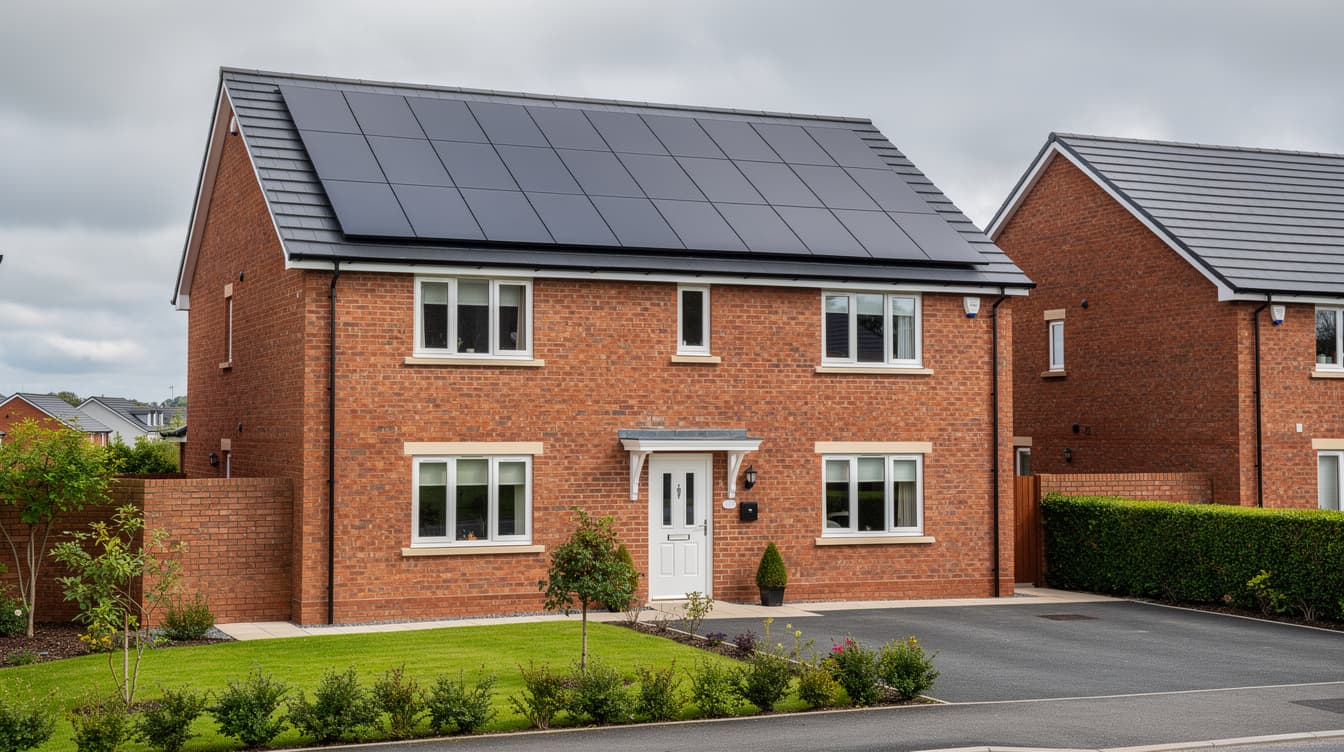
Solar Panels for a 3-Bed House in Ireland: System Size, Costs & Savings (2026)
Solar Panels for a 3-Bed House in Ireland: System Size, Costs & Savings (2026)
The 3-bed semi-detached is Ireland’s most common house type. Here is exactly how many solar panels you need, what it costs, and how much you will save — with three worked examples based on real 2026 data.
You have a 3-bed semi, you are paying too much for electricity, and you are wondering whether solar makes sense. The short answer: yes, almost always. A 3-bed semi is one of the best candidates for solar panels in Ireland because the roof size, electricity usage, and SEAI grant all line up perfectly.
This guide gives you everything you need to make a decision: the right system size, realistic costs after grants, and honest savings projections based on 2026 electricity prices.
The Quick Answer
For a typical 3-bed semi-detached house in Ireland:
- Recommended system: 10 panels / 4.4 kWp
- Roof space needed: ~19–21 m²
- Cost before SEAI grant: €7,300–€8,500
- Cost after SEAI grant: €5,500–€6,700
- Annual savings: €800–€1,200
- Payback period: 5–7 years
Those are the headline numbers. Now let us walk through the logic so you can see exactly how they apply to your specific house.
System Sizing: How Many Panels Does a 3-Bed Semi Need?
The right system size depends on one thing above all else: how much electricity you use. Here is how to figure that out:
Step 1: Check Your Annual Usage
Look at your electricity bills or online account. Add up the kWh from the last 12 months. If you cannot find this, use these averages:
| Household Type | Typical Annual Usage | Annual Bill (2026) |
|---|---|---|
| 3-bed semi, gas heating, 2 people | 3,200–3,800 kWh | €1,200–€1,450 |
| 3-bed semi, gas heating, 4 people | 4,000–4,800 kWh | €1,500–€1,817 |
| 3-bed semi, electric heating, 2–4 people | 5,500–7,000 kWh | €2,090–€2,660 |
| 3-bed semi + EV charging at home | 5,500–6,500 kWh | €2,090–€2,470 |
Average Irish electricity price in 2026: ~€0.38/kWh including standing charges and PSO levy.
Step 2: Match Usage to System Size
In Ireland, 1 kWp of solar panels produces roughly 900–1,050 kWh per year depending on your location and roof orientation. Here is how different system sizes match different usage levels:
| System Size | Panels | Annual Output | Best For |
|---|---|---|---|
| 3.1 kWp | 7 | ~3,000 kWh | Low-usage couple, tight budget |
| 4.4 kWp | 10 | ~4,200 kWh | Average 3-bed family (most common) |
| 5.3 kWp | 12 | ~5,000 kWh | Higher usage, EV charging, heat pump |
| 6.6 kWp | 15 | ~6,300 kWh | Electric heating, max self-sufficiency |
Our recommendation for most 3-bed semis: 10 panels (4.4 kWp). This matches the average 3-bed household usage of 4,200 kWh and stays within the SEAI grant-eligible range. If you have an EV or heat pump (or plan to get one), step up to 12 panels.
Does Your Roof Have Room?
A standard 440W solar panel measures approximately 1.9m x 1.1m (about 2.1 m²). Here is what each system size requires:
| Panels | Roof Area Needed | Fits a Typical 3-Bed Semi? |
|---|---|---|
| 7 panels | ~15 m² | Yes — comfortably on one roof face |
| 10 panels | ~21 m² | Yes — most south-facing roof faces |
| 12 panels | ~25 m² | Usually — may need both roof faces |
| 15 panels | ~32 m² | Tight — likely needs east/west split |
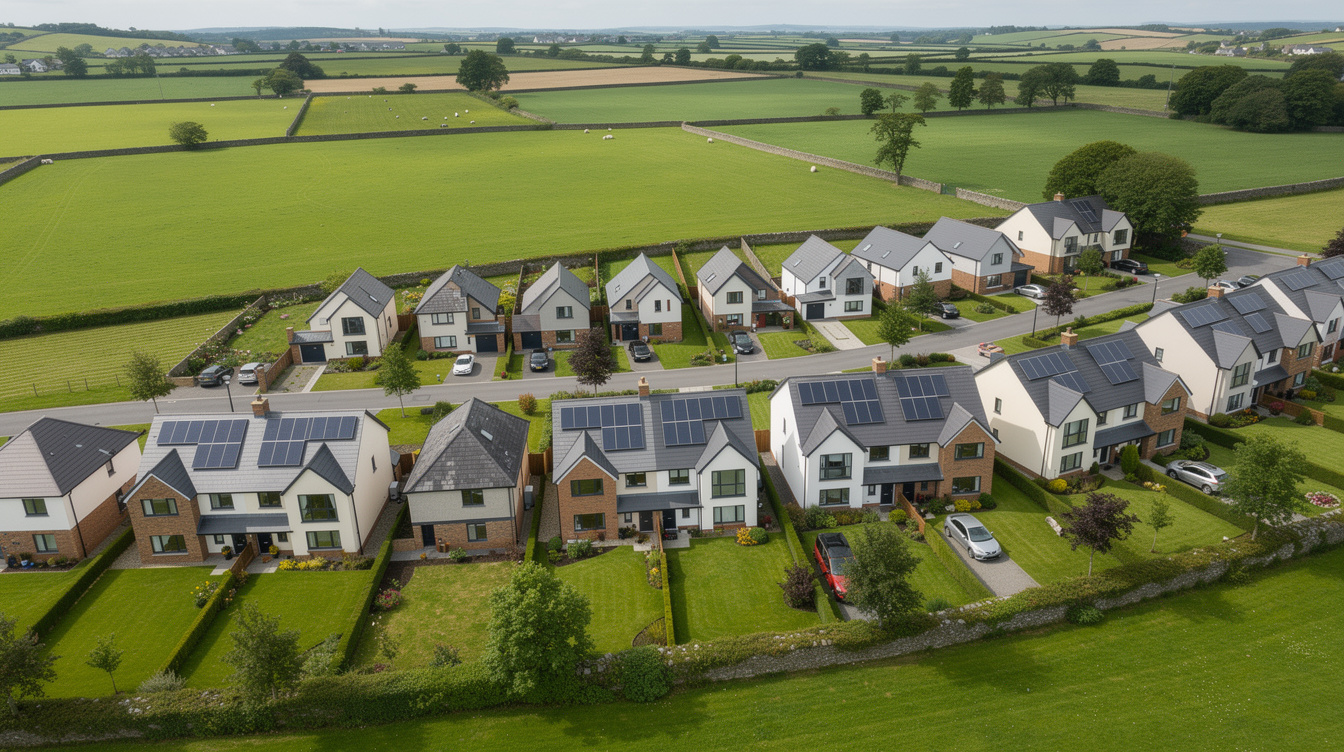
The typical 3-bed semi-detached house in Ireland has a south-facing roof area of roughly 25–30 m². That is enough for 10–12 panels with room to spare for vents, skylights, and chimneys.
What If Your Roof Faces East or West?
An east or west-facing roof gets about 85% of the output of a perfect south-facing one. It still works well — you just produce more energy in the mornings (east) or evenings (west), which can actually be better for matching your usage patterns. Read our guide to east/west solar for details.
Not Sure If Your Roof Is Suitable?
Get a free assessment from SEAI-registered installers in your area.
Full Cost Breakdown for a 3-Bed House
Here is what you will actually pay for solar panels on a 3-bed house in Ireland in 2026, broken down by system size and with/without battery storage:
| System | Before Grant | SEAI Grant | You Pay |
|---|---|---|---|
| 7 panels (3.1 kWp) — panels only | €5,500–€6,500 | €1,500 | €4,000–€5,000 |
| 10 panels (4.4 kWp) — panels only | €7,300–€8,500 | €1,800 | €5,500–€6,700 |
| 10 panels + 5 kWh battery | €10,500–€12,500 | €1,800 | €8,700–€10,700 |
| 12 panels (5.3 kWp) — panels only | €8,200–€9,500 | €1,800 | €6,400–€7,700 |
| 12 panels + 10 kWh battery | €13,500–€16,000 | €1,800 | €11,700–€14,200 |
Prices include 0% VAT (extended through 2026 for residential solar), installation, inverter, mounting hardware, and commissioning. Full pricing guide →
What the SEAI grant covers: €900 per kWp for the first 2 kWp, then €0 for each additional kWp — capped at €1,800 for systems of 2 kWp or larger. Since every 3-bed system is at least 3 kWp, you get the full €1,800. How to apply for the SEAI grant →
Realistic Savings: What You Will Actually Save
Solar savings depend on two things: how much solar energy you use yourself (self-consumption) and how much you export to the grid for payment under the Clean Export Guarantee.
For a typical 3-bed semi with a 4.4 kWp system producing ~4,200 kWh/year:
| Scenario | Self-Use | Export | Annual Saving |
|---|---|---|---|
| Working from home | 55–65% | 35–45% | €1,050–€1,200 |
| Both out during the day | 30–40% | 60–70% | €700–€850 |
| One person home | 40–50% | 50–60% | €850–€1,000 |
| With battery storage | 75–85% | 15–25% | €1,200–€1,400 |
Self-consumed electricity saves €0.38/kWh (avoided purchase). Exported electricity earns €0.185/kWh under the Clean Export Guarantee (average rate across suppliers, May 2026). Full savings breakdown →
Tips to Maximise Self-Consumption
- Run appliances during daylight: Set your dishwasher, washing machine, and tumble dryer to run between 10am and 3pm when solar output peaks.
- Use timer on immersion heater: Heat your water cylinder during the day with free solar energy instead of at night on grid electricity. A solar diverter can do this automatically.
- Charge your EV during the day: If you work from home or have a home charger, schedule charging for peak solar hours.
- Get a smart meter: Smart meters track your import/export automatically, ensuring you get paid for every kWh you send back.
3 Worked Examples: Real 3-Bed Scenarios
Example 1: The O’Briens — Family of 4, Gas Heating, Both Working
- House: 3-bed semi in Swords, Co. Dublin. South-facing roof.
- Usage: 4,500 kWh/year. Both parents working, kids in school.
- System: 10 panels (4.4 kWp), no battery.
- Cost: €7,800 − €1,800 SEAI grant = €6,000
- Self-consumption: 35% (1,470 kWh used directly)
- Export: 65% (2,730 kWh sold at €0.185/kWh)
- Annual saving: (1,470 × €0.38) + (2,730 × €0.185) = €559 + €505 = €1,064/year
- Payback: €6,000 ÷ €1,064 = 5.6 years
Example 2: Mary — Retired, Home All Day, Oil Heating
- House: 3-bed semi in Galway city. Southeast-facing roof.
- Usage: 3,600 kWh/year. Home most days, uses immersion for hot water.
- System: 7 panels (3.1 kWp), no battery.
- Cost: €6,000 − €1,500 SEAI grant = €4,500
- Self-consumption: 60% (1,800 kWh used directly)
- Export: 40% (1,200 kWh sold)
- Annual saving: (1,800 × €0.38) + (1,200 × €0.185) = €684 + €222 = €906/year
- Payback: €4,500 ÷ €906 = 5.0 years
Example 3: The Murphys — Family of 3, Heat Pump + EV
- House: 3-bed semi in Cork suburbs. West-facing roof (85% output).
- Usage: 6,200 kWh/year (heat pump + EV charging).
- System: 12 panels (5.3 kWp) + 5 kWh battery.
- Cost: €11,500 − €1,800 SEAI grant = €9,700
- Self-consumption: 70% (3,550 kWh used directly, boosted by battery)
- Export: 30% (1,525 kWh sold)
- Annual saving: (3,550 × €0.38) + (1,525 × €0.185) = €1,349 + €282 = €1,631/year
- Payback: €9,700 ÷ €1,631 = 5.9 years
The pattern is clear: regardless of household type, solar panels on a 3-bed semi in Ireland pay for themselves in 5–7 years, then generate free electricity for the remaining 20+ years of their lifespan.
See What You Could Save
Try our free calculator or get personalised quotes from local installers.
Should You Add a Battery?
A battery stores excess solar energy produced during the day so you can use it in the evening. Here is how to decide:
| Factor | Add Battery | Skip Battery |
|---|---|---|
| Daily schedule | Out all day, use electricity evenings | Home during daylight hours |
| Budget | Can afford €3,000–€5,000 extra | Keeping costs down |
| Payback priority | Maximise self-sufficiency | Fastest payback period |
| Future plans | Getting EV or heat pump | No major changes planned |
Our take: For most 3-bed semis, start with panels only. A 10-panel system without a battery has the fastest payback (5–6 years). You can always add a battery later — most modern inverters are “battery-ready”. Read our full battery guide for detailed costs and brand comparisons.
How to Get Started: 5 Steps
- Check your electricity usage. Log into your supplier account or check your last 4 bills. Add up the total kWh for the year.
- Get 3 quotes. Contact at least 3 SEAI-registered installers for quotes. Make sure each quote specifies the panel brand, wattage, inverter brand, and total kWp. How to choose an installer →
- Apply for SEAI grant. Your installer usually handles this. The grant (€1,800 for 2+ kWp) is deducted from your final invoice. Grant application guide →
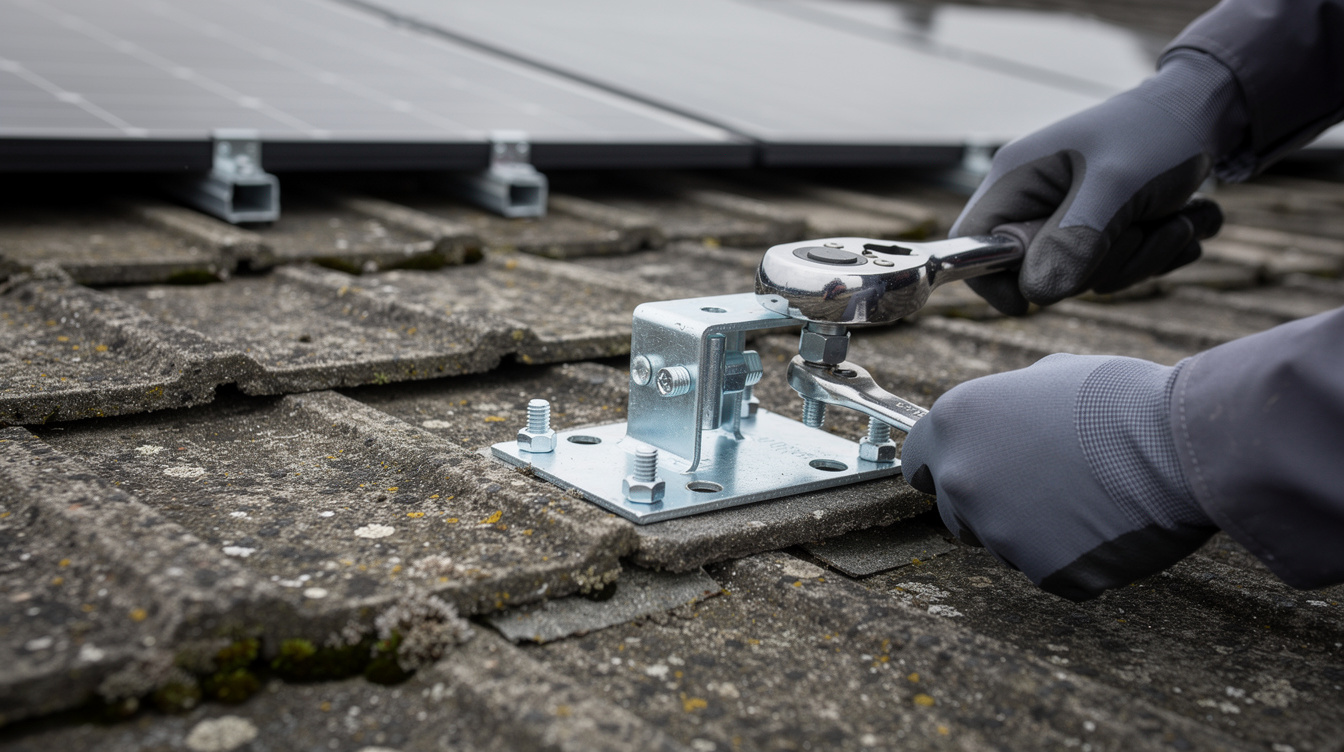
- Installation. Takes 1–2 days for a typical 10-panel system. No planning permission needed for roof-mounted panels on houses. Planning permission guide →
- Register for export payments. Contact your electricity supplier to sign up for the Clean Export Guarantee. You will need a smart meter — ESB Networks installs these free of charge.
Ready to Get Quotes for Your 3-Bed?
Get free, no-obligation quotes from SEAI-registered installers in your area.
The Bottom Line
A 3-bed semi-detached house in Ireland is the perfect candidate for solar panels. The maths works out for almost every scenario:
- 10 panels (4.4 kWp) covers the average household’s electricity needs
- €5,500–€6,700 after SEAI grant — and 0% VAT keeps costs down
- €800–€1,200 saved per year depending on your usage pattern
- 5–7 year payback, then 20+ years of near-free electricity
- Adds value to your home and improves your BER rating
The hardest part is not deciding whether to go solar — it is choosing between the three quotes. Start by requesting your free quotes today.
Related Articles
Solar Panel System Cost by Number of Panels Ireland 2026: 8, 12, 14, 20, 24 Panel Prices
What 8, 12, 14, 16, 20 or 24 solar panels actually cost in Ireland 2026 — net after €1,800 SEAI grant & 0% VAT, output kWh, roof area & battery add-ons.
6kW Solar System Cost Ireland 2026: Real Prices, Output & Payback
6kW solar costs €7,700–€10,500 net after the €1,800 SEAI grant and 0% VAT in Ireland 2026. Real quote, 5,270 kWh/yr output, EV/battery ROI.
5kW Solar System Cost Ireland 2026: Real Prices, Output & 25-Year ROI
5kW solar system costs €6,700–€9,200 net after the €1,800 SEAI grant and 0% VAT in Ireland 2026. Full itemised breakdown, real output data & battery ROI.